This was a Home Office consultation on proposed revisions to PACE codes C (detention) and E (audio recording of suspect interviews).
The proposals were in response to coronavirus. During the peak of the pandemic, legal representative were very concerned about the serious risk to health of attending police custody. The CPS, NPCC and Law Society agreed a joint interim interview protocol whereby interviews would be allowed to take place without legal representatives coming to the police station. Instead, lawyers have been providing legal representation during interviews by 'live link' (e.g. Skype) or 'audio link' (i.e. telephone), including for children and vulnerable adults.
NAAN secured changes to the intial joint interim interview protocol so that version 2 included the need for police to secure the consent of appropriate adults before remote legal advice was used. The arrangements did not apply to appropriate adults, who continued to attend the police station or voluntary interview throughout.
The proposed changes to Code C and E would mean that remote legal representation in interviews would be formalised in PACE, including for children and mentally vulnerable adults, albeit with safeguards including:
A requirement for police to undertake an assessment of a person's suitability for remote legal advice
A requirement for consent from the suspect, appropriate adult (if required) and parent (in the case of children)
While NAAN recognised the serious health risks posed by coronavirus, especially in custody where social distancing is not always possible, there were a number of concerns:
The strategic focus should be on doing whatever is necessary to ensure police custody is safe for all. Failure to meet health and safety responsibilities to officers, lawyers and appropriate adults does not justify measures which disadvantage suspects by modifying their right to legal advice.
The use of remote legal advice for children and vulnerable adults presents a risk to the integrity of the justice system
Amending the PACE Codes will normalise remote legal advice, thereby increasing the risk that measures are adopted in the long term
While the amendments are intended to support the continued use of the joint interview protocol, they can be used in isolation from the wider context of that protocol
Under the joint interview protocol the safeguards (i.e. consent) are not being fully implemented and appear to have become a default route
Police are not trained to deliver assessments of suitability for interviews involving remote legal advice
People who have an untrained familial appropriate adult are likely to be at increased risk due to the reliance on AAs to ensure police conduct effective assessments of suitability for remote legal advice and to withhold consent appropriately
Even for trained appropriate adults from organised schemes, this places significant extra responsibilities on their shoulders - and there is still no statutory provision of AAs for vulnerable adults
While professionals increasingly report being content with the operation of arrangements, there is no mechanism for evaluating how clients/suspects are impacted or feel about it
The 12-month fixed period for operation of the temporary arrangements does not reflect the dynamic nature of the risk If revisions will be made without Parliamentary approval, the need for regular review is even greater.
What were NAAN's proposals?
NAAN's main proposals focused on excluding children and vulnerable adults from remote arrangements, due to the risks to justice.
Shift the strategic focus from modifying suspect rights to doing whatever is necessary to achieve safe custody suites for all (e.g. by introducing checks/accountability, assigning/adapting additional rooms)
Consider the availability of evidence concerning the potential impact on children and vulnerable adults
Exclude any suspect for whom an AA is required from the provisions allowing remote legal advice during interview
Amend Code C to explicitly state that children and vulnerable adults have a right to free legal advice in person
Publish an amended joint interview protocol reflecting the above.
However, recognising that this outcome was far from certain given the level of support the protocol has from influential institutions, NAAN also provided proposals to mitigate the negative impact as much as possible for children and vulnerable adults. This included:
Only allowing the use of remote legal advice in interviews with children and vulnerable persons in extremis, within tightly prescribed circumstances, where social distancing is not possible and appropriate PPE is unavailable, and only where video is available
Excluding children and adults from audio-only (telephone) legal representation in interviews
Strengthening the assessment of suitability process
Strengthening the consent safeguards by changing the information to be given to suspects, emphasising their rights rather than efficient process; ensuring that both suspects and AAs are fully informed; making it explicit that consent can be withdrawn by either at any time; ensuring the question of remote legal advice is dealt with at the earliest possible stage by all parties; and clarifying the suspect’s options if their lawyer will not attend
Explicitly maintaining the link with the wider requirements of a (revised) protocol
Defining a clear level of risk that triggers/removes the availability of these temporary, emergency arrangements; explicitly linking the operation of the temporary arrangements to the context from which its purpose derives (e.g. legal pandemic status, health data) rather than a blanket 12 months
Including a formal review mechanism, with a period no shorter than 2 months between reviews, which includes relevant external stakeholders, including a role for the PACE Strategy Board to which NHS/PHE representatives should be invited.
Quis custodiet ipsos custodes? (Who watches the watchers?")
Appropriate adults are an important part of the checks and balances of our criminal justice system. They help to ensure that people are treated fairly by the police. But to make sure the AA system works effectively, and to continually improve services, we also need accountability for appropriate adults.
The challenge
Accountability for professionals
Outcomes for children and vulnerable adults who are detained or questioned by police are affected by a range of people - many of whom are professionals.
Reflecting the high risk of harm in this context, professionals are subject to systems of accountability and external scrutiny, aiming to ensure their compliance with the standards and regulations under which they operate.
Unlike these other roles, appropriate adult provision is not subject to inspection or regulation. This means:
It is more difficult to identify where children and vulnerable people are receiving high quality provision and where they are not;
It is more difficult to identify the extent to which problems are caused by police versus appropriate adult provision;
It is more difficult to increase confidence in appropriate adult provision.
NAAN is leading efforts to ensure greater accountability for AA provision.
We seek to work in partnership with Government, inspectorates, regulators, monitoring organisations, commissioners and professional bodies to improve accountability of appropriate adult provision, seeking to include oversight into existing arrangements where possible.
NAAN has:
Developed widely respected, evidence-based, national standards, designed with a future system of inspections in mind.
Created a national standards self assessment tool (NSSAT) to support local areas in ensuring their provison meets standards and would meet or exceed inspection expectations.
Piloted anOfqual-regulated qualification for appropriate adults.
Secured the inclusion of appropriate adults in youth justice inspections.
National standards
Appropriate adults
NAAN publishesnational standards for organised appropriate adult provision. These are approved by the Youth Justice Board (in relation to children), Association of Directors of Adult Social Services (in relation to adults), as well as the Association of Police and Crime Commissioners.
Self-assessment
NAAN also provides members with a national standards self-assessment tool. This allows managers/commissioners, coordinators and appropriate adults to evaluate their scheme's compliance with the standards. Self-assessments are an internal tool to help drive a scheme's performance. The result of self-assessments are not public information and do not have to be submitted to NAAN. Publication of self-assessment would likely limit its effectiveness in driving performance since it would discourage open and critical analysis.
Youth justice
Under thenational standards for youth justice, Youth Offending Teams "should implement clear youth justice specific local policies and protocols covering: provision of persons to act as appropriate adults to safeguard the interests of children detained or questioned by police officers in line with the NAAN national standards". This does not apply to provision forvulnerable adults.
Monitoring
Supervision
This applies to frontline AA practitioners and is carried out by the local scheme coordinator. NAAN national standard 4.2 states that, "AA's individual development and support needs are quickly identified and effectively addressed". However, as there is no inspection of schemes, it is currently not known how many schemes meet this standard. A limitation of this measure is that it is not independent of the organisation providing the support.
Contract management
The main form of accountability for AA provision is currently through management or contract monitoring. Where a local authority (i.e. YOT or adult social care) runs its own AA provision, accountability is via the internal management structures. Where provision is contracted out, accountability is normally via regular contract monitoring reports and meetings. The focus of these tends to be on 'output metrics' such as how many times the scheme has attended and how quickly. Sometime providers will also be asked to provide a small number of case studies to show what outcomes they have achieved. A limitation of this measure is that it is not independent of the organisation responsible for ensuring provision.
Custody visiting
Independent Custody Visitors (ICVs) are volunteers attend police stations to check on the treatment of detainees and the conditions in which they are held and that their rights and entitlements are being observed. In one sense, they are the local eyes and ears of the HM Inspectorate. However, they are actually part of policing, in the sense that they are recruited, trained and managed by the local Police and Crime Commissioner, to whom they report. Their national body ICVA has been encouraging ICV schemes to consider issues around vulnerability and appropriate adults and in some areas this is happening. However, ICVs are not present in interviews, whether in custody or voluntary attendances.
Inspection
Appropriate adult inspections
From 2025, HM Inspectorate of Probation includes AA provision for children in its two-week Inspection of Youth Justice Services (IYJS) programme. HMIP is a member of NAAN and worked in partnership with us to develop their inepction methodolgy and expectations in relation to appropriate adults - based on the NAAN national standards.
There is currently no system of independent inspection of AA provision for vulenrable adults against the NAAN national standards (or any other standards).
Childrens social care inspections
Ofstedis responsible for inspecting local authority children's services in England. In Wales theCare Inspectorate Wales is responsible. Although inspection reports focus on the experiences and progress of children who need help and protection (including safeguarding) and those in care who may have become involved in crime, they do not include the appropriate adult role in the context of social work. This is likely to be because the AA role is a statutory duty of Youth Offending Teams specifically.
Youth Justice Service inspections
HMI Probation leads the inspection of Youth Justice Services (YJS).Full Joint YJS Inspections include partner inspectorates covering health, children’s social care, education and training, and police. They are full members of the inspection team (and they contribute to inspection judgements) These inspections consider: organisational delivery; court disposals and out of court disposals.
Following representations from NAAN, appropriate adult provision for children is included in YJS inspections from 2025. Appropriate adult provision for adults is not be covered.
Police child protection inspections
The police inspectorate (HMICFRS) carries outinspections of the child protection work of every police forcein England and Wales. These inspections include looking at a small sample of cases involving children detained in police custody. These inspections often pick up issues related to the police's actions in relation to appropriate adults. For example, they have found that the attendance of appropriate adults at the custody office is timed to coincide with other events, such as interviews, rather than when the child is detained. However, they do not inspect the appropriate adult scheme itself. Their remit is to inspect thepolice(from which AAs must by definition be independent).
Police custody inspections
HMICFRS works in partnership with the prisons inspectorate (HMIP) to carry outinspections of police custody suites. These inspections involve spending significant time in police custody. They often pick up issues related to the police's actions in relation to appropriate adults. For example, they have found that the police often do not secure an appropriate adult for adults who meet the definition of mentally vulnerable. Voluntary interviews of suspects (a growing trend) are not within the scope of these inspections. They do not include inspection of appropriate adult schemes. Their remit is to inspect thepolice(from which AAs must by definition be independent).
Joint and thematic inspections
From time to time, there are thematic inspection reports that take a national snapshot. These might be by a single inspectorate or a Criminal Justice Joint Inspection (CJJI) involving more than one inspectorate. Some of these have covered or touched on appropriate adults, and these are highlighted below.
Examples from joint and thematic inspections
Appropriate adults for children in custody
Who's looking out for the children? A joint inspection of Appropriate Adult provision and children in detention after charge
2011 (CJJI)
"There was a lack of any credible assessment of the quality of service provided by Appropriate Adults... While there are forums at both local and national level to monitor Appropriate Adult provision, the quality of the service given was rarely raised, and the providers generally assessed this based on a lack of complaint from the police".
Joint Inspection of the Treatment of Offenders with Learning Disabilities within the Criminal Justice System - Phase 1 From Arrest to Sentence
2014 (HMI Probation)
"Interview records show that the Appropriate Adult intervened when the police tried to test Michael’s understanding about being arrested. Although Michael knew he had been arrested he did not understood why or what it meant. The Appropriate Adult advised Michael and the police that he should be fully assessed by a CPN before being further interviewed. This helped with subsequent interviews as Michael had a better understanding of what he was being asked".
The welfare of vulnerable people in police custody
2015 (HMI Constabulary)
"The detainee voice discussions identified the importance of AAs in helping people to understand better what was happening and in reducing anxiety. Failing to provide an AA was a concern for some detainees who regarded themselves as vulnerable, and they thought that this should be addressed as a priority".
A joint thematic inspection of the criminal justice journey for individuals with mental health needs and disorders
2021 (CJJI)
"Whether AA provision is sufficiently comprehensive is a longstanding question. A common argument from those who think AA provision is insufficient would be that only a small proportion of those recognised as having a mental health condition are provided with an appropriate adult".
Neurodiversity in the criminal justice system: A review of evidence
2021 (CJJI)
"Some individuals reported that they had not always been provided with an AA, or that they were not actually very helpful, for example simply repeating, rather than explaining, questions. This was also noted in our remote fieldwork. In one force (Greater Manchester Police) an interviewee told us of the importance of securing the ‘right’ appropriate adult for a neurodivergent suspect, and that they would prefer to wait for a specialist AA to attend".
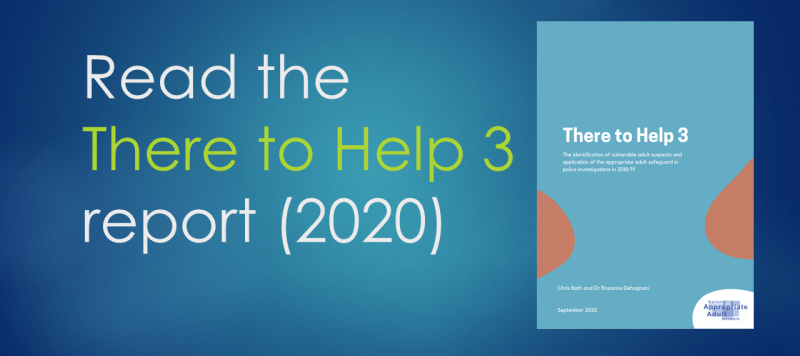
As Home Secretary, Theresa May commissioned NAAN to produce theThere to Help (2015)report. The report found significant problems with the police's identification of vulnerable suspects and the availability of appropriate adults when they were required in England and Wales.
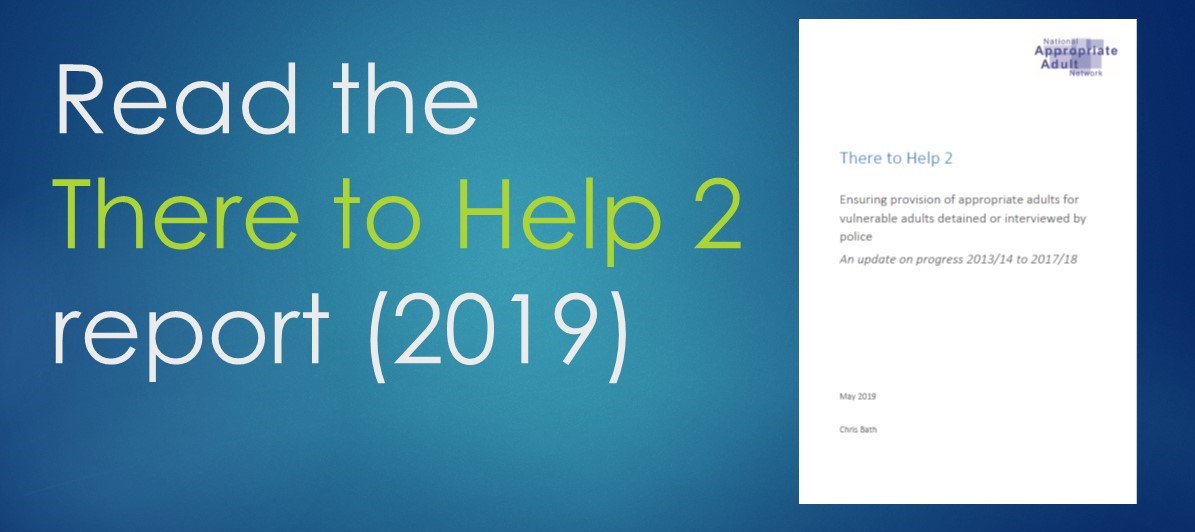
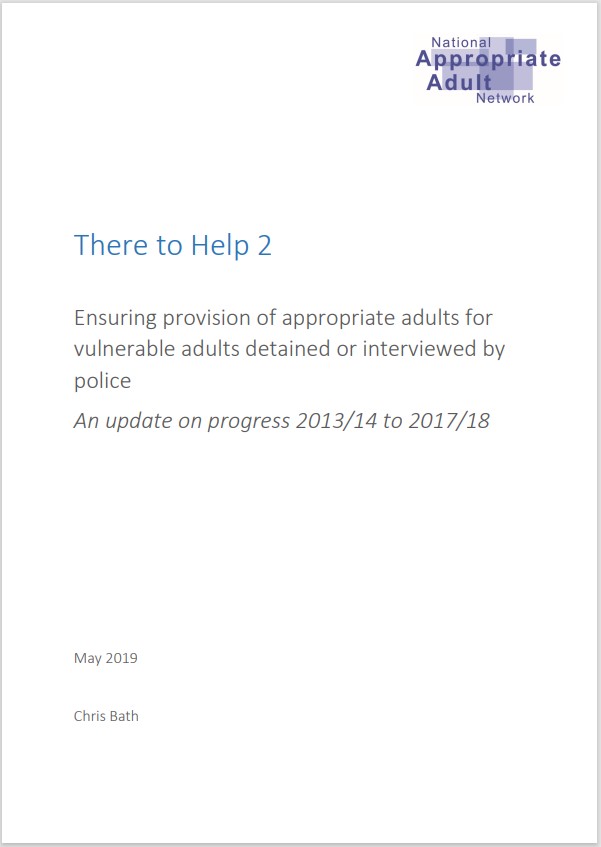
There to Help 2 follows up on progress between 2013/14 and 2017/18. It is based on data from:
The research took place prior to the significantJuly 2018 changes to PACE Code Crelating to vulnerable adult suspects. This means that police were required to obtain an AA if they hadany suspicionthat a personmayhave had anymental disorder or was otherwise mentally vulnerable.
Key facts
Police recorded the need for an appropriate adult in 6% of around 1 million adult detentions and interviews in 2017/18.
This was up from 3% in 2013/14, however academic studies have indicated that as many as 39% of adults in police custody have a mental disorder or intellectual disability.
There were large local variations, particularly in voluntary interviews, as different police forces recorded rates of AA need between 0% to 24%.
If police forces with the highest rates were representative of need, at least 111,445 detentions and voluntary interviews of vulnerable adults took place without need for an AA being recorded by police (although if the actual rate of need is 39% this would be closer to 400,000 per year).
Certain mental illnesses were less likely to result in an AA; 54% of adults known to have dementia, and 19% known to have anxiety disorder such as Post Traumatic Stress Disorder (PTSD), had an AA.
Appropriate adults were not provided to 34% of adults known to have a learning disability and 73% of adults known to have a mental health diagnosis.
Where police had no access to an organised AA scheme, they were half as likely to record an adult as needing one.
82% of England and Wales had some kind of organised appropriate adult scheme for adults (up from 52% in 2013/14) leaving 16% of the population in areas with no service.
Adult social services remained the largest funder of provision, providing around two-thirds of funding for AAs. However, in the continud absence of a funded statutory duty, the growth in AA schemes was largely due to police forces funding provision, raising questions around independence.
Recommendations
To ensure that all police forces record, retrieve, analyse and share reliable data:
Forces should ensure their information systems for custody and voluntary interviews can be used by police officers to quickly and simply record and retrieve reliable data on the need for, application of, and source of AAs, cross referencing with data on protected characteristics under the Equality Act 2010 (especially race and gender) to monitor for bias.
At a local level, forces should ensure this data is regularly shared with the local Head of Custody, Head of Criminal Justice, Office of the PCC, AA commissioners and providers.
At a national level, the NPCC should collate and share this data on an annual basis.
Forces should share best practice in the design and use of information systems (encouraged and facilitated by the NPCC, College of Policing, HM Inspectorates, IOPC, and PCCs).
To ensure that police identify all vulnerable adult suspects and apply the AA safeguard correctly:
The evidence base for the new (July 2018) PACE Code C definition of ‘vulnerability’ should be strengthened with research, and alternative terms considered (e.g. risks to justice, needs).
The NPCC should lead a partnership to develop, test and roll out an evidence-based national screening tool that can effectively and efficiently identify when people may be a ‘vulnerable person’ as defined in PACE Code C 2018 (e.g. with College of Policing, Liaison and Diversion, and academics from forensic psychology, forensic psychiatry and law).
Liaison and Diversion should screen 100% of suspects as soon as is possible in custody (subject to operational hours) and prior to any interview (including voluntary interviews).
Police forces should increase officer and staff awareness of the criminal justice risks and procedural safeguards associated with vulnerable suspects in custody and voluntary interviews, supported by NAAN, NPCC and College of Policing APP and learning resources.
Liaison and Diversion should ensure that its staff understand the PACE definition of vulnerability and AA requirement, through induction training and professional development.
To ensure that effective AA provision is available when and where required:
The Government should achieve parity for adult suspects by establishing a funded statutory duty on local authorities to ensure AA provision which is independent of policing as required under PACE, as is the case for children under the Crime and Disorder Act 1998 s.38(4).
In the continued absence of a statutory duty, the Government could mirror its success with Liaison and Diversion by providing programme funding to local authorities to establish AA provision under a clear framework for ensuring standards, accountability and sustainability.
The evidence base regarding the outcomes achieved by appropriate adults (for vulnerable people, police and the justice system) should be strengthened through further research.
The Government should ensure that, in addition to HMICFRS, HMIP and ICVs holding police accountable for their responsibilities (identifying need and promptly contacting AAs), the commissioning and provision of AAs is made accountable via existing health and social care inspectors/regulators, recognising the importance of the AA’s independence from policing.
NAAN, Home Office, Association of Directors of Adult Social Services (ADASS), the Association of Police and Crime Commissioners (APCC) and others should promote adherence to theNational Standards (2018)and local completion of the national self-assessment tool.
Click on the tweet below (not the Guardian article link) to view a Twitter thread by Chris Bath, highlighting the main findings and recommendations from the report.
1/ Today we publish #ThereToHelp 2, a report on progress in ensuring ‘vulnerable adults’ get #appropriateadults. Here’s a thread on some of our findings & recommendations, inspired by @gmhales's (frankly incomparable) data/charts threads. https://t.co/UzdoaSNCk6
— National Appropriate Adult Network (NAAN) (@AA_NAAN) May 31, 2019
This page contains information for NAAN members on how to complete a data return. Data returns are currently sent out annually. You do not need to use this page unless you have recieved a request for an update.
Information for publication on the NAAN Map
Click on a heading for instructions on how to complete your data return.
[widgetkit id=16]
Information for NAAN (will not be published on the NAAN Map)
[widgetkit id=17]
Written on .
Latest updates
Thank you for your interest in the consultation on the National Standards Review 2018. Here is our progress report:
NAAN sought to consult as widely as possible with stakeholders in developing the standards. This included the following actions.
A member workshop: A workshop on the national standards enabled members, working in small groups, to discuss and amend an early draft of the revised standards.
Public consultation: A public consultation was run based on a draft updated in light of the member workshop. Written submissions were received from the following organisations and individuals.
Association of Directors of Adult Social Services
Association of Youth Offending Team Managers
Dr Harriet Pierpoint, Centre for Criminology at University of South Wales
Headway, the brain injury association
HM Inspectorate of Constabulary, Fire and Rescue Service and HM Inspectorate of Prisons (joint)
Home Office
Independent Custody Visiting Association
Independent Office for Police Conduct
National Police Chief’s Council
NHS England (Liaison and Diversion)
Northumbria AA Scheme
Office of the Police and Crime Commissioner for Cambridgeshire
Police Federation of England and Wales
Thames Valley Police
The Law Society
The Youth Justice Board
YSS
Service user participation: NAAN commissioned advice from service users on the public consultation version. Our thanks go to:
Chris Hilliard, an expert in relation to autism
Members of the Working for Justice group (facilitated by KeyRing), experts in relation to learning disability
Moira Tombs (Encompassing Health), expert in relation to mental health
Public Consultation
The deadline for responses to This email address is being protected from spambots. You need JavaScript enabled to view it. was March 9th 2018. However, you can still access the consultation information below.
If you would like to know more about the sources referenced in the draft standards, please read the evidence review compiled by Dr Dehaghani of Cardiff University's School of Law.
The existing standards are mapped against the draft revised standards in the consultation documents above. However, standalone copies of the existing national standards are also available.
Written on .
For liaison and diversion
NAAN has worked closely with NHS England and strongly encourages the development of local relationships between liaison and diversion (L&D) and appropriate adults (AA) services, as part of the integrated vision set out in the Bradley report (2009).
We know that effective local relationships are critical, and hope the information on this page is of assistance to L&D professionals.
Under the Police and Criminal Evidence Act 1984 Code of Practice C, an AA is required for all people for whom the police have reasons to suspect may be vulnerable.
However, research has shown that:
Without appropriate tools, mental vulnerability is significantly under-identified by police officers
Vulnerable suspects are under-identified according to police data.
The identification of vulnerable suspects has been shown to be lower in areas with no organised AA scheme for adults
Legal definitions and thresholds in PACE Code C are not always applied and some mental disorders, such as depression and ADHD, seem to be less likely to trigger police to contact and AA.
Early data from the L&D programmesuggested that the AA safeguard was applied by police to only 20% of adult suspects who enaged with L&D.
What are the consequences of under-identification?
The potential consequences of failing to identify the need for an AA include:
subjecting innocent people to miscarriages of justice; and
rendering evidence against guilty people inadmissible in court.
What does this mean for L&D?
L&D don't decide whether the AA safeguard applies to an individual - that is the responsibility of the police.
However, L&D do use their skills to provide relevant information to support justice decision-makers (e.g. the police). Both the Liaison and Diversion Standard Service Specification (2019) and PACE Code C make it clear that L&D play an important role in ensuring that the need for an AA is identified.
If consulted, L&D practitioners should provide police with relevant information based on the PACE definition and threshold. This requires that L&D professionals:
are confident that they understand the PACE Code C definition and threshold; and
have the necessary professional comptencies in relation to the suspected condition(s).
An AA is required for all people aged under 18, and anyone of any age about whom the police have reason to suspect may be a vulnerable person (as defined by PACE Code C).
2
Legal duty on police
Contacting an AA for any suspect who meets the criteria is a legal duty on police officers (PACE Code C).
3
No refusal
A person cannot refuse to have an AA present if the criteria are met. The AA is an imposition on police, not a 'right' of the suspect. The issue of capacity is not relevant.
4
Parents for children, experience for adults
The law prioritises parents in the AA role for children. Vulnerable people should have a person who is experienced or trained in their care, unless they prefer a family member.
5
Statutory duty to provide for children
There is a legal requirement on local authorities to provide AAs for children (Crime and Disorder Act s.38(4), typically delivered via youth offending teams
6
No statutory duty to provide for adults
Despite being a legal requirement that police find an independent AA, local authorities are not legally required to provide AAs for vulnerable adults
7
AAs must be independent of police
The AA must be independent of the police; they cannot be under the control or direction of the police force, or under contractual arrangements to the chief constable.
8
AAs are not just for interviews
The AA has a role throughout a detention episode, from the explanation of rights and entitlements, all the way through to bail or charge and related actions (such as cautions). The specific rules are complicated, and sometimes police can do some procedures without an AA.
9
Private consultations at any time
A detained person has a right to speak privately to their AA at any time.
10
AAs have rights
AAs have a wide range of rights, for example they can insist that a solicitor attends, and make representations at reviews of detention. If L&D are aware of the extent of the legal rements for AA presence, they can help to make sure people receive the support to which they have a right.
"provide advice to decision makers within youth and criminal justice agencies on the range and appropriate use of reasonable adjustments for those individuals identified with vulnerabilities, including advising on the appointment of an appropriate adult"
"have reinforced links to other relevant services which should include appropriate adult services".
Provide information to police that constitutes a reason to suspect a person is vulnerable (and therefore police need to secure an AA)
Appropriate adults
Can provide referrals to L&D, based on information given to them by the person they are supporting
All adults for whom an AA is required should have been assessed by L&D if available
How can L&D and AA services collaborate?
What about voluntary attendance at interviews?
Many of the people that L&D and AA services exist to support will, for the best of reasons, be increasingly diverted from custody. This trend away from arrests towards voluntary interviews presents a shared challenge for police, L&D and AA schemes.
Voluntary interviews are still PACE interviews and carry the same risks and the same AA safeguard. However there is no custody sergeant to provide oversight and L&D and AA schemes are often structured around custody.
Whilework is underway at a national level to consider these challenges, local partnerships should be considering how L&D and AA schemes can work with police to ensure mental ill health and other vulnerabilities are identified and supported appropriately outside of police custody.
Can we collaborate locally on training?
NAAN encourages local AA and L&D providers to collaborate on training. The local AA scheme could provide L&D with awareness training on the role of the AA.
L&D services may be able to assist the local AA scheme with training of their AAs (e.g. on mental health or learning disability issues). This can result in and improved support for the individual and better justice outcomes.
What actions can we take now?
Make contact with the local AA scheme leader and discuss joint working. You can find local AA providers using theOur members page.
Work with the AA scheme, and police lead, to ensure processes for the identification of need for an AA are effective and comply with PACE. You can use our PACE vulnerability training videos as a resource for joint training.
Consider the potential for the local AA leader to sit on any local L&D advisory or steering group and vice-versa. This can be a great foundation for communication, problem-solving, and relationship building.
Encourage your local police force to use the AA video for family AAs (we've developed avideo implementation pagefor them). This will help untrained AAs to be as effective as possible.
Explore Our Training Services or
Sign Up to Start With Our Online Courses
Contact the organisation and ask for the contact details of the person responsible for their AA scheme.
If you are not satisfied with their response, you may want to raise the complaint with a more senior person from that organisation.
If you are still not satisfied, and the service is funded by a different organisation (eg. the local council) you could raise your complaint with that organisation.
If the AA scheme is provided or commissioned by a local authority, and you are not satisfied with how the local authority has handled your complaint, you could try contacting theLocal Government and Social Care Ombudsman (we can't say how they will respond).
Making a complaint about an appropriate adult scheme
Under National Standard 4.20, all members of NAAN are expected to have a complaints policy.
You can ask to see the complaints policy of the organisation that is providing the service. This should tell you how to complain.
If the service is provided by local government, you may be able to go to the local government Ombudsman.
If the service is commissioned (provided by a charity or business) then go to the commissioning organisation:
For children this will be local Youth Justice Service.
For adults you will need to ask the provider, but the most likely is adult social care or the police and crime commissioner.
Can I complain to NAAN?
The National Appropriate Adult Network (NAAN) is a charity for organisations and individuals with an interest in the appropriate adult role.
NAAN provides support, representation and leadership. It does not provide, inspect or regulate appropriate adults.
NAAN publishes national standards for appropriate adult schemes. You can use them to find out how AA schemes are expected to handle feedback and complaints by reading Standard 1.10 (Feedback and complaints) on page 25.
Complaints about appropriate adult schemes
NAAN does not have the power or resources to handle complaints about appropriate adults or AA schemes. We do not have a public helpline. Please use the processes above to make your complaint.
Sharing information
If you believe that an AA scheme that is a NAAN member is acting recklessly or dangerouslyyou can tell us here.
This is not a complaints process and does not replace the need to follow the processes above.
Complaints about NAAN
If you would like to complain (or provide feedback of any kind) about NAAN itself, please do not hesitate to contact us.
All complaints start by being investigated by the local police force. So you should start by complaining to the police.
Complain to the police online
You can find the contact details for individual police forces on their website. Police forces usually have a web page all about their complaints process. You may be able to make your complaint online. Search 'police', 'complaints' and the name of your area to find it.
Complain to the police in person
Many police stations have a 'front desk' that is open to the public. It may only be open at certain times of the day and week. You can ask to see the 'duty officer' and make your complaint in person.
Complain to the Independent Office for Police Conduct (IOPC)
The IOPC will investigate more serious complaints. All complaints raised with the IOPC must also be recorded by the relevant police force who will be asked to look into the matter.
If you need more information, you can contact the IOPC in lots of different ways.
What are your rights?
If you are under 18, you can look at the Government's Youth Justice Charter website to understand how you should be treated by police.
IOPC Youth Panel
Are you a young person who wants to improve policing and the police complaints system? You might be interested in the IOPC's Youth Panel. It is made up of 42 young people aged 16-25 from diverse communities across England and Wales.
If a family member has died in police custody or after police contact, you may wish to access the help and advice and the skills toolkit provided by the the charityInquest.
Taking legal action against the police
If you wish to take legal action against the police, you should talk to a specialist solicitor. The easiest way of finding a company is to use The Law Society’s Find a Solicitor function. Search under the legal issue of ‘Consumer and Civil Rights’. From there you can refine your search to ‘Actions Against the police – legal aid.’
Legal Aid
You may be able to obtain ‘legal aid’ to help with legal costs. This depends on how much you earn, your savings, and what sort of legal help you are looking for.
LawWorks is an independent charity with a mission to support, promote and encourage a commitment to ‘pro bono’ across the solicitors’ profession. Pro bono means solicitors give their time for free.
The charity enables access to justice for individuals in need of advice, who are not eligible for legal aid but cannot afford a lawyer.
Making a complaint about your legal advice
Complaints about poor service
In the first instance, normally, you should put your complaint in writing to the lawyer or law firm concerned. Keep copies of everything you send and everything you receive back.
If you are not happy with the outcome, you can then complain to the Legal Services Ombudsman. They have the power to make a company or individual pay you compensation for poor service.
If you need help to make your complaint, contact your local Citizens Advice Bureau.
Failure to comply with professional regulations
If you think your solicitor broke one of the Solicitors Regulation Authority’s (SRA) principles, you can report the solicitor to them.
The principles include things like; acting with integrity, providing a proper standard of service and not allowing their independence to be compromised.
The SRA cannot award compensation and does not deal with complaints about poor service.
The charity Unlock provides information and advice for people living with convictions. If you are facing difficulties as a result of a criminal record, you may find their Information Hub helpful.
Deleting a criminal record
If you can prove that the arrest was unlawful or that no offence existed, you may be able ask the police to remove a criminal record using their ‘Exceptional Case Procedure’.
The only other option is to appeal against the conviction. This can normally only be done within a short time after the conviction. You should seek legal advice to do this.