Appropriate adults work with police every day, in police environments. Independence from policing is a legal requirement of their role.
As the national body, we work with policing at the national level to increase understanding of the appropriate adult role.

Children
General
- Authorised Professional Practice on Children and young persons (College of Policing)
Youth Offending Team's responsibilities in regard to appropriate adults
- Standards for children in the youth justice system: These standards define the minimum expectation for all agencies that provide statutory services to ensure good outcomes for children in the youth justice system.
- How to manage bail and remands: Information on what happens when a child is arrested, including advice and what to consider at the police station, appropriate adults and when a child appears in court.
- A guide for youth justice professionals who are managing appropriate adults and appropriate adult services
Local authority accommodation transfers (PACE s.38(6))
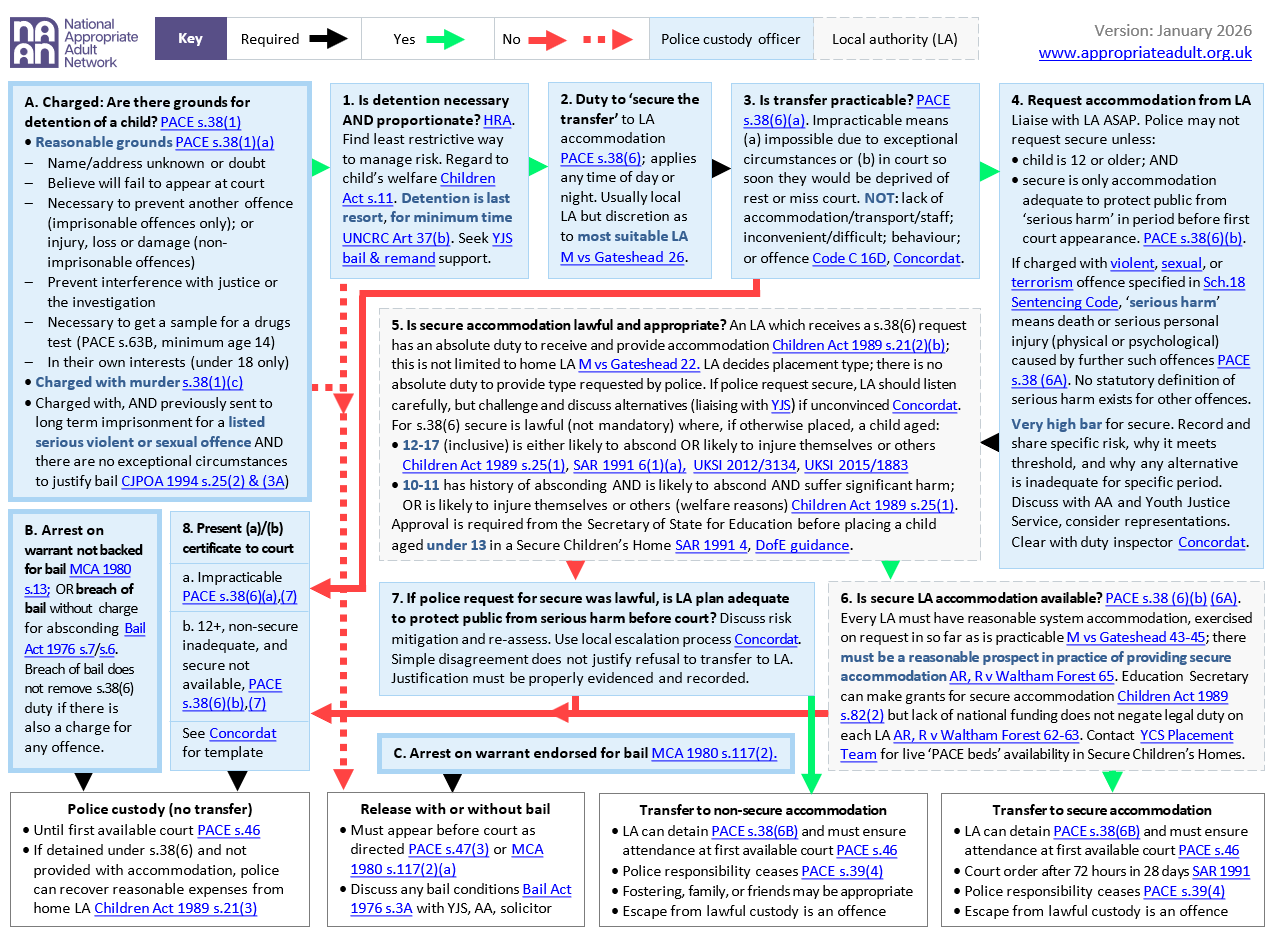
When a child under 18 is refused police bail, with few exceptions they must be transferred to local authority accommodation pending the first available court appearance. This is an important part of minimising detention times for children, which is a requirement under the UN Convention on the Rights of the Child.
- NAAN flowchart (updated 2026): Post-charge detention of children: A guide to transferring children refused police bail to local authority accommodation
- NAAN policy briefing: Transfers to local authority accommodation
- Home Office: Concordat on Children in Custody (2017)
- Welsh Government : All-Wales guidance for the appropriate management and transfer of children and young people by the Police and Local AuthoritiesAll-Wales guidance for the appropriate management and transfer of children and young people by the Police and Local Authorities (2016)
- London Safeguarding Children Board: London Protocol for the provision of local authority accommodation for children held in police custody (LSCB 2019)
- Just for Kids Law: No child in cells campaign and briefing: “It’s horrible when they keep you in there at night” Ending the overnight detention of children in police custody
Vulnerable people
Identification of vulnerable people
- Vulnerability Identification Tracker
- There to Help reports
- PACE vulnerabilty training videos
- PACE vulnerability and appropriate adults training slide deck 2022 (NAAN)
- Detailed guide to PACE Code changes - July 2018 (NAAN)
- Who do appropriate adults support?
- Do the police have to involve an appropriate adult?
- Vulnerability Identification Card Schemes in use by police forces in England and Wales
Availability of schemes for vunerable adults
General
- Authorised Professional Practice on Mental health, learning disabilities and other mental vulnerabilities (College of Policing)
- Professionals in the Criminal Justice System working with Offenders with Learning Disabilities (Department of Health) p.37
Family AA guides
PACE Code C requires police officers to explain an appropriate adult's role to them. Given the complexity of the role, this can be challenging for police officers. Unfortunately, the Home Office guidance for parents, carers and other untrained AAs was last updated in 2003. So here are some resources to help.
Video
Being an appropriate adult is an animated video developed by NAAN and the London School of Economics (2022).
Advice on using the video in police custody, and a downloadable poster, are available on our video implementation page.
Printable
Our detailed guide to being an appropriate adult is a similar length to the old Home Office guidance from 2003. It can be printed on four A4 sheets double-sided (2018)
Our quick guide to being an appropriate adult is a short summary leaflet, designed to be printed on a single A4 sheet, double sided and folded into thirds (2018)
Online
About appropriate adults is a webpage covering frequently asked questions about appropriate adults
Working with AA schemes
National standards
The national standards for the development and provision of appropriate adult schemes in England and Wales
Commissioning guidance
National development and commissioning guidance (requires registration)
Vetting guidance
A proportionate approach to vetting appropriate adults from organised schemes
Effective appropriate adults: what does it take?
PACE updates
Our PACE updates provide guidance on changes to PACE focused on children, vulnerable people and appropriate adults.
Policy and research
Read our policy and research papers on important issues such as vulnerability, voluntary interviews, legal advice, and strip searching.
Police strategy and guidance
College of Policing
Authorised Professional Practice on Detention and Custody
HM Inspectorate of Constabulary, Fire and Rescue Services
Expectations for police custody: Criteria for assessing the treatment of and conditions for detainees in police custody (version 4)
NAAN membership
While full membership is restricted to organisations providing appropriate adults, associate membership of NAAN is open to police forces. Key benefits include:
Access to iKAAN
Access to iKAAN, the online knowledgebase that brings together legislation, case law, policy and best practice on the treatment of children and mentally vulnerable adults who are detained or questioned by police.
Free events
Free tickets to our regular professional development events.
E-updates
E-updates directly into your email inbox, for example notifications of national policy change, the latest research, updates to PACE and upcoming events.