Bail and accommodation transfers
The extent to which police authorisations, reviews of detention and pre and post charge bail decisions are focused on children’s interests is variable.
The police are less likely than courts to grant bail.
Councils are failing in their legal duty to provide accommodation and sometimes police do not request it, or request secure accommodation when the legal threshold is not met (see our dedicated page on PACE section 38(6) transfers to local authority accommodation).

Limited access to appropriate adults
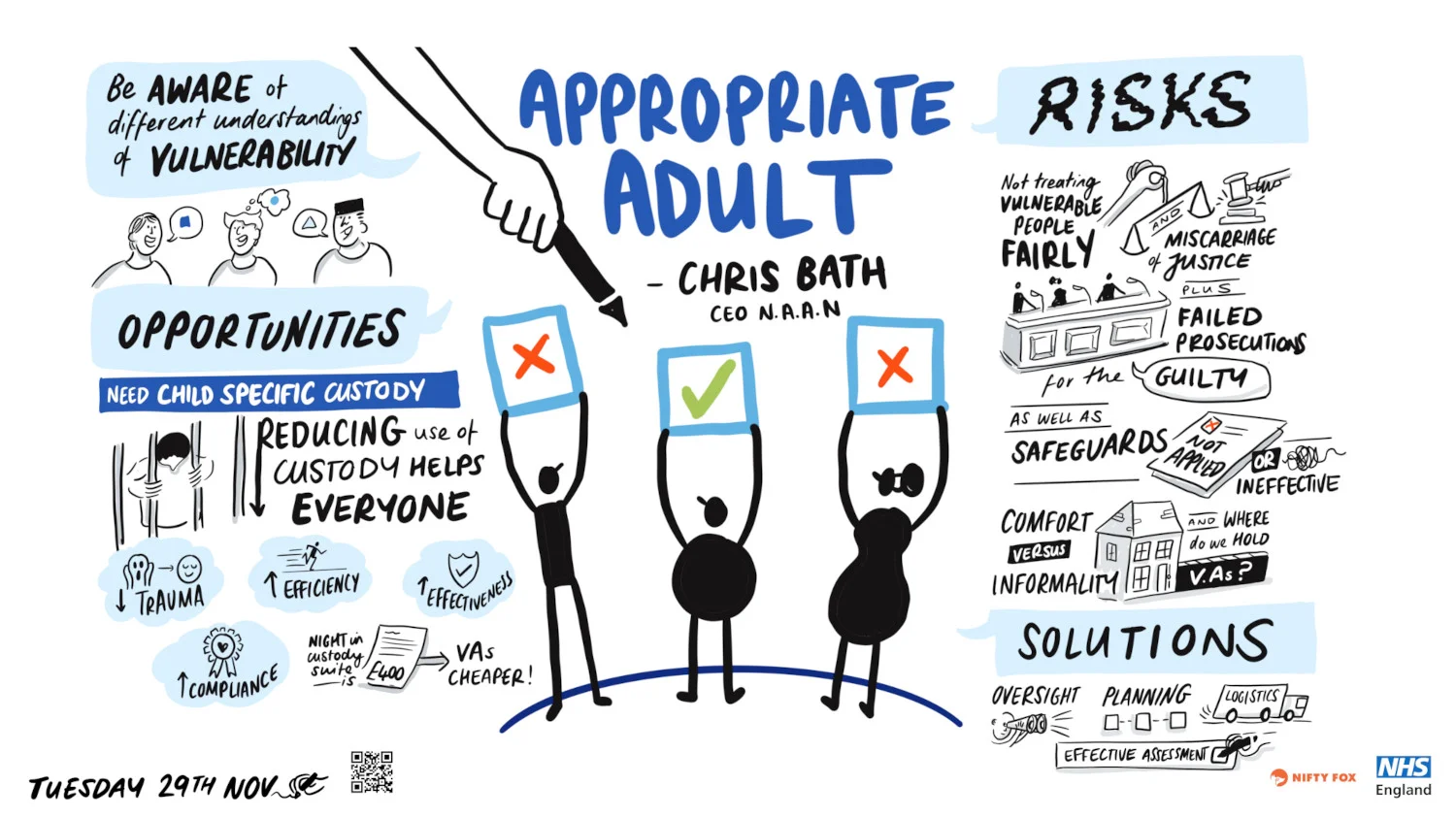
The AA safeguard is essential, but too often it is not used effectively. While many children receive rapid, extensive and excellent support, some only get an AA immediately before an interview. They spend hours without support, significantly increasing risks to justice.
PACE requires police to tell the AA and secure their attendance as soon as is practicable, and children have a right to consult privately with their AA at any time. However, research has found police delaying referrals and limiting access to children.
Legislation and standards make it clear council AA provision must be available at any time. Nevertheless, availability is a common frustration.
Despite clear national standards, some schemes are still not able to operate 24/7, respond quickly enough, support the entire custody process, or support voluntary interviews. Councils must design and resource AA schemes that enable PACE compliance.

Family appropriate adults
PACE prioritises parents as AAs (unless involved in the case), and many children will value someone familiar and trusted who understands them. Yet, in emotional circumstances, parents must interpret PACE, understand their role, and challenge police appropriately, while relying on them for information. Well trained AAs (volunteers or paid) have the knowledge and experience to challenge without obstructing an investigation and, in theory, could be subject to inspection or regulation. But they are usually unknown to the child and must be skilled in building rapport. We've developed resources for family appropriate adults, including a video. And we are encouraging AA schemes to work together with parents.

Access to legal advice
In England and Wales, the age of criminal responsibility is set at only 10 years old - one of the lowest in the world.
While children are asked by police whether they want legal advice, they are allowed to waive this right.
The take up rate for children has historically been low. This is often due to children not understanding the risks and benefits, making short-term decisions, having misconceptions about lawyers' independence or fees, or a lack of trust.
However, under PACE Code C 6.5A, appropriate adults have the right to ensure a solicitor attends the police station. While the child cannot be forced to then meet the solicitor, they nearly always do. However, the AA must first be aware of this right, and the value of legal advice - a key theme in NAAN's training for AAs.

Remote legal representation
In response to Covid-19, a joint interim interview protocol was agreed by the CPS, NPCC, Law Society, CLSA, and LCCSA in March 2020. This supported the delivery of remote legal advice and interview support by legal representatives as temporary measure in extremis to cope with an unprecedented public health crisis. Since then NAAN has raised repeated concerns about the negative impact on children in police custody and interviews, resulting in several changes to the protocol over the months. This included a joint report with Transform Justice and Fair Trials International, based on evidence from appropriate adults.
Sadly a decision to require legal representation to be in person in all cases involving children (in version 3 of the protocol) was later reversed, allowing the continued use of representation by video and phone in some circumstances. Despite the relaxation of other Covid-19 regulations, this protocol remains in place. In our view, the arrangements are in breach of the Police and Criminal Evidence Act 1984 Codes of Practice and should end.

Voluntary interviews
The extent to which police authorisations, reviews of detention and pre and post charge bail decisions are focused on children’s interests is
While addressing concerns about using custody for children, voluntary interviews bring their own risks. In addition to most AA schemes, most liaison and diversion services (which expertly identify vulnerability in custody) are not configured to serve them. With no independent custody officer, investigating officers are responsible for rigorously applying safeguards against themselves. Children (and parental AAs) may see such interviews as informal chats, not deserving of legal advice. See our dedicated policy page on voluntary interviews.
Strip searches
Whether it is strip searches or intimate searches of children, in police custody or under stop and search, the system of police powers is complex. And the safeguards are more limited than most people realise.
Our report, prompted by the strip search of Child Q and others, highlights a wide range of issues including ethnic disparities and traumatic impacts, especially on children and vulnerable people. It suggests a range of potential strategic and technical changes, including a new focus on safeguarding.

Vulnerability
The average human brain takes 25 years to develop. Yet at just ten, a child is criminally responsible and must make key decisions, such as whether or not to have legal advice.
Children in custody are disadvantaged by more than cognitive development. They are much more likely than other children to have poor mental health, a learning disability (up to 32% versus 4%), communication disorder (up to 90% versus 7%), be autistic (15% versus 1%), or have suffered a head injury with loss of consciousness for more than 20 minutes (18% versus 5%). Race, gender, abuse, neglect, trauma, exclusion, and ‘looked after’ status can also compound disadvantage.
Much of this is invisible unless actively looked for. Children detained regularly may be seen to ‘know the ropes’ causing their distress and disadvantage to go unrecognised and unaddressed.
