Public articles

Statutory provision

Since 1984, police have been required to secure an appropriate adult (AA) for vulnerable people suspected of an offence. It must be someone independent from policing.

In 1998, local authorities were given a legal duty to ensure AA provision for children. But in over 40 years, nobody has been made legally responsible for AAs for adults with learning disabilties, autism or mental ill health. 

In summary

  1. When police detain, question, or strip search a child or a vulnerable person, they have a legal duty to secure someone independent of policing to act in the role of the appropriate adult (AA).
  2. AAs are a 'procedural safeguard' which seek inclusion and fair justice - they protect the innocent against miscarriages of justice and protect the reliability of evidence against the guilty.
  3. People may be defined as vulnerable for a range of reasons, including learning disability, mental health conditions, neurodivergence (e.g. ADHD, and autism) or physical conditions (e.g. dementia).
  4. Although intended as a social work function, many local authorities have terminated their AA provision for vulnerable adults due to financial pressures - a voluntary agreement in 2018 between PCCs and local authorities did not resolve this.
  5. Local authorities have a statutory duty to ensure  AAs for children, but a gap in the law means nobody is responsible when an AA is needed for a vulnerable people aged 18+, leaving patchy and unstable support.
  6. A statutory duty would enable police to comply with the law, protect the rights and participation of the most vulnerable in society, and improve the efficiency, effectiveness and legitimacy of policing and justice. 

Appropriate adults safeguard a child or vulnerable person’s interests (rights, entitlements, welfare) through:

  • Support, advice and assistance
  • Checking understanding of rights
  • Assisting with communication
  • Observing police treatment
  • Intervening to protect rights 

The absence of an AA when required can lead to evidence being ruled inadmissible in court. 

Download the briefing

Support

Professor the Lord Patel

Chair Social Work England (2018-23), Former Chair of the Mental Health Act Commission

"The lack of any statutory provision for vulnerable adults, means that trained appropriate adults are often unavailable or provision is limited. The non-statutory nature, means those areas with a service are defenceless in the face of budget cuts. Placing appropriate adult provision for mentally vulnerable adults on a statutory footing...would ensure parity with children’s services, provide clarity and accountability, and prevent mentally vulnerable adults from ‘slipping through the cracks’ between agency responsibilities and ensure independence from the police".

Rt Hon Theresa May MP

Prime Minister (2016-19), Home Secretary (2010-16)

"The status quo is clearly not acceptable and I was concerned to read that a number of mentally vulnerable adults, who clearly meet the current eligibility criteria in PACE Code of Practice C, do not receive the support of an appropriate adult...the priority must be to act to ensure that vulnerable people are provided with the support they are entitled to".

Rt Hon Lord Bradley PC

Former Minister for Criminal Justice

"The police work in a difficult environment with incredible time pressures. Trained appropriate adults must be quickly available wherever they are needed. Along with liaison and diversion, and street triage, they are critical part of a coherent approach to vulnerabilities which both saves money and delivers better outcomes."

Chief Constable Balhatchet

National Police Chiefs’ Council (NPCC) lead for Custody (2025)

“Appropriate adults (AA) play a crucial role in the effective operation of not only custody, but the Criminal Justice System as a whole. The provision of a quality AA service ensures the needs of children and vulnerable adults are met, and that their rights and entitlements are fulfilled. In doing so, it ensures that any product of the custody process, such as an interview or collection of forensic evidence, is going to stand up to scrutiny in court and be admissible. Unlike the statutory duty imposed on Local Authorities to provide AAs for children, there is no such obligation for vulnerable adults. This has created an inconsistent and inadequate provision for some of the most vulnerable members of our society and a significant challenge for policing to comply with the law. I strongly support the call for a statutory provision of AAs for vulnerable adults, as there already exists for children in the Crime and Disorder Act 1998.”. 

Deputy Chief Constable Kemp

National Police Chiefs’ Council (NPCC) lead for Custody (2024)

““I strongly support the establishment of a statutory duty to provide appropriate adults (AAs) for vulnerable people, as exists for children in the Crime and Disorder Act 1998. The availability of independent AAs is critical to ensuring custody meets the needs of policing and the expectations of the public, and that evidence is reliable and admissible. Custody performs a pivotal function in the criminal justice process, but the absence of an AA to support a vulnerable person at this point has the potential to undermine the very purpose of the process: justice. While police have a duty to identify and secure AAs, there is no corresponding legal obligation for any authority to ensure AAs' availability for vulnerable adults. This gap has caused significant operational challenges. Statutory provision will enhance the integrity and effectiveness of our justice system”. 

Rt Hon Chris Philp

Minister of State for Policing (2022-2024)

"We acknowledge that appropriate adult provision for vulnerable adults needs to improve and will look towards both the police and local authorities to work together to improve in this area.

Local authorities have a statutory responsibility for the provision of appropriate adults for children who must be provided an appropriate adult when detained in police custody.

Adults identified as vulnerable must be supported in custody by an Appropriate Adult. The 2018 PCC-Local Authority Partnership was introduced to improve the planning and delivery of appropriate adult services".

Response to a parliamentary question by Janet Daby MP, 28 November 2022

Martyn Underhill MBE

Police and Crime Commissioner for Dorset (2012-21), Chair of the Independent Custody Visitors Association (2014-22)

"We are clearly not getting it right for the more vulnerable members of our communities who need that extra protection and support. When a vulnerable person comes into contact with the police, their needs deserve to be properly identified, with a needs assessment made, and for them to then be dealt with quickly and fairly. For this to happen, every area needs an organised, trained appropriate adult scheme which is totally independent of the police.”

Dame Anne Owers

Chair of the Independent Custody Visiting Association (2024)

“The availability of high-quality AAs is fundamental to ensuring the rights, dignity, and equitable treatment of vulnerable people detained in police custody. As we have found at ICVA, it is clear that this is not always the case, especially out of hours. Yet no-one is legally responsible – and therefore accountable - for ensuring provision. For over 25 years it has been a statutory duty to provide AAs for children. As Chair of ICVA, I urge policymakers to act on NAAN’s call to provide the same mandatory protection for vulnerable adults.”. 

Avtar Bhatoa

Chair of Law Society Criminal Law Committee (2015)

"To ensure fair justice for all, mentally vulnerable people need the help of an appropriate adult during what can be a daunting and confusing time. With the right support, mentally vulnerable people are less likely to suffer an injustice or to waive their right to free legal advice through fear and misunderstanding, which can compound their disadvantage in the justice system. It is vital that the recommendations in this important report are implemented."

James Bullion

President of the Association of Directors of Adult Social Services (2020)

“Helping to support and safeguard our most vulnerable citizens, whether they are victims or suspects, is central to the role of adult social care services.

"Many local authorities have a long history of providing social workers or funding dedicated AA schemes". 

Rt Hon Nick Hurd MP

Minister of State for Policing (2017-19)

“We know that appropriate adult provision across England and Wales is varied and could be much improved...vulnerable people…are at risk of being let down…this can lead to miscarriages of justice…investigations cannot proceed - placing a strain on police resources and detaining vulnerable adults for longer than is necessary". 

Gísli Guðjónsson CBE

Emeritus Professor of Forensic Psychology, expert in false confessions

"Mentally vulnerable people are at increased risk of providing information which is inaccurate, unreliable or misleading. “The involvement of an appropriate adult to facilitate communication, ensure they understand their rights and are treated fairly, is absolutely critical to a fair process”.

The challenge

  • 1. Police

    Must secure AAs for children and vulnerable

    Police have a statutory duty to secure an AA for two groups: children and vulnerable people. 

    While the AA is often a family member or friend, an alternative is required when this is inappropriate or impossible, for example when they are a witness or are caring for others.

    Under the Police and Criminal Evidence Act 1984 and statutory codes (PACE) it is critical that the AA is independent of policing. AAs cannot be:

    • a police officer or employee,
    • under the control and direction of police
    • under contractual arrangements with police.
  • 2. Local authorities

    Must provide AAs for children

    Local authorities have an explicit statutory duty to provide appropriate adults under the Crime and Disorder Act 1998 s38. 

    However, this only applies to children. 

    Local authorities have historically ensured the provision of AAs. They have variously done this via volunteers, social workers, sessional staff, and contracted providers.

    However, there is no statutory equivalent for vulnerable people.

  • 3. A gap in the law

    The Police and Criminal Evidence Act 1984 (PACE) was a landmark law that contributed to public confidence in policing. It recognised the risks associated with two groups - children and vulnerable people - and required police to secure an appropriate adult. 

    It was a response to the report of the Royal Commission on Criminal Procedure (1981). Both the Commission and the Act assumed that social workers would fulfil this role where family could not. 

    The Crime and Disorder Act 1998 ensured AA provison with an explicit statutory duty on local authorities for children. But no provision was made for vunerable adults.

  • 4. Patchy and insecure

    Since 2004, NAAN research has shown how this has resulted in patchy, ad-hoc, and insecure AA provision for vulnerable people. 

    Key findings include:

    • “Most forces commented that the poor level of service provision was due to a lack of statutory responsibility for vulnerable adults."
    • "Provision varies widely across the country…[with] various statutory bodies arguing about who had responsibility for the service."
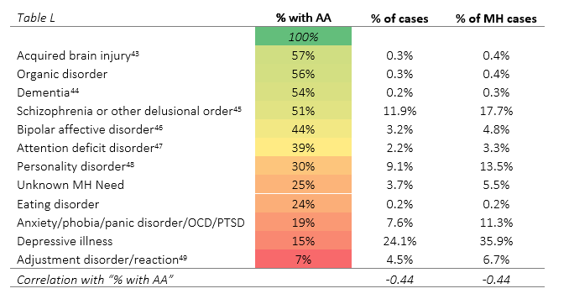
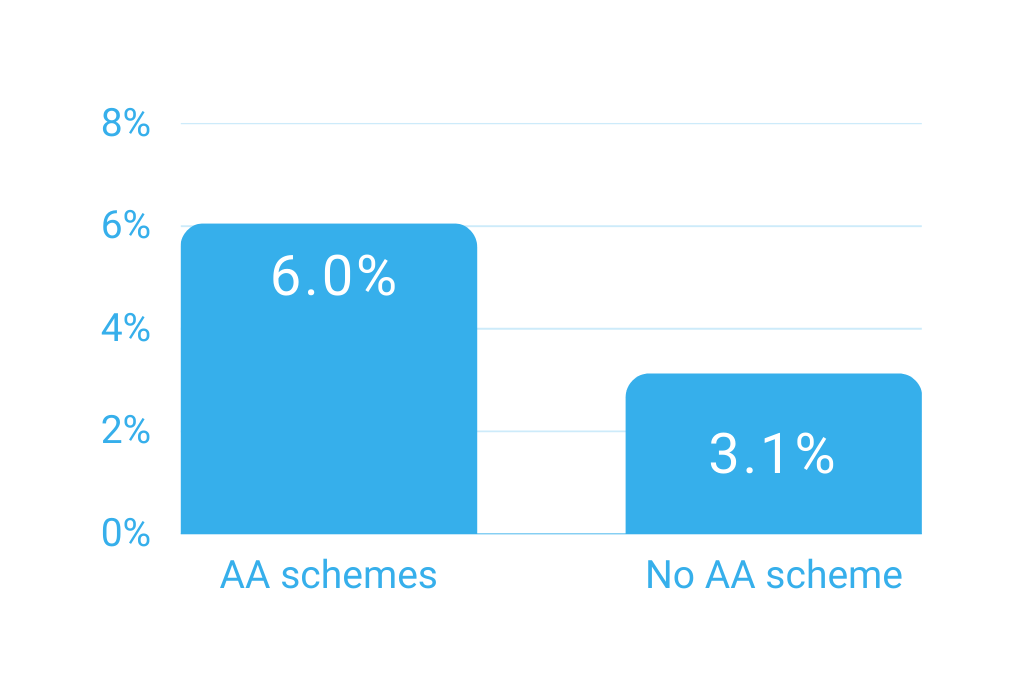
    • "Need for an AA is around half as likely to be recorded where there is no organised provision” 
  • 5. Increasing demands

    Despite adult arrests reducing between 2007/08 and 2020/21, appropriate adult schemes have recently seen significant increases in demand due to: 

  • 6. Falling supply

    Just when we need a stable system for ensuring appropriate adults are available:  

    • Local authorities (LAs) have increasingly terminated AA schemes, sometimes with little notice, citing non-statutory status and severe financial pressures in social care. 
    • Covid exposed the systemic fragility of a non-statutory approach. While the vast majority of AA schemes continued to provide in-person support throughout the pandemic, some schemes for vulnerable adults simply stopped.
    • Post-Covid, the recruitment and retention of AAs has become a major challenge, with a national shortage of volunteers and pressures on wages. 
    • Policing budgets have been used to plug the gap, raising concerns about independence. Some Police and Crime Commissioners (PCCs) have been forced to develop emergency measures. 

Progress

National recognition of the need for change

Lord Patel - Queen’s Speech Debate

House of Lords (9 June 2014)

"I am pleased to have the opportunity to raise an issue...which I believe is long-standing and urgent and on which I believe the Government could act now through a simple amendment to either the Criminal Justice and Courts Bill or the Serious Crime Bill"

"The lack of any statutory provision for vulnerable adults means that trained appropriate adults for this group are often unavailable or that provision is limited. In many areas, services are non-existent".

"We need to see a clear commitment by the Government to take action within this parliamentary Session to tackle these important issues. I fear that without such action, we are heading towards crisis and placing some of the most vulnerable people in our communities at serious risk".

Read this speech

Centre for Mental Health

The Bradley Report 5 years on (2014)

“There is no body or agency with a statutory responsibility… In places, this means that response to requests is patchy and ad-hoc, with local social services emergency duty teams responding if they have no higher priorities”. 

Read this report


Home Secretary's commission

A key milestone

Significant efforts have been made in recognising and addressing the lack of as statutory duty to proviude for vulnerable people.

A key milestone was NAAN being commissioned by the home secretary to review the situation and make recommendations.

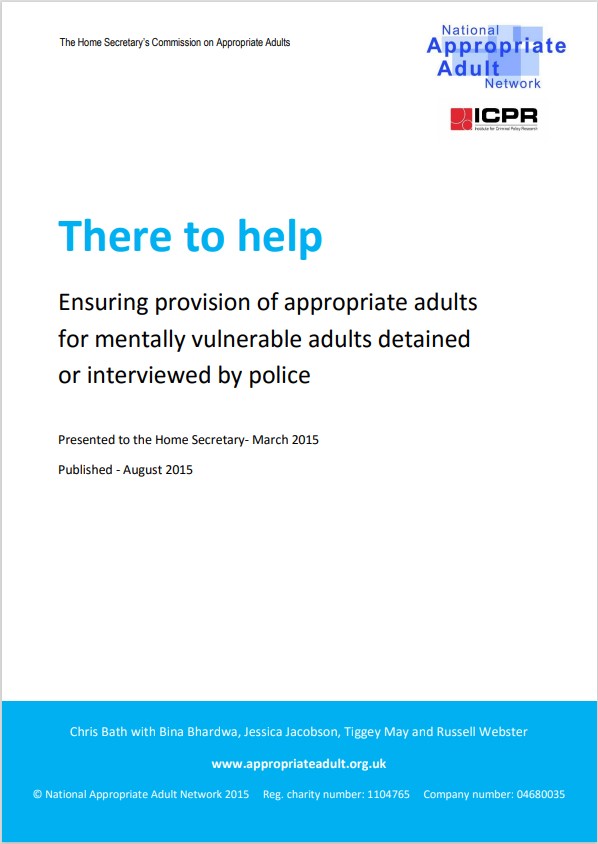
We worked with ICPR and an experienced advisory board to publish There to Help (2015). 

Recommendations

There to Help offered 10 recommendations. These included: 

  • A cross-departmental Government committment to ensuring timely access to AA support
  • A clear and consistent national framework for local co-comissioning, informed by Health and Wellbeing Boards and Safeguarding Adults Boards
  • Enhanced national standards to support local commissioners
  • Parity with children's AA provision via a statutory (legal) duty to ensure provision for vulnerable adults.

Advisory board members

  • CHAIR: The Rt Hon. Lord Bradley PC, Member of the House of Lords. Author of the Bradley Report
  • Mick Connell National lead for social care and offenders, Association of Directors of Adult
    Social Services (ADASS). 
  • Martyn Underhill Police and Crime Commissioner for Dorset, Association of Police and Crime Commissioners
  • Kate Davies OBE, Head of Public Health, Armed Forces and Families and Health & Justice
    Commissioning, NHS England
  • Superintendent Alan Greene, National Police Chiefs' Council custody portfolio
  • Heather Hurford, HM Inspectorate
    of Constabulary, Lead Inspector, The welfare of vulnerable people in custody, National Policy Lead for Mental Capacity Act and Mental
    Health Act, Care Quality Commission
  • Jenny Talbot OBE (Chair) Chair of Trustees, National Appropriate Adult Network, Director of Care not Custody, Prison Reform Trust
  • Grev Wallington Appropriate Adult Scheme Co-ordinator, Southwark Council. Trustee,
    National Appropriate Adult Network

Rt Hon Theresa May MP

Home Secretary (2010-16)

"The status quo is clearly not acceptable...the priority must be to act to ensure that vulnerable people are provided with the support they are entitled to".


Impact of the commission

1. Media coverage

2. Working group

December 2015

Home Secretary Theresa May established a Home Office-chaired working group to "consider the recommendations of the report and options for implementation". Members included:

  • NAAN
  • Local Government Association
  • Association of Directors of Social Services
  • ADASS Cymru
  • NHS England
  • Association of Police and Crime Commissioners
  • National Police Chiefs' Council
  • HM Inspectorate of Constabulary
  • Ministry of Justice

3. Government research

November 2016

The Home Office Police Integrity and Powers Unit commissioned the department's Crime and Policing Knowledge Hub to build on the NAAN research by:

  • Gathering information on existing models of AA provision
  • Exploring the potential costs of plugging the gaps in provision

The aim was to develop sufficient understanding to enable officials to put options to ministers.

Rt Hon Nick Hurd MP

Minister of State for Policing

September 2017

In response to a question from Luciana Berger:

"In recognition of the importance of appropriate adult support for vulnerable adults, and the challenges identified by the National Appropriate Adult Network in their report ‘There to Help: Ensuring provision of appropriate adults for mentally vulnerable adults detained or interviewed by the police’, the Government is working with partners through the Vulnerable Adult Working Group to explore how best to improve appropriate adult support across England and Wales".

4. LGA review

February 2017

A Local Goverment Assocation (LGA) appropriate adults review paper presented their Community Wellbeing Board with options including: (1) no change, (2) a statutory duty on local authorities, (3) an informal agreement, or (4) Home Office responsibility. 

Councillors on the cross-party Board concluded that local authorities were not prepared to take on more statutory duties without further funding, but they did not feel empowered to indicate alternatives. 

The Board "expressed concerns that Concerns that vulnerable adults fall through the net as a consequence of a scattergun approach in the support provided" and that "Local authorities are particularly concerned they will have to pick up safeguarding where vulnerable adults have fallen through the net".

5. Angiolini review

October 2017

The landmark Report of the Independent Review of Deaths and Serious Incidents in Police Custody is published. 

Dame Elish Angiolini's recommendations include:

  • "Increased funding is required for appropriate adult schemes within a national framework for commissioning.
  • "This should include improved training and consistency of Appropriate Adult services".

6. Change of PACE

July 2018

Parliament agrees changes to PACE Code C, increasing requirements on police to identify the vulnerable people for whom they must secure an approrpiate adult:

  • Changing the definition of a vulnerable person, placing the emphasis on 'function' rather than diagnosis
  • Requiring police to secure an AA, when there is 'any reason to suspect' a person may be vulnerable (instead of when there is 'any suspicion')
  • Requiring police to make 'reasonable efforts' to identify what information is available that is relevant to whether a person is vulnerable. 

However, it remains the case that nobody is responsible for providing appropriate adults for vulnerable adults. 

Baroness Manzoor

HM Government

June 2018

Parliamentary debate: PACE 1984 (Codes of Practice) Order 2018

"The noble Lord, Lord Paddick, also raised the issue of finding an appropriate adult. Having worked in the police force, he has vast experience, and I take on board the point he raised. The Government are aware of the problems and keen to work towards resolving them. We will shortly be introducing a voluntary national framework to address this issue. There will be more work and closer partnerships between the PCCs, police forces and other authorities to find solutions to this issue".

7. Voluntary agreement

July 2018

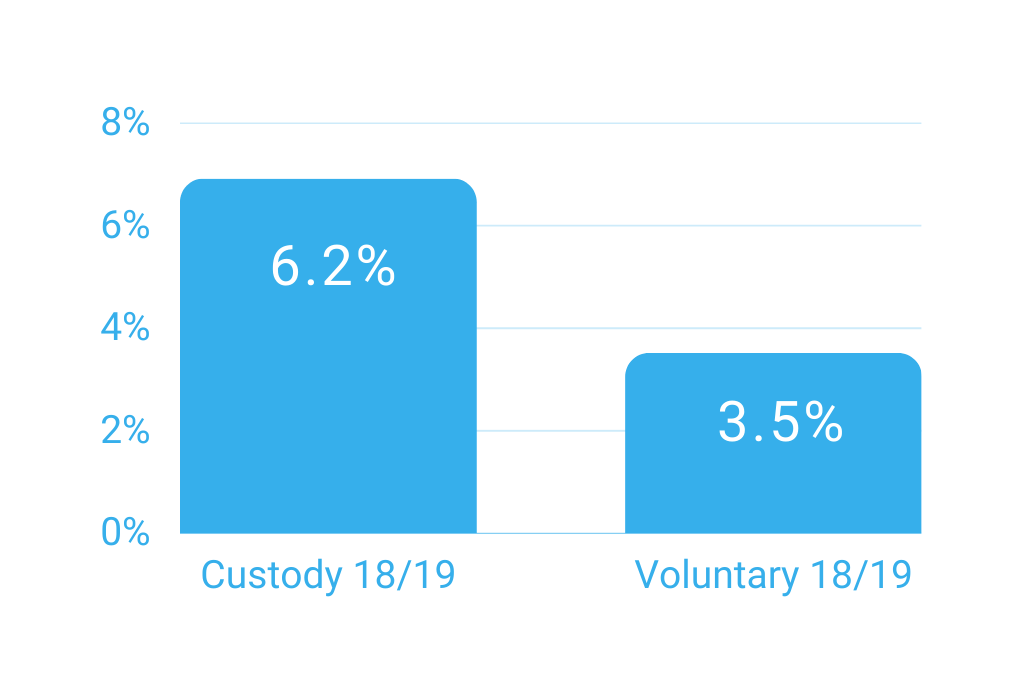
The Home Office published the Appropriate Adult PCC-Local Authority Partnership Agreement England to encourage local authorities to improve appropriate adult provision for vulnerable adults, working with police and crime commissioners (PCCs) to understand demand. It was a voluntary agreement, intended to support local solutions. No funding was attached. 

The Home Office committed to evaluate its impact after 6 and 12 months, reviewing the availability, timeliness and standard of AA provision to inform the need for any improvements. However, his has not been published. The voluntary agreement did not prevent the continued termination of local authority AA provision.
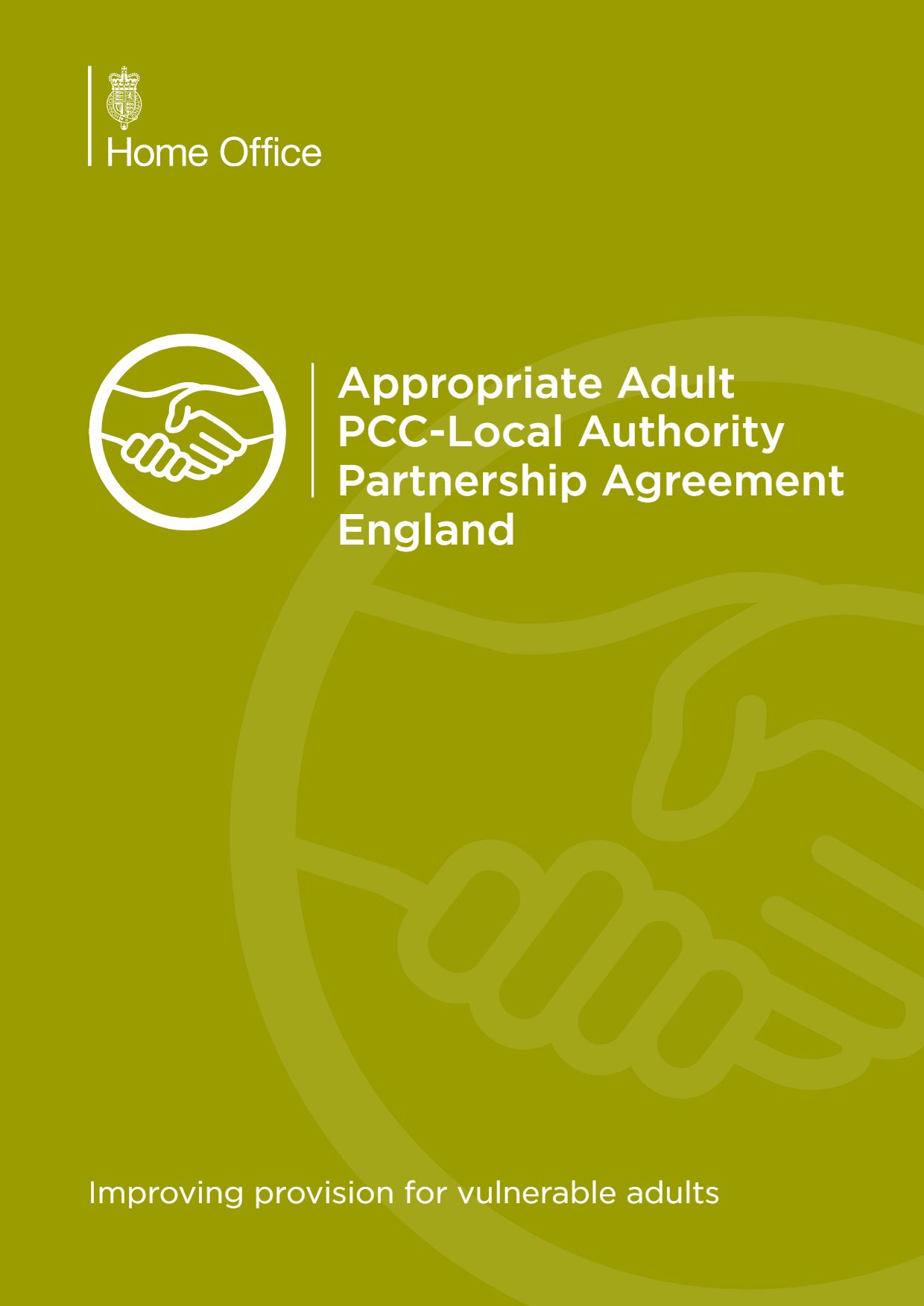
Image of the front cover of the Home Office Appropriate Adult PCC Local Authority Partnership Agreement

Across the UK: AAs for vulnerable adults

England

No statutory duty for adults

In England, there is a statutory duty on local authorities to ensure the provision of AAs for children. However, there is no statutory duty to provide appropriate adults for vulnerable people.

In recent years, many local authorities have closed their services or ended funding for AAs for vulnerable adults. Responsibility has continued to informally shift from social care to policing, as Police and Crime Commissioners have increasingly been forced to step in, without additional funding, to ensure police investigations can continue.

Wales

No statutory duty for adults

In Wales, there is a statutory duty on local authorities to ensure the provision of AAs for children. However, there is no statutory duty to provide appropriate adults for vulnerable people.

In recent years, local authorities have closed their services or ended funding for AAs for vulnerable adults. Police and Crime Commissioners have been forced to step in, without additional funding, to ensure police investigations can continue. As a result, responsibility has completely shifted from social care to policing. 100% of AA schemes for vulnerable adults in Wales are now commissioned by PCCs. 

Northern Ireland

Centrally-funded service for adults

In Northern Ireland, there is no statutory duty to provide AAs for either children or vulnerable adults.

However, the devolved government funds a combined service for children and vulnerable people. The Department of Justice commissions the Northern Ireland Appropriate Adult Scheme (NIASS), provided by the mental health charity Mindwise.

Under NI's version of PACE Code C, an AA may not be an employee of the Policing Board (the equivalent of Police and Crime Commissioners in England and Wales)

Scotland

Local authority duty for adults

In 2019, Scotland placed a statutory duty on local authorities to provide trained appropriate adults when required by any criminal investigative agency. The Scottish Government publishes guidance for local authorities, a quality improvement framework for self-evaluation, and the Care Inspectorate is legally responsible for assessing quality and publishes reviews.

Scotland has a distinct legal system. AAs play a slightly different role during police investigations. The safeguard does not apply to under 16s, but in addition to suspects also applies to vulnerable victims, witnesses 

England & Wales: by force area

The table below gives an indication of the dominant model in each force area for vulnerable adults. It should not be read to mean there is functioning provision for in all local authority areas within a force area, or at all times. Police force areas usually cover several local authorities, and provision may be different in each authority area. Commissioning and provision arrangements are subject to regular change and the latest arrangments may not be relected in this table. If you would like to porvide an update, please email This email address is being protected from spambots. You need JavaScript enabled to view it. 

Force area Approach Authority
Avon and Somerset Commissions

PCC 

Bedfordshire Delivers

Local authority

Cambridgeshire & Peterborough Commissions

Local authority & PCC

Cheshire Commissions

PCC

City of London Commissions

City of London Corporation

Cleveland Commissions

PCC

Cumbria Commissions

PCC

Derbyshire Commissions

PCC

Devon & Cornwall Commissions

Local authority (some areas)

Dorset Commissions

PCC

Durham Commissions

Police (out of hours only)

Dyfed-Powys Commissions

PCC

Essex Commissions

Local authority

Gloucestershire Commissions

Local authority (commissioned)

Greater Manchester Commissions

Combined Authority (Mayor)

Gwent Commissions

PCC

Hampshire Commissions

PCC (commissioned)

Hertfordshire Commissions

Police

Humberside Commissions

PCC (commissioned)

Kent Commissions

PCC

Lancashire Commissions

Police

Leicestershire Commissions

Police

Lincolnshire Commissions

Local authority

Metropolitan (London) Commissions

Mayor of London (MOPAC)

Merseyside Commissions

PCC

Norfolk Commissions

Integrated health and social care

North Wales Commissions

PCC

North Yorkshire Delivers

Local authority

Northamptonshire Commissions

PCC

Northumbria Commissions

PCC

Nottinghamshire Commissions

Local authority and police

South Wales Commissions

PCC

South Yorkshire Commissions

Local authority

Staffordshire Delivers

PCC

Suffolk Commissions

Local authority

Surrey Commissions

Local authority

Sussex Commissions

Police

Thames Valley Delivers

Local authority (some areas)

Warwickshire Delivers

PCC

West Mercia Commissions

Local authority & police

West Midlands Delivers

PCC 

West Yorkshire Commissions

Local authority

Wiltshire Commissions

Police

Latest updates

Government answer to Lord Bradley

July 2026

Lord Bradley asked the Government what plans it has to ensure the financial stability and development of appropriate adult services over the next three years. Answering for the Home Office on 9 July 2026, Lord Hanson of Flint said that AA services are delivered locally through a range of partnership arrangements, and that the Home Office provides grant funding to NAAN. The answer did not set out plans for the next three years, or say who will be responsible for AA provision for vulnerable adults once police and crime commissioners are abolished in 2028.

Home Office commitment

March 2026

The head of the Home Office's Police Powers Unit replied on behalf of the minister. Thanking NAAN for the briefing, she recognised the previous meeting and stated, "It is absolutely vital that there are functional safeguards in place for this group" and options for AA provision for vunerable adults "will be explored as part of the new local governance arrangements that will replace Police and Crime Commissioners in 2028".
Police governance changes

November 2025

Following the home secretary's announcement of the abolishment of police and crime commissioners (in 2028), NAAN wrote to the policing minister stating that this "puts the importance of a statutory duty into sharp relief and sets a timeline for deciding where responsibility will sit".

Change of minister

6th September 2025

Three days after the options paper commitment, a cabinet reshuffle led to Sarah Jones MP being appointed as the new Minister of State for Crime and Policing. NAAN wrote to Minister Jones informing her of the issue and asking that she recommit to asking officials to develop an options paper. 

Policing minister meets NAAN CEO

3rd September 2025

At a meeting with NAAN chief executive Chris Bath and Deputy Mayor Kate Green (APCC), the policing minister Rt Hon Dame Diana Johnson DBE MP asked Home Office officicals to develop an options paper setting out the potential solutions. 

Invitation to meet policing minister

July 2025

The policing minister, the Rt Hon Dame Diana Johnson DBE MP, invited NAAN to meet with her to discuss the issue. The meeting was scheduled for early September 2025.

Interim reply from UK Government

May 2025

The Minister of State for Policing and Crime Prevention wrote to NAAN to provide an interim response. In the letter, the minister stated that due to the "complexity of this issue" and the "need for careful consideration of the issues you have raised" she had been holding "robust discussions with officials".

Raising with new UK Government

February 2025

NAAN chief executive Chris Bath wrote a letter to the UK Government minister responsible for policing. The letter highlighted the issue, enclosed a breifing, and requested a meeting. 

Interested in knowing more ...?

Identifying vulnerability

Policy

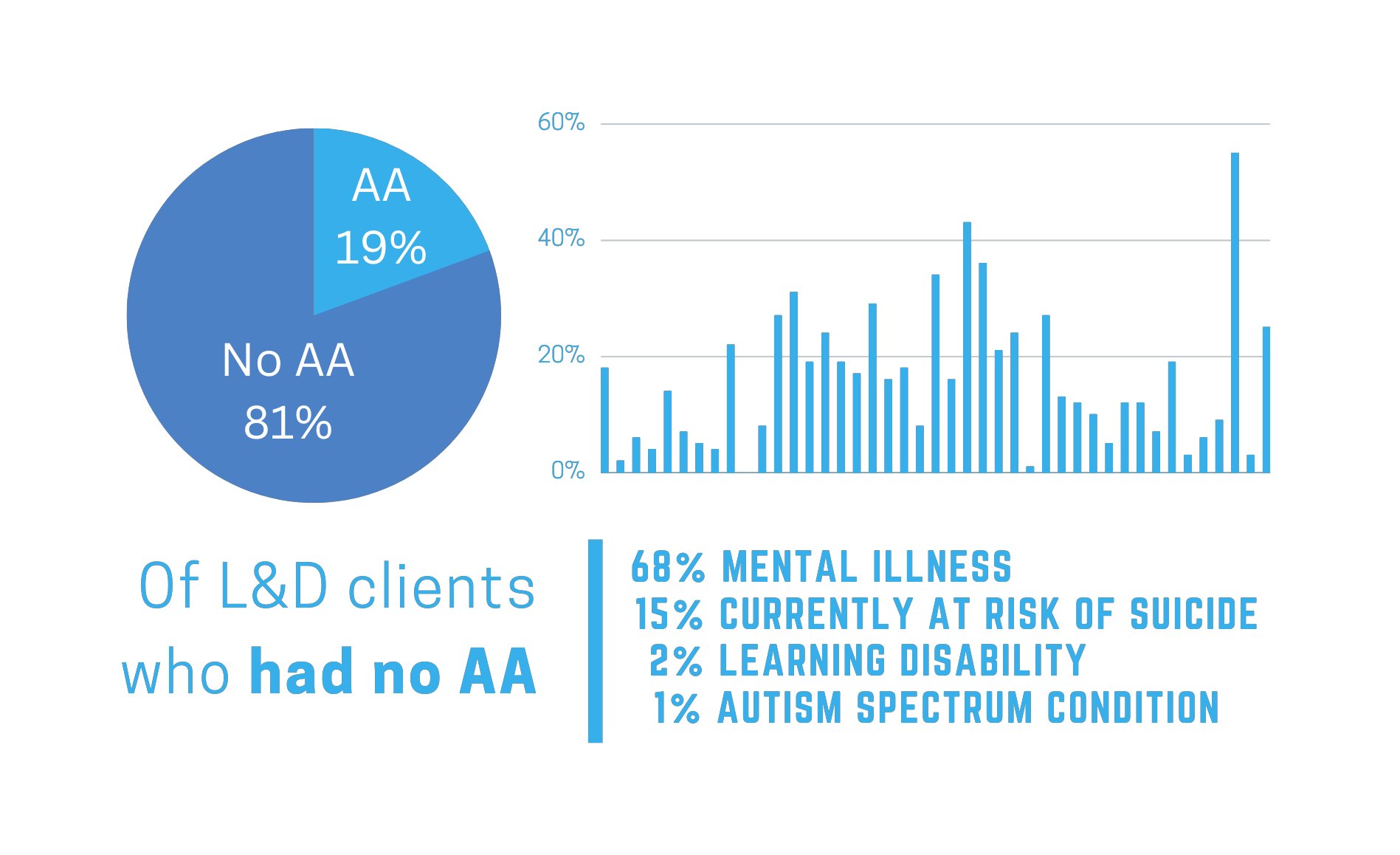
Every month, thousands of people with additional needs go unidentified when detained or questioned by police in England and Wales.

This means many people, including those with learning disabilities, mental illnesses, and neurodiverse people, do not get the support of an appropriate adult as required by law.

Read more

National Standards

Standards

The National Appropriate Adult Network develops and publishes the national standards for the development and provision of appropriate adult schemes in England and Wales.

The latest version has been approved by ADASS, the Youth Justice Board, and the Association of Police and Crime Commissioners.

Read more

About AAs

Information

The role of the appropriate adult is to safeguard the interests, rights, entitlements and welfare of children and vulnerable people who are suspected of a criminal offence, by ensuring that they are treated in a fair and just manner, and are able to participate effectively.

Discover more about the appropriate adult role, and find your local scheme.

Read more

Continue reading

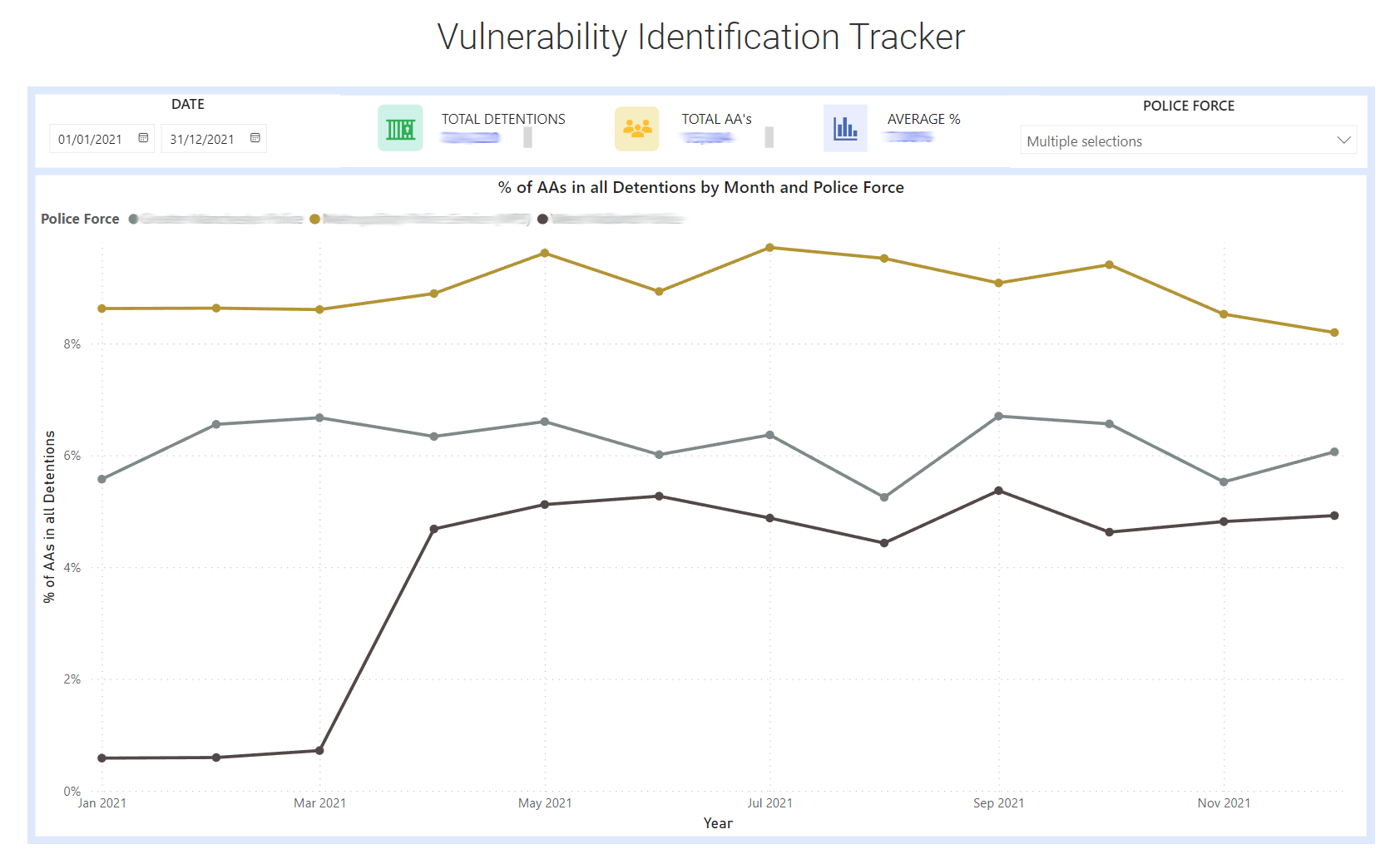
Vulnerability Identification Tracker

Police are required to secure an appropriate adult whenever they have reason to suspect that a person may be vulnerable.

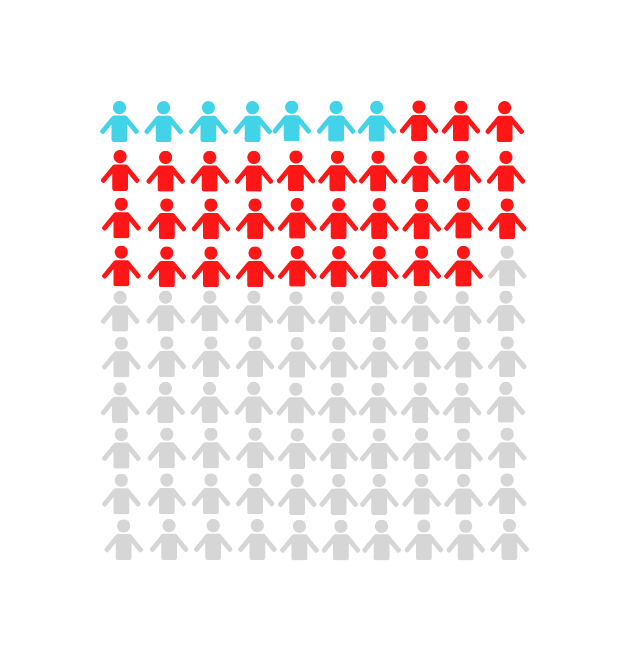
Studies indicate that 39% of adult detentions are of people with a mental illness or learning disability. The tracker indicates that many vunerable people are not being identified as needing an appropriate adult.

The Tracker

The Vulnerability Identification Tracker (VIT) is part of our identifying vulnerability work, and grew out of our There to Help research series. We want to help improve the identification and recording of 'PACE vulnerability', and the application of appropriate adults for vulnerable adults.

The VIT uses police data to show the percentage of adult detentions in which police called an appropriate adult. Where our research reports reflect what was known at the time, the VIT uses the best available data. 

The Tracker:

  • can take a few seconds to load
  • is best used on a laptop or desktop
  • is subject to change based on new data
  • is updated annually using national statistics.

The Vulnerability Identification Tracker was created free by digital transformation company UBDS. They didn't ask us to put this hyperlinked logo here. So we have. Our particular thanks to Andy Wakefield, Head of Business Intelligence.

Latest updates

  • May 2026 - click for details

    1. Updated data
    • Added data for 2024/25 from the official Home Office police custody statistics.
    • Replaced Warwickshire’s monthly data for 2021/22 to 2023/24, previously obtained through FOI, with annual data provided by Warwickshire OPCC, on the basis that it is more accurate. Home Office ADR data was retained for 2024/25.
    • The VIT is now based on almost 6 million detentions in England and Wales since 2017/18.
    • Benefit: Latest data now available
    2. Accessibility improvements
    • Moved the England and Wales average tracker to the first page.
    • Simplified chart titles to make each chart easier to understand.
    • Added legends and instructions to improve ease of use.
    • Replaced the retired geographical mapping system with more accessible colour coding to show lower rates, higher rates, and missing data.
    • Improved the accuracy of annual volume figures by avoiding month-level rounding before annual totals are aggregated for detentions and AAs.
    • Benefit: Easier to use and more accurate.
    3. Data quality
    • The VIT is now based on almost 6 million detentions in England and Wales since 2017/18.
    • Only two forces provided no data in 2024/25, compared with six in 2023/24 and ten in 2022/23. This returns data completeness to a level similar to that achieved through NAAN’s FOI collection in 2021/22. Durham has not provided this data since 2013/14. Humberside has not provided data to the Home Office since the collection began in 2022/23, although it did provide data to NAAN between 2019/20 and 2022/23.
    • All four Welsh forces provided data. Three recorded zero unknowns, while North Wales Police recorded 97% unknowns.
    • Of the 39 English forces, 37 provided data. Twenty-six recorded no unknowns. Among the remaining forces, the average unknown rate was over 90%; in NAAN’s analysis these cases are counted as “No AA required”.
    • Benefit: Data are more reliable
  • February 2026 - click for details

    1. Updated data
    • Data added for 2023/24 (from official statistics)
    • Data added for 2017/18 (from NAAN FOIs)
    • Additional data added for various forces and dates due to forces providing data after we published the relevant There to Help reports.
    • Benefit: Latest public data now available
    2. Use of financial years now used throughout
    • Data is clearly presented by financial year (e.g. 2023/24) rather than calendar year.
    • Users can still drill down to monthly detail if needed (limited to NAAN FOI data years 2017/18 to 2022/23).
    • Benefit: Reporting now aligns with how police forces now submit data to Home Office.
    3. Missing data returns are more visible
    • Where a force has not submitted data for a year, the chart shows a break rather than connecting the line.
    • Be aware that data points will not always be joined by lines (you will see a “floating dot” where there is no data for either the previous or next year).
    • Benefit: Gaps in submissions are transparent and cannot be overlooked.
    4. Consistent time range for fair comparison
    • The timeline no longer changes depending on which force is selected.
    • All forces are shown against the same overall reporting period.
    • Benefit: Clearer and fairer comparisons between forces, including in terms of missing data.
    5. Clearer national level comparisons
    • England & Wales (aggregated), Northern Ireland, and British Transport Police can now be compared.
    • Benefit: National level comparisons are now accurate and easier to interpret.
    6. England and Wales no longer includes British Transport Police
    • BTP has been removed from the main force comparison pages (the first three pages).
    • It is now only included alongside national averages on the dedicated comparison page.
    • Benefit: More accurate average figures for Home Office territorial forces, while still allowing BTP to be viewed transparently.
    7. Easier police force selection
    • Users no longer need to hold Ctrl to select multiple forces.
    • Search has been added to force selectors.
    • Benefit: Simpler and more intuitive filtering.
    8. Cleaner, more consistent layout
    • Clearer movement between the four pages with a tabbed navigator at the top.
    • Navigation buttons and slicers are now aligned across pages.
    • The overall structure is clearer and more consistent.
    • Benefit: A more professional and user-friendly experience.

Insights

Click below to discover insights generated by the Tracker. 

Found an interesting insight of your own? Share it with us at This email address is being protected from spambots. You need JavaScript enabled to view it. and we may add it here. 


England & Wales Average

National average above 9% for first time

How to view

  • Select the England & Wales Average page tab
  • Set the period from 01/04/2017 to 01/03/2025
  • Select area: England & Wales

Insight

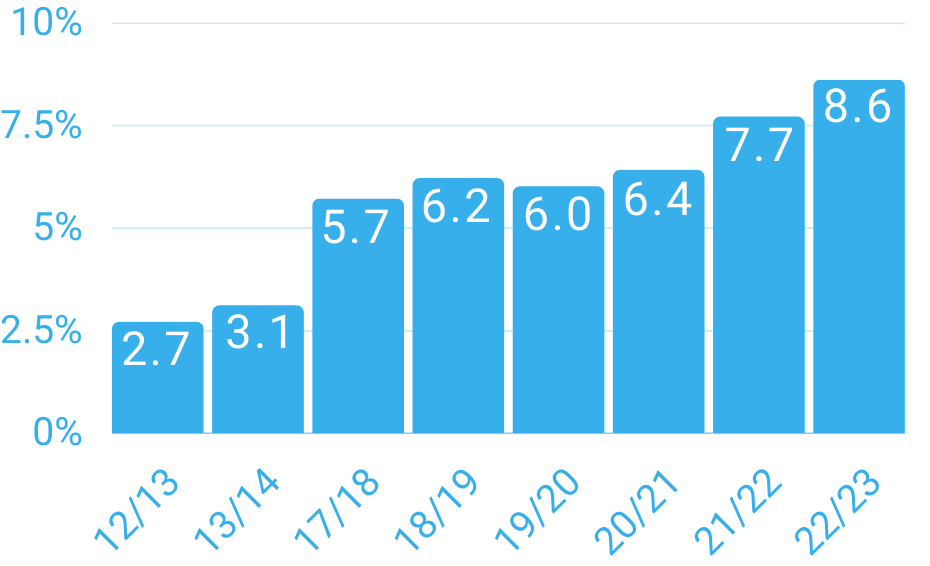
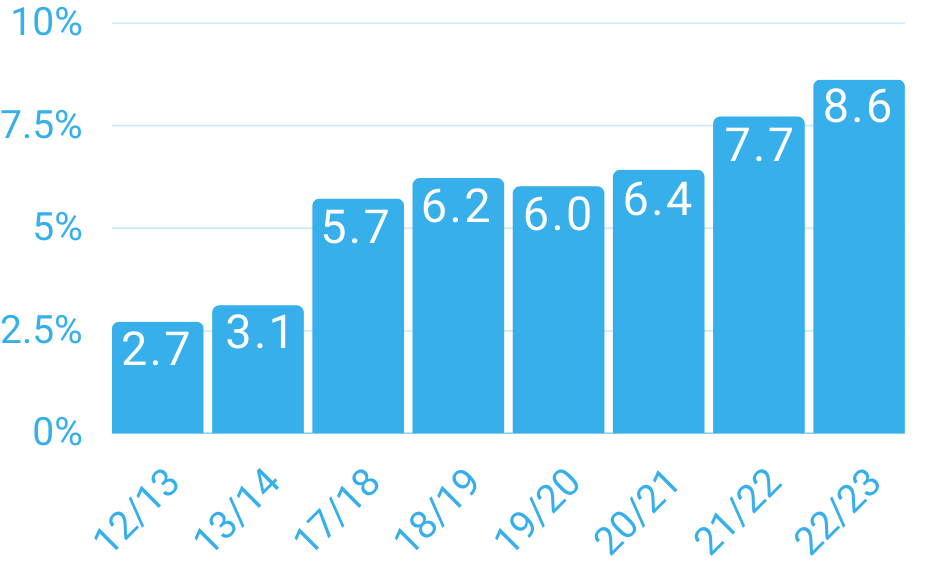
In 2024/25, police recorded calling an AA for 9.05% of adult detentions. After slowing slightly in 2023/24, the rate of change has increased again, . For reference, NAAN also holds data for 2012/13 and 2014/14, when the national average rates were 2.7% and 3.1% respectively. with research showing that 39% of adult detentions involve someone with a mental illness, learning disability or or neurodivergent condition, rates seem set to increase


Ranking & Map

  • Lincolnshire comes from 16th place to top rankings in 2025

    How to view

    • Select the National Ranking & Map page tab
    • Set the period from 01/04/2024 to 01/03/2025
    • Select all police forces

    Insight

    In 2024/25, the six highest recorded AA rates were in Lincolnshire (up from 16th), Cleveland (no change), Derbyshire (down from 1st), the Metropolitan Police (down from 3rd), Cumbria (no previous Home Office data), and Sussex (down from 4th).

    Four forces recorded AA rates of 18% or higher, compared with two in 2023/24.

    The lowest recorded rate in 2024/25 was 2.6%, up from 1.9% in 2023/24 and 0.3% in 2022/23.

  • Geographical clusters of forces with similar AA% rates

    How to view

    • Select the National Ranking & Map page tab
    • Select all police forces
    • Set the period from 01/04/2023 to 01/03/2024
    • Change the period to from 01/04/2024 to 01/03/2025

    Insight

    In 2023/24, a chain of forces across the south coast of England had AA% rates well above average. Devon and Cornwall, Dorset, Hampshire, and Sussex all had rates above 11% (compared to a national average of 8.66%). Kent sits at the end of the chain, with a rate just above 9%. Another chain of forces, this time with lower rates around or below 5%, runs in a thick belt from Norfolk through Suffolk, Essex and Hertfordshire, down to Surrey and West through Warwickshire Gloucestershire. This links up with North Wales, Dyfed-Powys, West Mercia and Cheshire, all also under 5%. In the North, a chain of forces from Cumbria, through Durham, North Yorkshire and Humberside, were all unable to provide AA data to the Home Office. 

    In 2024/25, reporting has improved in the North, leaving only two unconnected forces reporting no data. However, the "High South Coast" and Below Average Belt" patterns persist. 


    It may be that local forces are more likely to share mutual support, resources, or even culture.  

  • Detention volumes and AA% rates are both increasing

    How to view

    • Select the Volume v Identification page tab
    • Set the period from 01/04/2017 to 01/03/2024
    • Select the 11 police forces which provided data in all years fomr 2017/18 to 2024/25: 
      • Avon and Somerset Constabulary
      • Cheshire Constabulary
      • Dorset Police
      • Essex Police
      • Gwent Police
      • Merseyside Police
      • Metropolitan Police Service (MPS)
      • North Wales Police
      • Northumbria Police
      • Surrey Police
      • West Mercia Police
    • Observe the bar and line chart on the right hand side, showing detention volumes and AA identification rates

    Insight

    By choosing a sample including only forces that reported in every year, we can conduct a fair comparison of detention volumes. 

    Between 2017/18 and 2021/22, detention volumes slowly reduced from 299,000 to 271,000. Beyond this, they started to rise again, ending up broadly where they started at 294,000. 

    In contrast to this shallow V-shape curve, the proportion of detentions recorded as needing an AA first dipped to 6% in 2019/20, before rapidly increasing to a 'new normal' of around 10%.

    Vulnerability identification rates first fell as volumes fell, then rose as they continued to fall, and stayed high as volumes have increased. 

    Since 2021/22, vulnerability identification has strengthened despite growing volume pressures. This is positive, but creates a double demand effect for AA schemes: more detentions overall, combined with a higher proportion requiring an AA. This reinforces the importance of ensuring AA services have sufficient capacity to meet rising need.


Compare Forces (Bar)

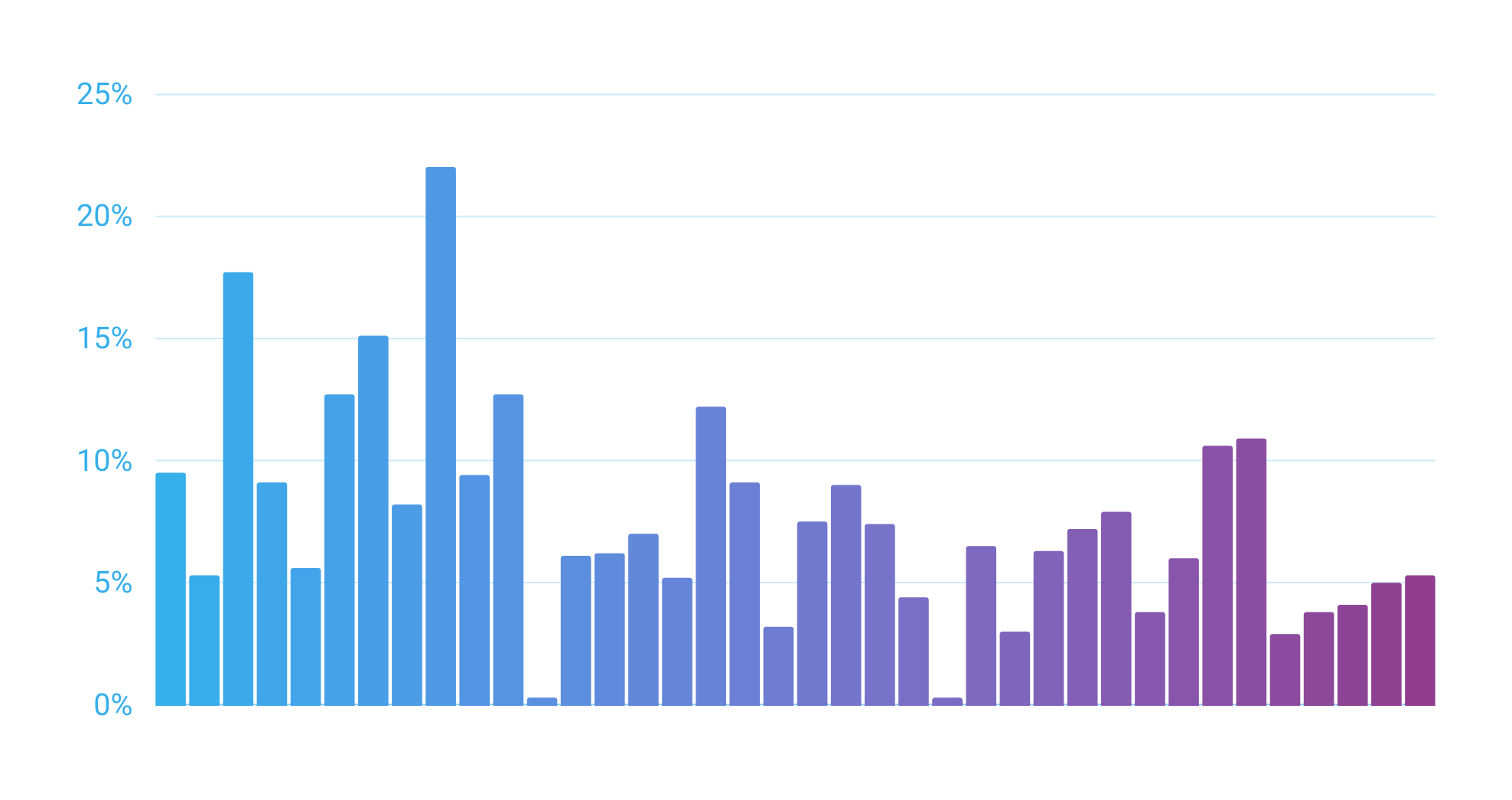
  • Lincolnshire and Derbyshire have highest increases since 2018/19

    How to view

    • Select the Compare Forces (Bar) page tab
    • Set the period from 01/04/2024 to 01/03/2025.
    • However over the chart on the right hand side.
    • Scroll up and down using the vertical scroll bar

    Insight

    Data are available for 2018/19 and 2024/25 for 34 forces. Around 70% of those forces saw some increase over that period. Of these, it increased most significantly in two forces: Linconshire (up 17.3%) and Derbyshire (up 14.8%). A further 6 forces increased their rates by more than 5%. 

  • Sussex, Cambridgeshire, Avon & Somerset down since 2018/19

    How to view

    • Select the Compare Forces (Bar) page tab
    • Set the period from 01/04/2024 to 01/03/2025.
    • However over the chart on the right hand side.
    • Scroll up and down using the vertical scroll bar

    Insight

    Between 2018/19 and 2024/25, the recorded AA rate reduced significantly in three forces: Sussex (-11.1%) Cambridgeshire (-5.5%), and Avon & Somerset (-4.9%) .

    Sussex's large reduction is slightly misleading. It experienced a very high, but short lived, peak in 2018/19 (the baseline year). After this its rate has ranged from around 11% to 14%, and it has always remained higher than Cambridgeshire and Avon & Somerset.

    To see these changes go to the Compare Forces (Line) page, set the start date to 01/04/2017, and select the three forces.


Compare Forces (Line)

  • Lincolnshire and Dyfed-Powys lead increases in 2024/25

    How to view

    • Select the Compare Forces (Line) page tab
    • Set the period from 01/04/2023 to 01/03/2025
    • Select Lincolnshire and Dyfed-Powys.

    Insight

    Between 23/24 and 24/25, the largest increase was in Lincolnshire, where the recorded AA rate rose from 7.5% to 20.0%.

    Dyfed-Powys recorded the second-largest increase, rising from historically very low rates (0.2% to 2%) to 9.4% (above the national average).

  • Big drops in Avon & Somerset, Staffordshire in 2024/25

    How to view

    • Select the Compare Forces (Line) page tab
    • Set the period from 01/04/2023 to 01/03/2025
    • Select Avon & Somerset and Staffordshire.
    • Then select the Ranking & Map tab

    Insight

    Between 23/24 and 24/25, the largest fall in recorded AA rates was in Avon and Somerset, where the rate dropped from 8.4% to 2.7%, raising questions about data quality. Staffordshire also saw a marked reduction, falling from its peak of 12.1% in 2023/24 to 7.8% in 2024/25, moving from 6th to 18th in the ranking.

  • Wales records 40% more demand in one year

    How to view

    • Select the Compare Forces (Line) page tab
    • Set the period from 01/04/2024 to 01/03/2025
    • Select Dyfed-Powys Police, Gwent Police, North Wales Police, and South Wales Police.

    Insight

    Across Wales, recorded demand for AAs increased by 40% between 2023/24 and 2024/25. This was driven by a 17% rise in detention volumes combined with an increase in the AA rate from 6.4% to 7.6%.

    This is much higher than in England where (among the 34 forces with data in both years) recorded demand for AAs increased by 11%, driven by a 4% rise in detention volumes and an increase in the AA rate from 8.8% to 9.5%.

  • Consistently high rates in Derbyshire, Cleveland and Met

    How to view

    • Select the Compare Forces (Line) page tab
    • Set the period from 01/04/2019 to 01/03/2024
    • Select Cleveland Police, Derbyshire Constabulary, and Metropolitan Police Service.

    Insight

    These forces consistently record some of the highest identification rates nationally. In 2024/25 Cleveland and Derbyshire were effectively at 20%, while the Met remains close below at 18%. Their sustained performance suggests strong identification processes and organisational focus on vulnerability.

  • Met consistently has highest rates of large forces

    How to view

    • Select the Compare Forces (Line) page tab
    • Set the period from 01/04/2017 to 01/03/2025
    • Select Metropolitan Police Service, Greater Manchester Police, and West Midlands Police.

    Insight

    Amongst the largest forces, the Met has consistently maintained the highest recorded vulnerabilty identification rate; always followed by GMP, then West Mids below.

    In 2021/22,West Minds increased its rate, almost converging with GMP, and since then rates within the the two forces have remianed fairly flat at between 4.8% to 6.3%.

    In constrast, the Met's rate increased significnatly, including a sharp rise between December 2021 (8.2%) and January 2022 (15.1%). This may relate to the introduction of structured vulnerability assessment approaches, showing how investment in identification processes can make a measurable difference.

  • Dyfed-Powys and Warwickshire break out of low rates (May 2026)

    How to view

    • Select the Compare Forces (Line) page tab
    • Set the period from 01/04/2017 to 01/03/2025
    • Select Dyfed-Powys Police, Hertfordshire Constabulary, Humberside Police, North Yorkshire Police, Northumbria Police, Warwickshire Police, and West Midlands Police.

    Insight

    These seven forces have historically recorded low identification rates, around or below 4%. BUt in 2024/25, Dyfed-Powys (9.4%) and Warwickshire (5.8%) broke out of the group. 

    It is unclear to what extent these low rates (and improvements) reflect data quality issues or differences in identification practice. This highlights why a robust, evidence-based approach to improving vulnerability identification remains an important national priority.

  • Wales: four forces, four different stories

    How to view

    • Select the Compare Forces (Line) page tab
    • Set the period from 01/04/2017 to 01/03/2025
    • Select Dyfed-Powys Police, Gwent Police, North Wales Police, and South Wales Police.

    Insight

    Welsh forces show striking variation. South Wales Police was increasing steadily but has seen a dip in the last two years. North Wales has remained broadly flat at around 4%, but again has taken a dip in 2024/25 and now has the lowest rates in Wales. Dyfed-Powys long had the lowest recorded rates across England and Wales, but saw the second-largest increase of all forces in 2024/25 and now above average. Gwent has remained at the top, fluctuating over time but also experiencing a significant increase in the last year, to remain top in Wales.

  • Close collaboration in Norfolk and Suffolk

    How to view

    • Select the Compare Forces (Line) page tab
    • Set the period from 01/04/2017 to 01/03/2025
    • Select Norfolk Constabulary and Suffolk Constabulary.

    Insight

    These two closely collaborating forces have annual AA rates that match almost perfectly. Both reached levels significantly above average in 2022/23. Then plunged to around half the national average in the following two years. This shows how shared systems and partnerships can produce similar outcomes. 

  • A tale of two Londons

    How to view

    • Select the Compare Forces (Line) page tab
    • Set the period from 01/04/2018 to 01/03/2025
    • Select Metropolitan Police Service and City of London Police.

    Insight

    Between 2018/19 and 2023/24, the rates in the two forces moved like mirror images. The Met historically recorded slightly lower identification rates. That switched in 2021/22 but the two forces remained within 2% of each other. In 2022/23 the Met recorded sharply higher rates (16.5%), while City's rate reduced just as sharply (2.7%). 

    The figures  for 2024/25 break the mirror-image mould with both forces increasing their rate. City has effectively returened to its 2018/19 rate at 9.5%, but an increase in the Met (18.1%) means its rate is still almost twice as high. 

    Despite operating in the same city, these forces are very different in terms of scale and the types of crime delt with. THis may explain different vulnerability rates, but perhaps not the wide variations over time. 

  • Sussex's record-breaking peak

    How to view

    • Select the Compare Forces (Line) page tab
    • Set the period from 01/04/2018 to 01/03/2025.
    • In the police force selector, choose Sussex Police only.
    • Click anywhere on the chart and use the drill-down button (double down arrows ) that appears in the top right of the chart to switch to monthly data view.

    Insight

    Sussex recorded the highest identification rate ever seen, averaging around 25% in 2018/19. Monthly data shows the true peak was far higher — almost 40%, with internal figures suggesting it briefly reached around 50%. This reflects a period when appropriate adults were embedded in custody, dramatically increasing identification. When this changed, rates fell sharply and stayed continuously flat. This demonstrates how operational practice can strongly influence identification rates.


Volume v Identification

  • Larger forces recording higher AA% rates on average

    How to view

    • Select the Volume v Identification page tab
    • Ensure all police forces are selected
    • Set the period from 01/04/2017 to 01/03/2018 and observe the dotted trendline on the scatter chart (left side)
    • Then change the period to 01/04/2024 to 01/03/2025 and observe how the trendline has changed

    Insight

    In 2017/18, there was almost no relationship between detention volume and AA identification rates. Larger and smaller forces recorded broadly similar rates, with no clear pattern.

    By 2024/25, a slightly clearer positive relationship has emerged, with larger forces tending to record higher identification rates.

    This suggests that higher custody demand does not prevent effective identification of vulnerability. Larger forces may now have stronger processes, training, or access to better funded AA provision, enabling more consistent application of the safeguard at scale.

  • Detention volumes and AA% rates both increasing

    How to view

    • Select the Volume v Identification page tab
    • Ensure all police forces are selected
    • Set the period from 01/04/2017 to 01/03/2025
    • Observe the bar and line chart showing detention volumes and AA identification rates

    Insight

    Across the 38 forces that provided data in both 2023/24 and 2024/25, recorded demand for AAs increased by 12.5%, from 65,649 to 73,859. This reflected both higher adult detention volumes (up 4.5%) and an increase in the recorded AA rate from 8.7% to 9.3%.

    Custody demand has increased significantly, and the proportion of cases where an AA was called has increased even more rapidly.

    Identification rates have risen , rather than falling as demand increased. This indicates that vulnerability identification has strengthened despite growing operational pressure.

    However, this creates a double demand effect for AA schemes: more detentions overall, combined with a higher proportion requiring an AA. This reinforces the importance of ensuring AA services have sufficient capacity to meet rising need.

How to

  • Move between the report pages

    Use the navigation tabs at the top of the report to move between the pages:

    1. England & Wales Average
    2. National Ranking & Map
    3. Compare Forces (Line)
    4. Compare Forces (Bar)
    5. Volume v Identification

  • Select a time period

    Use the date selector at the top left of the report. You can either:

    • Enter your preferred start and end dates; or
    • Use the calendar icons to browse to a differnt year, month and day.

    Notes:

    • The earliest available data are from April 2017. If you set a start date before this, the report will include data from April 2017.
    • The latest data currently available are annual totals for 2024/25. If you select an end date of 1st March 2025 or later, all data for 2024/25 will be included. 
    • By default, data are presented by financial year (April–March). However, for some years, you can 'drill down' to monthly detail (see below for how to drill down).
    • There is no day-level data. However, each month's data is registered on the 1st day of the month, so any day in April will include all of the data for the month of April.
    • To ensure accurate financial year results, make sure you pick a start date in April and an end date in March.
  • Select one or more police forces

    Click the drop-down box labelled "2. Select police forces(s)".

    If you wish to view all the available data:

    • Click to tick the "select all" box (this is the default view)

    If you wish to view data for a single force:

    • Click to untick the "select all" box (this is the default view)
    • Start typing the name of the force in the search bar (just above "select all")
    • Or scroll down and click to tick the force

    If you wish to view data for multiple forces at the same time:

    • Click to untick the "select all" box (this is the default view)
    • Scroll down and click to tick each force (the report will instantly update as you add forces)
    • Click to untick a force if you wish to remove it.
  • Compare England & Wales with NI and BTP

    Select page "England & Wales Average"

    The default view shows the annual average for all Home Office territorial forces combined. 

    Click the drop-down box labelled "2. Select area(s)" to compare England & Wales with:

    • Northern Ireland

    • British Transport Police

    You can drill down to a monthly level for some time periods (see "How to drill down")

  • Drill down to monthly data

    The reports now default to annual data. This is because from the financial year 2023/24 only annual data are available (via Home Office statistics).

    Prior to 2023/24, NAAN secured monthly data from forces via the Freedom of Information Act. These monthly data are still available in the report via "drill down". 

    In years where only annual data are available (2023/24 onwards) the monthly data will show as a flat line. This is because we have averaged the annual totals across 12 months - so this is not accurate at the month level).

    Forces have the option to provide us with corrected data. If they provide us with accurate annual totals we use them to replaced erroneous monthly data. Again, we have averaged these across the months.

    There are two ways to drill down, depending on what you want to see. 

    If you want to see the monthly data for a specific year

    1. Choose the Compare Forces (Line) or England & Wales Average report page
    2. Select the force(s) you want to see
    3. Right click on the data point (the node connected by lines) for the year you want to drill down into
    4. A menu will appear by the data point
    5. Left click "drill down"
    6. The x axis will now show each month for the year that you clicked on.

    If you want to see all the monthly data for a specific force (or group of forces)

    1. Choose the Compare Forces (Line) or England & Wales Average report page
    2. Select the force(s) you want to see
    3. Left click a blank space on the report (not on a data point)
    4. A menu will appear in the top right corner of the report (under the NAAN logo and Vulnerability Identification Tracker title) with various arrows.
    5. Click the double arrows pointing down to drill down to monthly data. The X axis will change to monthly
    6. The x axis will now show each month for all the years for which there is data 
    7. A scroll bar will appear at the bottom of the screen - move this to the right to see later months.
    8. Click the single up arrow (first button) to drill back up to annual data.

    About the tracker

    • What is the tracker?

      The Vulnerability Identification Tracker illustrates the extent to which each police force (and all police forces as a whole) apply the appropriate adult safeguard to adult detentions. 

      It shows the percentage of adult detentions in custody in which the police recorded that they called an appropriate adult. 

    • What can I do with the tracker?

      Subject to the limitations below, here are some of the things you can use the vulnerability identification tracker for:

      • identify opportunities for development in your local police force
      • see whether identification is changing over time (locally or nationally)
      • track the impact of any changes being made (e.g. new training)
      • compare multiple police forces in a particular geographical area
      • compare multiple police forces that are a similar size
      • compare the averages in England and Wales with Northern Ireland.
    • What information does it provide?

      The tracker has five pages. Use the tabs along the top to move between them. Every page has the same two controls: a period selector and an area or police force selector. Every page also shows three summary figures for whatever you have selected: total adult detentions, total AAs called, and the AA rate (AA%), which is the percentage of adult detentions in which police recorded calling an appropriate adult.

      1: England & Wales Average

      A line chart of the AA rate for England and Wales as a whole, by financial year. You can add British Transport Police and Northern Ireland to compare them with the England and Wales average. For 2017/18 to 2022/23 you can drill down to monthly data (see "Drill down to monthly data" in the How to guide).

      2: Ranking & Map

      Two linked views for your chosen period. On the left, police forces are ranked from the highest AA rate to the lowest. Click a force to highlight it on the map. On the right, a map of police force areas is shaded by AA rate: darker blue means a higher rate, and grey means the force provided no data for the selected period. Hover over or click an area to see its rate.

      3: Compare Forces (Line)

      A line chart showing how the AA rate has changed over time in one or more police forces. Where a force did not provide data for a year, the line is broken rather than joined, so gaps in reporting are visible. As on page 1, you can drill down to monthly data for 2017/18 to 2022/23.

      4: Compare Forces (Bar)

      Two bar charts. On the left, the AA rate for each selected force in your chosen period. On the right, the change in each force's AA rate since 2018/19, shown in percentage points. Forces with no data for 2018/19 are not included in the right-hand chart. To see the latest change, select the most recent financial year (for example, 01/04/2024 to 01/03/2025).

      5: Volume v Identification

      Two charts exploring whether the AA rate is related to how busy custody is.

      On the left, each dot is one police force in one financial year, plotted by its number of adult detentions and its AA rate. The dotted trendline shows the overall relationship: if it slopes upwards, forces with more detentions tend to record higher AA rates; if it slopes downwards, they tend to record lower rates; if it is flat, there is no clear relationship. If you select a single force, each dot shows that force in a different year.

      On the right, bars show total adult detentions and the line shows the AA rate for each financial year. Detentions are only counted for forces that also provided AA data, so this chart does not follow a fixed group of forces over time.

    • Where are the data from?

      Financial years 2018/19 to 2022/23

      Data were provided by police forces to NAAN, in response to requests made under the Freedom of Information Act 2000 (FOIA). Police force responses are available via WhatDoTheyKnow.com. Data up to March 2019 was previously published in There to Help 3 (2019). Data from April 2019 has not previously been published. 2022/23 was the last year that NAAN collected monthly data via FOI due to the inclusion of annual data in the ADR (see below)

      Financial years 2023/24 onwards

      Data were provided by police forces to the Home Office as part of the Annual Data Requirement informing the Police powers and procedures England and Wales statistics. These data are annual only (there are no month level data). Reporting on AAs started in 2022/23 however we have preferred the FOI data provided to NAAN in this cross-over year, as this was provided at the monthly level.

      Force updates

      Where a police force identifies that data provided to NAAN (via FOI) or the Home Office (via the ADR) was poor, and can provide higher quality data, this will be used instead even if it requires the use of annual data over monthly data. See "What are the data limitations" below.

    • What are the data limitations?

      No data on children

      The VIT does not include any data related to children (under 18 years). All children must have an AA by virtue of age.

      National statistics indicate that in 2023/24, an appropriate adult was called for 98% of child detentions.

      Data relating to AA involvement

      The VIT aims to understand the extent to which the AA safeguard is being triggered. In practice, there are several stesp in this chain, including the prevalance of relevant conditions, identification of a person as vulnerable, recognition that this equates to vulnerability as defined by PACE Code C, the calling of an AA, the arrival of an AA, and the recording of the above.

      For simplicity, we have sought to focus on whether the police recognised the need to apply the AA safeguard.

      Where data were obtained via FOI Act requests, our request was for the "total number of authorised detentions of adult suspects (aged 18 or over) in which the need for an appropriate adult (under PACE Code C) was recorded in that month".

      With the switch to official statistics, the Home Office now ask police to report separately on:

      1. Adults in custody by whether they were considered vulnerable
      2. Vulnerable adults in custody by whether an appropriate adult was called

      We have assumed that the police contacted an AA for all adults for whom they considered there was a need. Therefore we have treated the second figure as equating to the question we asked under the FOI Act.

      This means that the VIT does not show the percentage of adult detentions:

      • which involved an adult who had some form of vulnerability
      • which involved a vulnerable adult as defined by Code C 1.4 and 1.13(d)
      • where an appropriate adult arrived
      • where police called an AA but did not record this in the custody record.

      It is possible that, in some cases, the need for an appropriate adult was recorded but no appropriate adult was secured. It is also possible that in some cases an appropriate adult was secured but this was not recorded. We have assumed that the net effect of any such cases is not material.

      Lack of any data for some forces in some periods

      Some forces were not able to provide monthly data on adult detentions (detention data) and recorded need for appropriate adults (AA data) for every period.

      Lack of AA data for some forces for some periods

      Where detention data were available, but AA data were not available, we have not included the detention data. This means that the tracker will not always give accurate detention data.

      Lack of month level data for some periods for some forces

      During the NAAN FOI period (2017/18 to 2022/23) most forces provided month-level data. However, some forces (e.g. North Yorkshire, Nottinghamshire) were only able to provide annual total figures.

      When these data became official national statistics (2022/23 onwards) only annual totals are available for all forces.

      Where only annual totals are available, we have averaged the total detentions and appropriate adults across the 12 months of the year. While this remains accurate at the annual level, it is not accurate at the month level. This averaging is clear when the chart is in 'drill down' mode as it it will show as a flat line throughout the year.

      Impact of IT systems

      Our research indicates that the choice of custody IT systems has a statistically significant effect on the recorded vulnerability identification rate.

      Some changes in reported recorded need will be the result of changes in custody IT systems. Such changes can impact the quality of both data recording and reporting. For example, Greater Manchester Police reported very low AA need in April-June 2019 before seeing a significant increase; the forces stated in it's FOI response that "In July 2019, GMP implemented one of the largest IT infrastructure changes in UK policing".

      For further information about data limitations, see There to Help 3 (2019) and individual FOIA responses.

      Differences between FOI and Official Statistics in 2022/23

      2022/23 was a 'crossover' year in which we have both NAAN FOI (monthly) data and Home Office (annual) data.

      On comparison, these data do not match up perfectly for all forces.

      • Several forces did not supply data to the Home Office despite haivng provided it to NAN under FOI.
      • One force (Hampshire) provided data to the Home Office but had not provided it to NAAN
      • The total monthly figures provided to NAAN do not all equal the total annual figure provided to the Home Office.

      We have generally preferred NAAN FOI data for 2022/23 in order to take advantage of:

      • higher number of forces that provided data
      • month-level data
      • higher totals (which we assume are more accurate).

      This generally favoured higher RVIRs (AA%). In most cases differences were less than 2%, although with the national average aorund 8% this is relevatively significant.

      Several forces had RVIR rates that were much higher in the NAAN data versus the Home Office data, prompting further analysis:

      • Lancashire (11.9% v 4%)
      • Northamptonshire (15% v 7.6%)
      • West Midlands (4.2% v 0.1%).

      In a small number of forces we switched to Home Office data instead in order to increase accuracy:

      • Bedfordshire's AA totals in the NAAN data were significantly lower than in the Home Office data, and out of line with previous and future years
      • Hampshire provided Home Office annual data but had been unable to provide NAAN with data
      • Lancashire provided NAAN with monthly detention totals that were clearly too low (with reference to separate arrest statistics)
      Updates from police forces

      Where we are informed that data provided to NAAN via FOI or the Home Office via the ADR is significantly inaccurate, we request corrected data from the police force or PCC. If this is available and verifiable, we update the data from the new source.

      The following forces have provided revised data:

      Warwickshire

      Data source: Office of the Police and Crime Commissioner

      Data replaced: 2021/22 and 2022/23

      Data supplied: 28.04.2026

      Notes: The OPCC also provided data for 2023/24 but as this was not supplied for the ADR there were no data to replace.

       
    • Visiting on a mobile device?

      The tracker can be used on mobile. However, you will

      • not have the ability to select multiple police forces
      • may find it difficult to see and navigate the tracker

      We recommend turning your device to landscape mode, and using a keyboard where possible (so that you can hold down Ctrl/Command)

      We recommend using a computer. 

    • What if I think the data are incorrect?

      Unlike our published reports, the VIT is intended to hold the best available data. If you believe the data are incorrect and better data are available, please email us at This email address is being protected from spambots. You need JavaScript enabled to view it.. 

    Interested in knowing more ...?

    Identifying vulnerability

    Policy

    Every month, thousands of people with additional needs go unidentified when detained or questioned by police in England and Wales.

    This means many people, including those with learning disabilities, mental illnesses, and neurodiverse people, do not get the support of an appropriate adult as required by law.

    Read more

    Vulnerable people

    Policy

    We're are not just working on identification. Did you know that while local authorities have a legal duty to provide an appropriate adult for children, there's no equivalent duty to provide one for vulnerable adults?

    Click below to find out more, and catch up on our latest activities, updates and media.

    Read more

    About AAs

    Information

    The role of the appropriate adult is to safeguard the interests, rights, entitlements and welfare of children and vulnerable people who are suspected of a criminal offence, by ensuring that they are treated in a fair and just manner, and are able to participate effectively.

    Discover more about the appropriate adult role, and find your local scheme.

    Read more

    Continue reading

    PACE vulnerability videos

    A suite of training videos focused on the concept of a 'vulnerable person' under the Police and Criminal Evidence Act 1984.

    These videos are designed to support learning, whether it is formal or informal, tutor-led or self-directed. They can be used with a range of professionals, including: 
    • police officers
    • police staff
    • healthcare staff
    • liaison and diversion staff
    • appropriate adults
    • lawyers
    • intermediaries

    Watched the videos?

    Send us your feedback

    "I am incredibly impressed (and grateful) for the vulnerability videos and vulnerability tracker on your website. I delivered the vulnerability input on the Custody Sergeant course this morning for 2 hours and used all of the videos. Really good feedback from the delegates and love the product. They are so good that I have instructed our training team to use exclusively on the ongoing Custody Officer course (and going forward).  I have also asked the investigation improvement lead to consider including them on the Detective PIP2 development course. Thank you for producing these and for your ongoing commitment to ensuring detainee’s needs are catered for".

    Inspector Anton Menzies (Custody Performance & Governance, South Yorkshire Police)

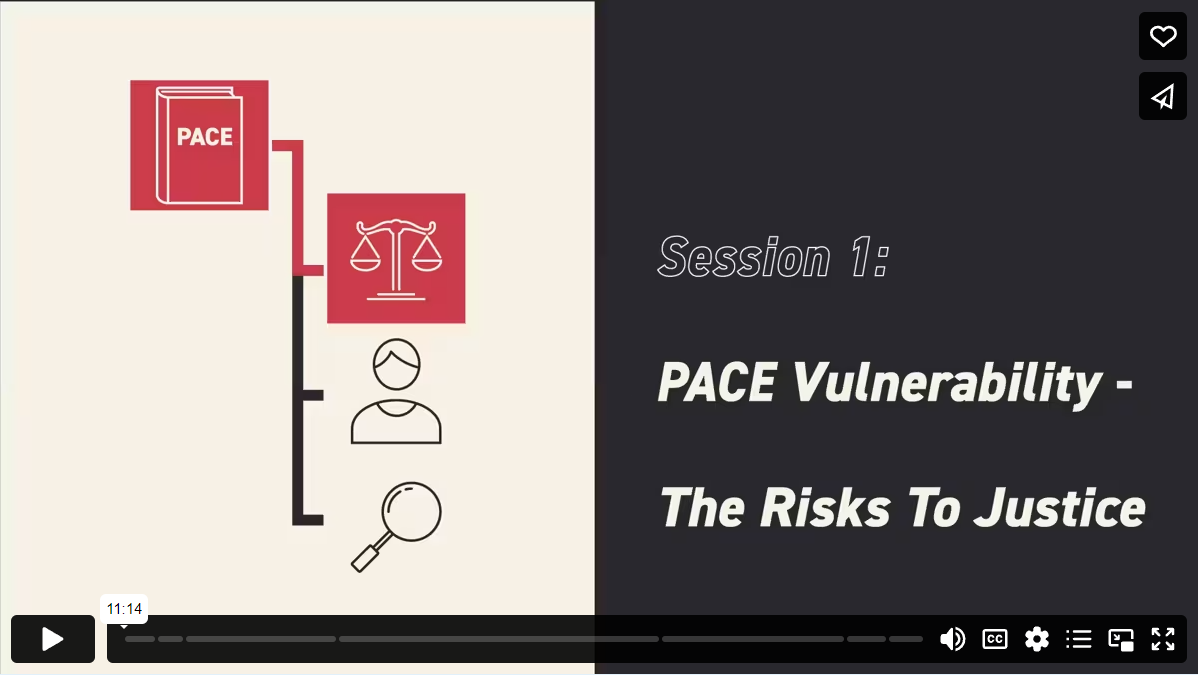
    1: The risks to justice

    This session:

    • highlights the importance of understanding and applying the PACE vulnerability provisions in order to safeguard justice
    • explains how certain conditions and contexts can make people and investigations vulnerable to unreliable evidence, which can lead to miscarriages of justice or failed prosecutions
    • highlights cases where individuals defined as vulnerable under PACE did not have an appropriate adult present
    • emphasises the need for appropriate support, such as appropriate adults, to ensure fair and reliable evidence and prevent injustices in the criminal justice system

    2: Defining PACE vulnerability

    This session:

    • focuses on the definition of a "vulnerable person" in PACE and when the appropriate adult safeguard is required
    • highlights that the phrase "vulnerable person" can have different meanings in different contexts and explains that PACE defines vulnerability based on the reliability of evidence
    • emphasizes that PACE vulnerability can arise from various factors and can change over time.
    • explains the functional and dynamic nature of the PACE vulnerability definition
    • provides examples of the six vulnerability factors outlined in PACE, along with associated psychological phenomena and conditions.

    3: Identifying PACE vulnerability

    This session:

    • focuses on identifying PACE vulnerability in practice
    • explores the role of police officers and staff, healthcare, liaison and diversion, and other professionals, in the identification process
    • provides guidance on sources of relevant information about potential PACE vulnerability.

    Watched the videos?

    Send us your feedback

    Frequently Asked Questions

    • Who created these videos?

      The project was a partnership between Dr Roxanna Dehaghani of Cardiff University and the National Appropriate Adult Network. 

      • Script and voiceover by Chris Bath and Dr Roxanna Dehaghani. 
      • Ilustration by Scott Spencer.
      • Animation by John Brown.
    • Does my organisation need permission to use the videos?

      Our PACE vulnerabililty videos are freely available online to all users.

      But please This email address is being protected from spambots. You need JavaScript enabled to view it. to let us know you're using them and how. 

    • How can I give you feedback?

      We'd love to hear feedback from anyone about the videos, especially what difference they have made to professional practice. Just click here to complete a short feedback survey. 

    • Visiting on a mobile device?

      We recommend turning your device to landscape mode and selecting the expand icon (bottom right of each video)

    Other PACE vulnerability resources

    Being an appropriate adult

    This session:

    • focuses on the role of the appropriate adult as defined in PACE 1984 and Code C
    • explores the purpose and objectives of the AA function in safeguarding the interests of a vulnerable suspect
    • explains how AAs can achieve their objectives through a range of rights and powers

    This video was created in partnership with Dr Miranda Bevan, to help inform family members (and other untrained AAs) about the role. It can be shared by police forces when asking a family member to act as AA, and included in the training of officers and staff.

    PACE vulnerability and AAs

    The slide deck for the training session upon which the PACE vunerability videos were based.

    What defines vulnerable?

    A simple video setting out the definition of vulnerability in PACE Code C from 2018 (2 minutes)

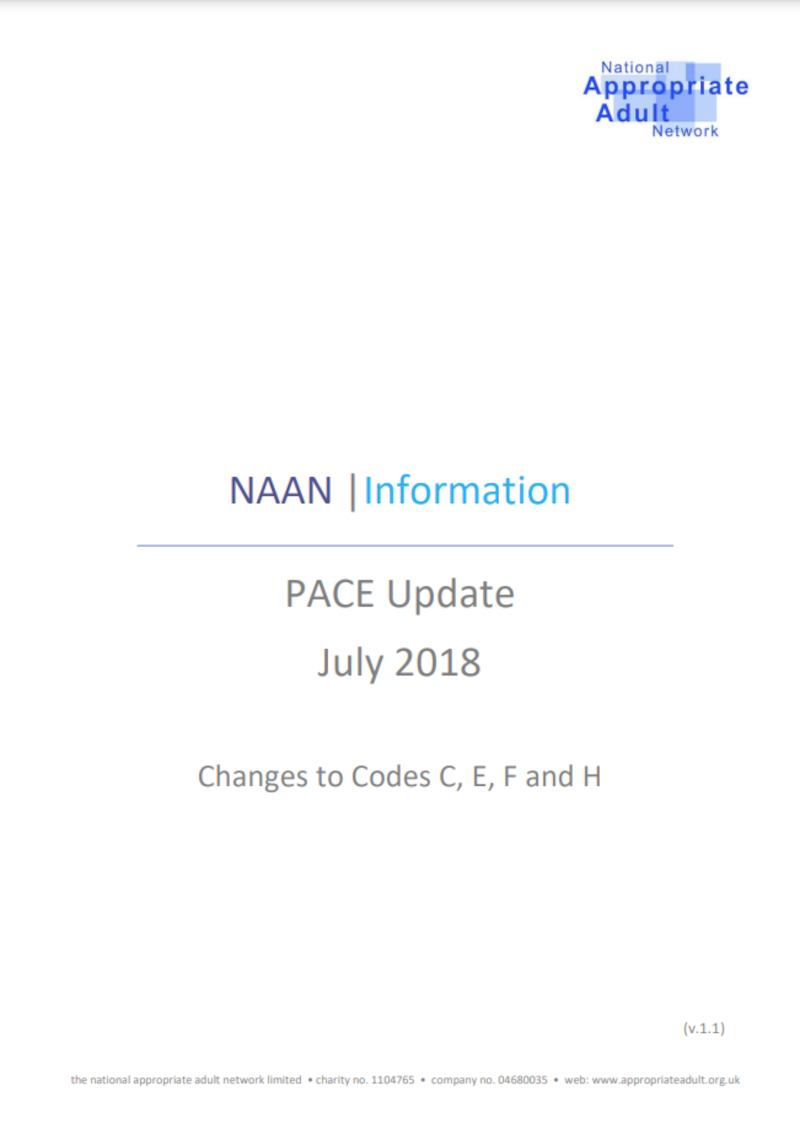
    NAAN PACE update (July 2018)

    A comprehensive guide to the changes to PACE vulnerability in 2018

    Criminal Law Review

    A detailed article aimed at lawyers and legal academics

    Interested in knowing more ...?

    Identifying vulnerability

    Policy

    Every month, thousands of people with additional needs go unidentified when detained or questioned by police in England and Wales.

    This means many people, including those with learning disabilities, mental illnesses, and neurodiverse people, do not get the support of an appropriate adult as required by law.

    Read more

    Vulnerable people

    Policy

    We're are not just working on identification. Did you know that while local authorities have a legal duty to provide an appropriate adult for children, there's no equivalent duty to provide one for vulnerable adults?

    Click below to find out more, and catch up on our latest activities, updates and media.

    Read more

    About AAs

    Information

    The role of the appropriate adult is to safeguard the interests, rights, entitlements and welfare of children and vulnerable people who are suspected of a criminal offence, by ensuring that they are treated in a fair and just manner, and are able to participate effectively.

    Discover more about the appropriate adult role, and find your local scheme.

    Read more

    Continue reading

    Identifying vulnerability

    Every month, thousands of people with additional needs go unidentified when detained or questioned by police in England and Wales.

    This means many people, including those with learning disabilities, mental illnesses, and neurodiverse people, do not get the support of an appropriate adult as required by law.

    The challenge

    Some people are at greater risk of unfairness

    Some people experience significant barriers to effective participation in police custody or voluntary interviews conducted under the Police and Criminial Evidence (PACE) Act 1984. 

    Disabling barriers can lead to miscarriages of justice and failed prosecutions.

    PACE Code C defines a 'vulnerable person' as one that may:

    • be highly suggestible or eager to please
    • become confused
    • have difficulty understanding the implications of police procedures and processes
    • have difficulty understanding or the significance of what they are told, of questions they are asked or of their replies.
    • not understand or be able to exercise their rights and entitlements.

    Unfairness has consequences

    This may be for a wide range of reasons, for example, learning disabilities, mental health conditions, menopause, and neurodiversity (eg. ADHD and autism), combined with context and circumstance.

    This does not mean people are not capable of providing evidence. It means that if their needs are not met:

    • their rights may not be fully respected
    • their welfare may be harmed
    • their ability to participate effectively may be limited.

    This can lead to unreliable information being obtained, including false confessions.  In turn, this can lead to a  miscarriage of justice or a failed prosecution.

    Appropriate adults are a mandatory safeguard

    Appropriate adults protect a vulnerable person's interests, including their rights, welfare and participation. 

    An appropriate adult is mandatory whenever police detain or interview a person who they have 'reason to suspect' may be vulnerable. 

    The person who acts as the appropriate adult must be independent of the police. The police cannot provide the appropriate adult.

    There are many tasks that police may not carry out without an appropriate adult being present. These include interviews, identity procedures, and some forms of search.

    Failure to secure an appropriate adult may result in evidence being ruled inadmissible in court.  

    Identifying the need for an AA is challenging

    The PACE definition of a 'vulnerable person' is complex (as you can see from the video below). Identifying who it applies to would be a challenge for psychologists and psychiatrists using detailed assessments. Police officers often have very limited tools and training in this area, relying in their instincts, experiences and judgement.  


    • Most vulnerable people are not identified as needing an appropriate adult

      Estimates on the number of people who are 'PACE vulnerable' have varied. 

      Clinical research (McKinnon and Grubin, 2013) has shown that of detentions of adults by the Metropolitan Police Service 39% involved a person with a mental disorder* and 25.6% involved a person with psychosis, major depression, intellectual disabilities, or who researchers felt lacked capacity to consent to a questionnaire.

      *In this context 'mental disorder' includes psychosocial disabilities (mental illness), learning disabilities, personality disorders, and autism, as per the Mental Health Act 1983 Code of Practice. 

      However, our There to Help research shows these prevalence rates are not reflected in police recorded need for an appropriate adult. For every 100 adult detentions in England and Wales in 2021, only 7 were recorded by police as needing an appropriate adult. This has increased since - but only slightly. 

      McKinnon and Grubin found that without access to specialist evidence-based tools, police (and unsurprisingly) significantly under-identified mental disorders amongst adults in custody. 

    • Chart: Adult detentions recorded as needing an appropriate adult by each force in 2021 (Source: Police forces)

      Image: Illustration of the percentage of adult detentions of people with a mental disorder [red] versus for whom the need for an appropriate adult was recorded in 2021 [blue]. (Sources: McKinnon and Grubin 2013; Freedom of Information Act requests)


    • Identification rates vary greatly between forces

      Our There to Help research has also found that recorded need for appropriate adults in adult detentions varies hugely across police forces. 

      In 2021, we obtained data from police forces in England and Wales. The average rates ranged from 22% down to just 0.3% of adult detentions.

      Even allowing for local population differences, this indicates that many people are not being identified.

    • Chart: Adult detentions recorded as needing an appropriate adult by each force in 2021 (Source: Police forces)

      Chart: Adult detentions recorded as needing an appropriate adult by each force in 2021 (Source: Freedom of Information Act requests)

      Compare forces


    • Identification is only part of the challenge

      Liaison and Diversion (L&D) services identify vulnerability in police custody, and give advice to police decision-makers. Data from NHS England indicates that, in 2018/19:

      • 68,581 adults engaged with L&D due to mental ill health, learning disabilities and other vulnerabilities.
      • Of these people, police had secured an AA for only 1 in 5 (19.4%)
      • There were large local variations between areas
    • Chart: (a) Percentage of people with identified vulnerabilities engaging with L&D who also had an AA; (b) Percentage by L&D area; (c) Information about L&D clients in police custody for whom an AA was not secured (Source: There to Help 3 / NHS England)

      Chart: (a) Percentage of people with identified vulnerabilities engaging with L&D who also had an AA; (b) Percentage by L&D area; (c) Information about L&D clients in police custody for whom an AA was not secured (Source: There to Help 3 / NHS England)

      Read more


    • Identification varies by condition

      Data from NHS England's Liaison and Diverson services show that expert identification of conditions does not always mean that police will secure an appropriate adult. 

      It also shows that certain conditions are much more closely associated with people getting an appropriate adult. 

      Some of the conditions most likely to get an AA are ones that are rarely recorded, such as dementia. While some more common conditions, such as depression, are unlikley to result in an AA. 

    • Chart: Adult detentions recorded as needing an appropriate adult in custody in 2017/18, by availability of AA schemes  (Source: There to Help 2, 2019)

      Chart: Adult Liaison and Diversion cases in police custody during 2016/17 in which a mental health diagnosis was identified and it was known whether or not an AA was used (Source: There to Help 2, 2019 p.65)

      Read more


    • Identification is lower if there is no AA scheme

      The challenge of identification (or at least recording) is llinked to the availabiilty of approrpiate adult support. 

      There to Help 2 (2019) evidence that, in relation to custody, police are half as likely to record the need for an AA where there is no organised AA scheme for adults.

      Though the requirement on police is the same, local authorities have a statutory duty to provide an appropriate adult when needed for a child, but not for a vulnerable person.  

    • Chart: Adult detentions recorded as needing an appropriate adult in custody in 2017/18, by availability of AA schemes  (Source: There to Help 2, 2019)

      Chart: Adult detentions recorded as needing an appropriate adult in custody in 2017/18, by availability of AA schemes (Source: There to Help 2, 2019)

      Read more


    • Identification is lower in voluntary interviews

      There are clear benefits for children and vulnerable adults attending voluntary interviews, wherever detention is not necessary. However, there are also increased risks that the process will not be fair.

      Compared to custody officers, investigating officers may be less familiar with how to identify vulnerable people, and the relevant safeguards.

      Our There to Help research indicates that adults who attend voluntary interviews are much less likely to be recorded as needing an appropriate adult. 

    • Chart: Adult detentions recorded as needing an appropriate adult in custody and voluntary interviews in 2018/19 (Source: Police forces)

      Chart: Adult detentions recorded as needing an appropriate adult in custody and voluntary interviews in 2018/19 (Source: There to Help 3, 2020)

      Read more


    • Identification is improving...slowly

      There is still a long way to go but things are improving. 

      Since we began raising awareness through our first There to Help report in 2015, recorded need for appropriate adults has been improving. 

      In 2012/13, police forces recorded the need for an AA in only 2.7% of adult detentions. By 2021 this had risen to 7.3%. 

      But that is still far below the best available evidence on how many people meet the criteria for support. 

      With the launch of our new tracker and training videos (below), we're looking forward to accelerating that change. 

    • Chart: Adult detentions recorded as needing an appropriate adult in England and Wales 2012-2020 (Source: Police forces)

      Chart: Adult detentions recorded as needing an appropriate adult in England and Wales 2012/13 to 2022/23 (Sources: There to Help 1, 2 and 3; Freedom of Information Act requests)

      Read more

    Change is uneven

    Although the national average is increasing, that progress is uneven across England and Wales.

    Some forces have increased slowly but consistently.

    Others have seen very significant increases over short periods of time. 

    While others have remained consistently low (or high).

    For more detail, see the tracker below.

    Our research

    We've been researching the identification of vulnerable people in police custody and voluntary interviews since 2015.

    To find out more take a look at our There to Help research series or select an individual report. 

    Vulnerability identification tracker

    Wondering how well your force is doing?

    Thanks to the kind support of digital transformation company UBDS, we've created the vulnerability identification tracker.

    Based on the data from the There to Help research series, the tracker lets you see how well each force is doing on vulnerability identification, month by month.  

    Users can compare:

    • individual forces over time,
    • other local or similar forces, or
    • England and Wales with Northern Ireland.

    Try the tracker

    PACE vulnerability videos

    How can we improve identification?

    We've developed three training videos aimed at professionals involved in identifying PACE vulnerability, for example:

    • police officers
    • detention officers
    • custody healthcare (forensic nurses and physicians)
    • NHS England liaison and diversion 

    Watch the videos

    Want to know more...?

    Vulnerability

    Policy

    We're are not just working on identification. Did you know that while local authorities have a legal duty to provide an appropriate adult for children, there's no equivalent duty to provide one for vulnerable adults?

    Click below to find out more, and catch up on our latest activities, updates and media.

    Read more

    Our priorities

    Policy

    We're working on a wide range of policy and practical issues, including:

    • Vulnerable adults
    • Children
    • Voluntary interviews
    • Strip and intimate searches
    • Remote legal advice
    • Accountability 

    Read more

    About AAs

    Information

    The role of the appropriate adult is to safeguard the interests, rights, entitlements and welfare of children and vulnerable people who are suspected of a criminal offence, by ensuring that they are treated in a fair and just manner, and are able to participate effectively.

    Read more

    Continue reading

    Information for intermediaries

    We recognise the value of intermediaries as specialist communications professionals. 

    We believe deeper understanding and closer working between intermediaries and appropriate adults will make for a fairer system.

    About appropriate adults


    Intermediaries and appropriate adults


    About the videos

    • Video 1 explains the history, application of the appropriate adult safeguard.

    • Video 2 explains the role of the appropriate adult.

    • Video 3 explores appopriate adults and intermediaries working together

    • Video 4 addresses key questions asked by intermediaries.

    The videos on this page are taken from a presentation to registered intermediaries in November 2022. 

    Fullscreen and auto-generated caption options are available via the controls on each video. 

    Video 4 includes 'chapters' that cover different questions. 

    Continue reading

    Information for solicitors and legal representatives

    Access to legal advice is critical to safeguarding the interests of children and vulnerable people. 

    We believe deeper understanding and closer working between solicitors, legal representatives and appropriate adults will make for a fairer system.

    About appropriate adults

    The appropriate adult role is defined by the Police and Criminal Evidence Act 1984 (PACE) and statutory Codes of Practice (primarily but not exclusively in Code C).

    Their purpose is to protect the interests of a child or vulnerable person including their welfare, entitlements and rights - including the right to effective participation. 

    The absence of an appropriate adult when one is required by the PACE Codes, may render evidence unreliable and unadmissible under sections 76-78 of PACE 1984.

    Find out more about appropriate adults here. 

    The appropriate adult is expected, amongst other things, to:

    • support, advise* and assist them when, in accordance with this Code or any other Code of Practice, they are given or asked to provide information or participate in any procedure;
    • observe whether the police are acting properly and fairly to respect their rights and entitlements, and inform an officer of the rank of inspector or above if they consider that they are not;
    • assist them to communicate with the police whilst respecting their right to say nothing unless they want to as set out in the terms of the caution;
    • help them to understand their rights and ensure that those rights are protected and respected."

    *It is not the role of the appropriate adult to give legal advice.

    Types of appropriate adults

    • Family

      Parents, family and close friends.

    • Organised schemes

      People from local official scheme delivered, funded or otherwise supported by local public bodies.

    • Known professionals

      People who are not part of AA schemes but know the child by virtue of a wider professional relationship, e.g. health, social care, community and youth workers.

    Organised appropriate adult services should meet the requirements set out in the Youth Justice Board’s case management guidance on bail and remand, and NAAN’s national standards. This includes providing appropriate adults who are trained, supoprted and DBS checked. 

    The appropriate adults may be paid staff, sessional workers or volunteers. They may be provided directly by the public sector or by organisations they have commissioned. 

    Virtually all organised AA schemes are within the NAAN membership.

    Children (juveniles)

    An appropriate adult must be called for any child (up to and including those aged 17). 

    The Crime and Disorder Act 1998 gave the local authority, through the newly created youth offending teams (YOTs), the statutory responsibility for ensuring the provision of an appropriate adult service for children when parents or carers were not available.

    Thus there should be appropriate adult provision in every area. This will be either run directly by the YOT or by another organisation on their behalf. 

    Whichever agency provides appropriate adults for juveniles, the YOT retains ultimate responsibility for this service.

    Vulnerable people

    An appropriate adult must be called for a person of any age about whom the police have reason to suspect may be a vulnerable person (see PACE Code C 1.4, 1,13(d)).

    The police have to make reasonable enquiries about what information may be available that is relevant to the whether someone is a vulnerable person. 

    Research indicates that vulnerable suspects are under-identified in police custody and voluntary interviews. Even where suspects are identified as vulnerable, the need for an appropriate adult is not always recognised. 

    Find out more about which suspects require police to secure an appropriate adult. 

    Issues

    • Legal privilege

      Under PACE Code C, "A detainee should always be given an opportunity, when an appropriate adult is called to the police station, to consult privately with a solicitor in the appropriate adult’s absence if they want." The same paragraph warns, "An appropriate adult is not subject to legal privilege." However, the case of A Local Authority v. B [2008] EWHC 1017 (Fam), Hedley J concluded that the presence of an appropriate adult during a conversation that would otherwise attract legal advice privilege does not negate that privilege. 

      Read more on our legal advice policy page.

    • Appropriate adult called as witness

      In addition to being bound by legal privilege where they are party to privileged conversations (i.e. legal consulations), appropriate adults are subject to the common law duty of confidentiality in all their interactions with clients. 

      This means that in extremely rare cases, appropriate adults may be called to court as witness for either the prosecution or the defence. NAAN has produced information for its members about such situations and has advised them on the procedures to follow in such (rare) cases. Organised appropriate adult services will generally follow these procedures if they receive any requests to access an appropriate adult’s notes or any request for a witness statement.

    • Right to request legal advice

      Trained appropriate adults should first seek to understand any objections the person has to legal advice, such that they request it themselves. However, appropriate adults have the right to request a solicitor even if the person being detained or interviewed waives their right (PACE Code C 6.5A). The police must treat this as a request from the person themselves. The person can refuse to see the solicitor when he or she arrives. Solicitors who attend will be paid by the LAA even if the person refuses to see them. However in almost all cases they will agree to meet. 

    • Identification procedures

      Appropriate adults should be present during all identification procedures for juveniles and vulnerable adults. They can and should witness requests for consent to any procedure but cannot give consent on behalf of the detainee. (Code D 2.12, 2.15).

    • Remote legal advice

      Organised appropriate adult schemes have been advised by NAAN not to enable or otherwise support the use of remote legal representation for children and vulnerable people. 

      Please see our legal advice policy page for further information on remote legal advice.

    Continue reading

    Policy overview

    We work with others to make the wider system of rights and safeguards work in a fairer way for children and vulnerable people.

    We are improving the identification of vulnerability, developing the evidence base, protecting and advancing rights and procedural safeguards.

    We use a range of methods, including research, consultations, papers, events, presentations and practical resources. 

    Our strategic policy objectives are

    All children and vulnerable people get an appropriate adult when required under the PACE Act 1984 and its Codes.

    Confidence in appropriate adults is increased, founded on rigorous evidence.

    Rights, entitlements and safeguards for children and vulnerable people are maintained and strengthened.

    Our current focus areas are

    Vulnerability

    Hundreds of thousands of people in mental distress, autistic people, people with learning disabilities, and other characteristics, are not getting the support that they are legally entitled to when they are detained or otherwise questioned by police.

    Children

    NAAN is engaged with a range of policy issues affecting children and young people who experience police custody or voluntary interviews.

    Voluntary interviews

    Voluntary interviews offer clear benefits for children and vulnerable adults, most notably the avoidance of custody. But there are also some areas of increased risk. How can the benefits be captured and the risks reduced?

    Strip and intimate searches

    The Child Q case raised public awareness of the ethnic disparities and trauma associated with police strip searches. Our work examines the complex system of police powers, and limited safeguards, in relation to police searches of people. We set out possible changes, including a new safeguarding-focused approach. 

    Accountability

    Quis custodiet ipsos custodes? Who watches the watchers? What benefits might greater accountabilty for the appropriate adult sector bring, and how could it work?

    Legal advice

    High quality legal representation is critical to ensuring a fair process and effective participation. Both funding streams and ways of working must act in the best interests of children and vulnerable people. We want to make sure legal advisors are paid appropriately for the work they do, that AAs can support people in legal consultations, and that in-person legal advice is not replaced with remote support. 

    Impact of Covid-19

    The Covid-19 pandemic had a huge impact on everyone. This certainly includes children and vulnerable adult suspects, and the work of appropriate adults. The impact is still being felt by AA schemes who face challenges in recruitment and retention as people - especially volunteers - make changes in their lives.

    Our research

    Access our published reports, from There to Help , to our work on COVID-19.

    Read more

    Our consultations

    Links to our own consultatations, and our responses to Government consultations.

    Read more

    Our PACE updates

    Keep up to date with changes in the law and statutory codes of practice. 

    Read more

    Continue reading

    This website is run by the National Appropriate Adult Network (NAAN). This page explains what cookies are, which ones we use, and how you can control them.

    Change my cookie settings

    What are cookies?

    Cookies are small text files that are placed on your computer or mobile device when you visit a website. They are widely used to make websites work, to remember your preferences, and to give the people who run a site information about how it is used. Similar technologies, such as browser local storage, work in the same way and are covered by this policy too.

    How we ask for your consent

    When you first visit the site you will see a banner asking whether you accept optional cookies. Strictly necessary cookies are always on, because the site does not work without them. Analytics cookies are only used if you choose "Accept all", or turn them on under "Manage preferences".

    Your choice is remembered for six months, after which we will ask you again. You can change your mind at any time using the "Cookie settings" button at the bottom of every page, or the button at the top of this page.

    Cookies we use

    Strictly necessary

    These cookies are needed for the website to work. They do not track you and are not shared with anyone else.

    CookieSet byPurposeExpires
    Session cookie (random 32-character name)appropriateadult.org.ukIdentifies your browsing session, keeps you logged in and remembers form state.When you close your browser
    joomla_remember_me_*appropriateadult.org.ukOnly set if you tick "Remember me" when logging in, so you stay logged in between visits.1 year
    joomla_user_stateappropriateadult.org.ukRecords whether you are logged in.When you close your browser
    naan_cookie_consentappropriateadult.org.ukStores the cookie choices you made in the banner, so we do not ask you again.6 months

    Analytics (optional)

    We use Google Analytics 4 to understand which pages and resources are most useful, so that we can improve the site. Google Analytics is only loaded after you consent. It does not record your IP address, and we do not use it for advertising. The data is processed by Google, which may transfer it outside the UK under standard contractual safeguards. You can read Google's privacy policy for more detail.

    CookieSet byPurposeExpires
    _gaGoogleDistinguishes visitors so that we can count how many people use the site.2 years
    _ga_*GoogleKeeps track of a single visit (session) for Google Analytics.2 years

    Embedded videos (third party)

    Some pages contain videos hosted by YouTube and Vimeo. When you open one of those pages the video player is loaded from the provider, which will receive your IP address and may set its own cookies on your device. We do not control these cookies. If you would rather avoid them, you can block third-party cookies in your browser settings; the videos will still play.

    CookieSet byPurposeExpires
    YouTube cookies (for example VISITOR_INFO1_LIVE, YSC, VISITOR_PRIVACY_METADATA)Google / YouTubeSet by YouTube when a video is played, for playback and Google's own analytics. See how Google uses cookies.Session to 6 months
    Vimeo cookies (for example player)VimeoSet by the Vimeo player when a video is played, to remember playback preferences. See Vimeo's cookie policy.Session to 1 year

    Controlling cookies in your browser

    As well as using our cookie settings, you can block or delete cookies through your browser. Blocking strictly necessary cookies may stop parts of the site working, for example logging in. The Information Commissioner's Office and aboutcookies.org.uk explain how to manage cookies in the most common browsers.

    Changes to this policy

    We will update this page if the cookies we use change. If the change is significant, the consent banner will be shown again so that you can make a fresh choice. This policy was last updated on 2 September 2026.

    Contact us

    If you have any questions about cookies or how we use your information, please email This email address is being protected from spambots. You need JavaScript enabled to view it.. Our privacy notice explains how we handle personal data more generally.

    Police searches of people

    A review of PACE powers

    This report shines a light on the complex system of police powers, and limited safeguards, behind the Child Q strip search case, and many others. It highlights the ethnic disparities in the use of search powers, and their traumatic impact, especially on children and vulnerable people. It suggests a range of potential strategic and technical changes, including a new focus on safeguarding.

    Download

    Words from Child Q

    Embed from Getty Images

    Source: City & Hackney Safeguarding Children Partnership (2022), Local Child Safeguarding Practice Review: Child Q March 2022. 

    “Someone walked into the school, where I was supposed to feel safe, took me away from the people who were supposed to protect me and stripped me naked, while on my period.

    “I feel like I'm locked in a box, and no one can see or cares that I just want to go back to feeling safe again, my box is collapsing around me, and no-one wants to help…“I don’t know if I’m going to feel normal again. I don’t know how long it will take to repair my box. But I do know this can't happen to anyone, ever again…But I’m just a child. The main thing I need is space and time to understand what has happened to me and exactly how I feel about it and getting past this exam season.

    “I need to know that the people who have done this to me can’t do it to anyone else ever again. In fact so NO ONE else can do this to any other child in their care.”

    Report highlights

    • Full review needed

      There is a need for a full review of the vast array of police powers to conduct invasive searches of members of the public, not just holding individual officers accountable for systemic issues.

    • Intimacy

      There is an urgent need for Government to respond to recent case law which, redraws the line between strip and intimate searches, enabling police to actually touch body orifices, such as a vulva, under strip search powers and including use of force, contrary to both public concern and existing safeguards including the use of medical professionals.

    • Trauma

      Strip and intimate searches are invasive and have traumatic impacts that can last years, particularly on children and vulnerable people. They are so traumatic that even those carrying out invasive searches can be affected. 


    • Limited safeguards

      There are limited safeguards for children and vulnerable people (such as those with poor mental health, learning disabilities, brain injuries, and autistic people).

    • Police in schools

      There are concerns that the introduction of police in schools is counter-productive, making them feel "like prisons".

    • Inequality

      There are inequalities in the use of search powers, including on the basis of race and sex.

    From the author

    “Child Q told us that she needs to know that what happened to her can never happen again. Our response must not be limited to individual accountability, nor minor policy tweaks.

    Many people are unaware that police strip searches of children or vulnerable people without an appropriate adult are often entirely within the rules. Appropriate adults are currently required in quite limited circumstances.

    The Government should act immediately to address the Owens judgment from 2021, which contrary to longstanding rules, gives police a new strip search power to touch people’s body orifices, such as the vulva, urethra or anus. We then need a full review of the underlying complex of powers and safeguards. Followed by a new, stronger, and simpler framework which will better protect police officers and the public – especially children and vulnerable people.”

    Media

    A Black school girl with long black hair and a backpack stands facing a female police officer

    Why police can’t resolve the strip search problem

    Policing Insight, 7th December 2022

    Read the article

    Panel discussion: The harms posed to children by stop and search and strip searching.

    Association of Youth Justice, 19th October 2022

    Responses

    • Saqib Deshmukh

      Interim Chief Executive, Alliance for Youth Justice

      "This is a timely and needed review. Given the focus on stop and search and in particular strip searching of children, and the case of Child Q, it's important that we review the powers in the different codes. The whole breaking down and the examination of the PACE codes is illuminating and helpful."

    • Professor Michael Zander KC

      Emeritus Professor, LSE Law School

      "The report is excellent. A major contribution to debate on this difficult topic".

    • Sergeant Chris Bentley

      General Secretary of the West Yorkshire Police Federation & Chair of the National Custody Forum

      “An excellent report, fair and balanced to the difficult position officers are placed when trying to interpret the codes in an operational setting.”

    Updates

    June 2024: Home Office proposes changes 

    The Home Office launched a public consultation on proposed amendments to PACE Codes of Practice A and C in relation to strip searches.

    NAAN's response to the consultation focused on 8 issues with the proposals.

    Jan 2025: Home Office updates proposals 

    The Home Office advised NAAN of revised plans for changes to PACE Code provisions on strip searches, following the consultation process. 

    The changes take on board a number of issues raised by NAAN in the intial proposals, and represent an improvement. However, the need for more fundamental reform remains. 

    The revised Codes will need to be approved by Parliament before they are 'commenced' and become the new rules.

    Continue reading