Public articles

Become a NAAN trustee

Become a trustee

At our AGM in December, full members of the National Appropriate Adult Network (NAAN) will elect up to four new trustees. This page explains what the role involves, who can stand and how to apply.

Key dates

  • Application forms must be returned byThe end of Friday 4 December 2026
  • AGM and election5pm, Monday 14 December 2026 (online)
This email address is being protected from spambots. You need JavaScript enabled to view it.

This opens an email to This email address is being protected from spambots. You need JavaScript enabled to view it.

About the Board

Background

NAAN was established as a membership organisation in 1995 by concerned appropriate adult (AA) practitioners and organisations such as Mencap and Revolving Doors. NAAN became a registered charity in 2004.

All charities are governed by a Board of Trustees. The NAAN Board meets at least four times a year.

The Board is responsible for the overall governance of the charity, rather than its day-to-day management. It works to ensure NAAN can carry out its mission both in the short and long term. It ensures NAAN and its staff are accountable to members, as well as funders and the wider public. The Charity Commission provides a helpful guide to the role of a charity trustee.

Like many charities, NAAN is also a company limited by guarantee. This means trustees also become company directors, but their maximum financial liability is limited to £1. NAAN also has insurance in place to indemnify trustees.

How the Board is made up

The maximum number of positions on the Trustee Board is 13.

Up to 7 of these are reserved for elected trustees: people who are elected by, and from within, the membership. Full members (organisations in England and Wales operating AA services) have the right to nominate a representative for election to the Board, and to vote on their behalf at General Meetings. This is normally the scheme leader, but it does not have to be. At the elections, there is one vote per organisation. Associate members, co-opted trustees and staff are not eligible to vote in the election. Elected trustees serve 3-year terms.

The Board can use the final 6 spaces to co-opt trustees from beyond full member organisations. This allows the Board to benefit from a wider set of skills, contacts and opportunities in areas such as strategy, policy, law, policing and finance. Decisions about co-option are made by the members of the Trustee Board. Co-opted trustees serve 3-year terms.

Whether elected or co-opted:

  • once appointed to the NAAN Board, they must legally act in the interests of the charity
  • no trustee can serve for more than 9 years.

You can see a list of current trustees on the Our people page.

Back to contents

The 2026 election

Date

This year, NAAN's AGM will be held at 5pm on Monday 14 December 2026. It will be an online meeting.

The election

At the AGM, the representatives of the full member organisations will be asked to elect up to four people to become trustees.

  • If there are four candidates, they will each require a majority vote from the membership.
  • If there are more than four candidates, the four people with the most votes will be elected.

Back to contents

How to stand for election

To be a candidate, you must:

  1. Be the nominated representative of a full member organisation. Each full member can only nominate one candidate. To be a full member organisation, an organisation must be an organisation in England and/or Wales operating AA services.
  2. Familiarise yourself with the role. Read the role description and what makes an effective trustee below.
  3. Request an application form by emailing This email address is being protected from spambots. You need JavaScript enabled to view it..
  4. Complete and return the application form by the end of Friday 4 December 2026.

If you need reasonable adjustments for this process, or would like a private discussion before standing for election, please This email address is being protected from spambots. You need JavaScript enabled to view it..

Back to contents

Role description: trustee (voluntary role)

Select each heading to open or close it.

About NAAN

Appropriate adults (AAs) achieve a fairer justice system by safeguarding the welfare and rights of children and mentally vulnerable adults detained or interviewed by police.

NAAN is the national charity and membership organisation supporting AA work. Our vision is that every child and vulnerable adult detained or interviewed by police has their rights and welfare safeguarded effectively by an AA. We gather, develop and share knowledge, skills and standards that inform, inspire and support effective AA policy and practice. The charity has around 120 members, most of which are organisations running AA schemes across England and Wales.

NAAN is a small but influential non-profit organisation. It is a registered charity and a company limited by guarantee. Its trustees are directors of the company. It has three employees (a Chief Executive, an Effective Practice Manager and an Operations Manager). It currently has a turnover of around £200,000 to £215,000 a year, through Government and charitable grants, membership contributions and earned income.

Location

The role does not require any specific location. Board meetings currently rotate between Microsoft Teams and in person (usually in London).

Minimum commitment
  • 12 hours per year for board meetings (plus travel time for in-person meetings)
  • 10 hours per year for planning, review, AGM and any other whole organisation activities
  • 8 hours per year for sub-committee or working group meetings
  • Ad-hoc telephone and email contact with the Chief Executive or other staff
Expenses

Expenses will be reimbursed in line with the NAAN expenses policy. This includes reasonable travel and subsistence costs to attend board meetings.

Legal status

NAAN is both a registered charity and a company limited by guarantee. This means you will be both a charity trustee and a company director, and information about you will be placed on the public register managed by Companies House. Read more about your personal information on the public record at Companies House.

Statutory duties
  • To ensure compliance with the governing document, charity law, company law and any other relevant legislation or regulations
  • To ensure pursuance of the objects as defined in the governing document
  • To ensure resources are used exclusively in pursuance of the objects
  • To contribute actively to the Board's role in giving strategic direction to the organisation, setting overall policy, defining goals, setting targets and evaluating performance
  • To safeguard the good name and values of the organisation
  • To ensure the effective and efficient administration of the organisation
  • To ensure financial stability
  • To protect and manage the property of the charity and ensure the proper investment of the charity's funds
  • To appoint the Chief Executive Officer and monitor their performance
Other duties

In addition to the above duties, each Board member should use any specific skills, knowledge or experience to help the Board reach sound decisions. This may involve:

  • scrutinising Board papers
  • assisting with other issues in which the Board member has special expertise
  • providing guidance on new or proposed activities
  • involvement in working groups, developing and delivering events and training
  • representing NAAN to external stakeholders and the media.

Regular attendance at, and active participation in, Board meetings is necessary. Currently there are four Board meetings a year (lasting approximately 3 hours), with two held remotely and two held in person in London. Trustees also attend the AGM (currently remote).

Read more about the role and legal responsibilities of trustees in the Charity Commission's guide, The essential trustee: what you need to know, what you need to do.

Back to contents

What makes an effective trustee?

This is an elected position, rather than an appointment. However, the following guidance is provided to help you decide whether the role is right for you. It is not necessary to have prior experience in a governance role. NAAN will make sure you are given an induction and supported to fulfil your role.

Ability
  • Understanding of the governance role of the board
  • Understanding and acceptance of the legal duties, responsibilities and liabilities of trusteeship
  • Ability to work effectively as a member of a team
  • Ability to devote the necessary time and effort to Board meetings and other events
  • Ability to think and act strategically
  • Ability to think creatively
  • Ability to make good, independent judgements
Commitment
  • Willingness to work in accordance with the seven principles of public life (the Nolan principles): selflessness, integrity, objectivity, accountability, openness, honesty and leadership
  • Commitment to the organisation, to always act in its best interests and to not act in a manner which might bring it into disrepute
  • Willingness to speak their mind
  • Willingness to support NAAN's agreed position on key policy and practice issues
  • Commitment not to use Board membership to promote the interests of oneself or one's own organisation
  • Commitment to declare any conflicts of interests as soon as they arise
  • Acceptance that NAAN's governing document prevents any trustee from receiving any payments for work undertaken, whether for acting as a trustee or in any other capacity (for example, as a trainer)

Back to contents

Diversity

NAAN works with a diverse range of people and organisations. We want to get the best results for them. Having a diverse board will help us to achieve maximum impact.

We are conscious of the role of privilege and power in people's experience of the criminal justice system, in the AA role, and in our organisation (including in the selection and development of our people).

You do not need to have been a trustee before to put yourself forward for election.

Every effort will be made to accommodate any needs to enable participation, such as covering reasonable travel and out-of-pocket expenses.

We actively encourage people from groups that are traditionally under-represented in charity governance; whether that be based on age, gender, sexuality, ethnicity, disability, socio-economic background, or lived experience of the criminal justice system.

If you require reasonable adjustments for this process, or would like to have a private discussion before standing for election, please This email address is being protected from spambots. You need JavaScript enabled to view it..

Back to contents

An insight from a former member-elected trustee

NAAN members sometimes tell us that they are not sure how their skills and experience would contribute to the governance of a national charity. Here's a note from a former trustee who shared those anxieties before applying.

"I have worked for Bristol City Council as a social worker since 1984. After many long years on the front line as a child care social worker, I joined Bristol Youth Offending Team in 1998, initially as a court officer, and latterly as a coordinator for a remand foster care scheme and also as the appropriate adult volunteer scheme coordinator for young people.

I joined NAAN in 2004, and have since had considerable benefits from this membership. Initially I attended the annual NAAN conference, in addition to supplementary days of training, and unique access to the NAAN website for information, guidance and support. The NAAN standards were crucial in enabling me to give shape and evaluation to the work.

I became inspired by the trustees of this remarkable little charity. The majority have always been AA scheme coordinators, working on the coal face just like myself. They were consistently enthusiastic and supportive, and clearly enjoyed their role and responsibilities.

I was encouraged to apply for the role as a vacancy was imminent. I'll admit that I had a preconceived idea that the NAAN board was rather 'high-brow' and perhaps I might be out of my depth. I took the plunge anyway, and to my delight I was invited to join the team. I should never have worried. Every person is valued (and AA coordinators in particular). You couldn't meet a friendlier, more committed and inclusive bunch of people.

The benefits have been tremendous: a wider perspective and a voice which has direct influence upon the work of NAAN, the chief executive and effective practice manager.

In addition to the benefits of learning and making a contribution, it has been a privilege to observe at close quarters the brilliant work that NAAN is doing behind the government scenes, towards constant progressive reforms. I have also had unique opportunities and rewards. When Chris organised a NAAN event at the House of Lords, I found myself in private consultation with the Chair of the Youth Justice Board. Wonderful...

I think it is only fair to stress that there is a great responsibility in being a trustee. For example, even with the guidance and support of a brilliant accountant, it's my duty to take an active interest in the financial affairs of NAAN and to be confident that money is being spent wisely. This is a group responsibility.

The NAAN Board needs AA scheme coordinators, in addition to other professional experts, to create balance and to reflect the challenges and direct experiences of appropriate adults themselves. There are vacancies this year and of course more will become available over the forthcoming years. I would encourage others to follow my lead and ask to be considered themselves."

Fiona Hodge, NAAN trustee 2013 to 2017

Back to contents

Ready to stand?

Request an application form and return it by the end of Friday 4 December 2026. The election takes place at the online AGM at 5pm on Monday 14 December 2026.

This email address is being protected from spambots. You need JavaScript enabled to view it.

Continue reading

Professional development day

Tuesday 13 October 2026 10:00am to 4:00pm Room 502-503, Curzon Building, Birmingham City University

Welcome to the National Appropriate Adult Network (NAAN) professional development day! Everything you need for today is on this page: the agenda, sessions and speakers, housekeeping, and how to give us your feedback.

Agenda

  1. Registration and welcome
  2. IntroductionChris Bath
  3. From power to empowermentProfessor Laura Hammond
  4. Refreshments
  5. Power in police custody: present, but not feltGrev Wallington (chair), Aaron Anthony, David Breakspear
  6. Lunch and networking
  7. Power: who has it, who uses it, who feels it?David Breakspear (chair), Adil, Sgt Simon Edwards, Michael Davies
  8. Welcome back to AARC: our journey and the power of our networkSarah Connelly, Scarlett Pickford
  9. What does power look like through shared resources? The Evidence Hub
  10. Refreshments
  11. Power in action: research happening within AARCDr Donna Peacock, Chloe Macdonald
  12. The power to shape NAAN's futurePenelope Gibbs, Chris Bath
  13. Closing comments
  14. Close

Back to contents

Sessions and speakers

Tap a speaker's name to read their biography.

10:30am

Introduction

Introducing NAAN and welcoming everyone to the day.

Speaker

Chris BathChief Executive, NAAN

Chris was appointed as NAAN's Chief Executive in 2013. Before this role, he was Director of Unlock, the national charity for people with convictions. Chris joined the criminal justice charity sector in 2005, having gained a degree in Management Science from Warwick University's Business School and then worked in sales and marketing.

He is a member of the Home Office PACE Strategy Board and a former fellow of the RSA. He has been a consultant on the King's Fund Cascading Leadership programme, a free peer-to-peer leadership development programme for voluntary and community sector (VCS) organisations working in health and wellbeing.

10:35am

From power to empowerment

In social psychology and leadership, the most widely recognised framework for describing power was developed by John French and Bertram Raven. It identifies six main types of power: the different ways one person can influence the behaviour of others.

  • Legitimate power is authority based on a person's formal title, role or official position in an organisation.
  • Reward power is the ability to give incentives, perks, promotions or praise to others for compliance.
  • Coercive power is the capacity to enforce compliance through threats, punishments or penalties.
  • Expert power is influence that comes from specialised knowledge, high-level skills or deep expertise.
  • Referent power is authority gained through interpersonal attraction, charisma, trust and being respected as a role model.
  • Informational power is control over access to, and distribution of, critical information or data.

Many of us will have at least some degree of each type of power, and there is often the potential to develop them and to use them in different ways. But should we be seeking to develop and use these powers? How much power is too much power? How could and should power be used to drive positive outcomes? And when might power be abused?

In this session we will ask you to reflect on what power means to you, and how important you think it is. We will ask which of the six types of power you recognise, and how you might have experienced them. Group discussions will then consider who has power, and who should have or be given power. Ultimately, we will look at how we can move from power to empowerment through the appropriate allocation and use of power.

Speaker

Professor Laura HammondProfessor of Psychology, Criminology and Policing, Birmingham City University

Laura is a Professor of Psychology, Criminology and Policing at Birmingham City University. Her research covers a wide range of related areas: from spatial patterns in crime and geographical profiling, to investigative processes and decision-making, the modelling of crime and study of criminal actions, public perceptions and experiences of crime, and juror decision-making.

Laura's work is driven by a focus on real-world impact. She has worked with police forces and law enforcement agencies around the world on consultancy projects and criminal legal cases, as well as with third sector organisations, charities and policy-makers.

A big focus of her current research is exploring how lived experience can be used to drive positive and lasting change in criminal justice processes and systems.

11:35am

Power in police custody: present, but not felt

Safeguards may be present in police custody, but are they felt by the person detained?

In this conversation, facilitated by Grev Wallington, David Breakspear and Aaron Anthony look at power in custody from the point of view of the person on the receiving end.

Aaron draws on interviews that he and Kamali Stevens undertook with children about their experiences of police custody. This was part of a wider study by Dr Miranda Bevan and Dr Vicky Kemp, looking into the adoption of a Child First approach in policing.

Speakers

Grev Wallington (chair)Effective Practice Manager, NAAN

Grev was appointed as NAAN's Effective Practice Manager in 2016. With 20 years of experience of leading appropriate adult (AA) schemes, he has personally acted as an AA in around 2,000 criminal and terrorism-related cases.

Before joining the staff team, Grev contributed 9 years of voluntary work to NAAN as a trustee, including a period as Chair. He is a qualified trainer and facilitator who has delivered AA training to hundreds of staff and volunteers across many organisations.

Aaron AnthonyYouth justice advocate

Aaron Anthony is a youth justice advocate with nearly two decades of experience working with children and families across schools, pupil referral units (PRUs), alternative provision, youth justice and exploitation services.

Most recently, Aaron was involved in research exploring young people's experiences of policing, helping to design and facilitate sessions across Brixton, Newham, Cardiff, Stockport, Salford and Nottingham. The research created space for young people to speak openly about stop and search, arrest, custody and their interactions with police. It highlighted recurring themes around power, respect, communication and how children experience authority within the criminal justice system.

Alongside his frontline practice, Aaron contributes to research on the impact of speech, language and communication needs on children's journeys through the criminal justice system. Drawing on professional and lived experience, his work focuses on making sure children are understood, their voices are heard, and professionals recognise how power, communication and vulnerability can shape a young person's experience of justice.

David BreakspearLived-experience speaker and justice reform advocate

David Breakspear is a lived-experience speaker, justice reform advocate and MSc Applied Forensic Psychology student. Permanently excluded from school at 14, he now uses his journey through the criminal justice system (CJS) to drive change in neurodiversity, school exclusion and rehabilitation.

He works across sectors to promote inclusion, challenge stigma and make sure no one is written off. Drawing on his experiences of exclusion, prison and personal transformation, he advocates for a fairer, more humane CJS. In July 2025, he was awarded the Freedom of the City of London.

1:20pm

Power: who has it, who uses it, who feels it?

When a person enters police custody, who holds the power, and how does that person experience it?

In this facilitated conversation, a custody officer, a police station representative and an appropriate adult consider whether someone who is frightened, distressed, intoxicated, neurodivergent or unfamiliar with the system can understand and exercise their rights.

They also ask how independent an appropriate adult can be when working inside a police-controlled environment and relying on the police for information and access. From there, the conversation will go where the contributors take it.

Speakers

David Breakspear (chair)Lived-experience speaker and justice reform advocate

David Breakspear is a lived-experience speaker, justice reform advocate and MSc Applied Forensic Psychology student. Permanently excluded from school at 14, he now uses his journey through the criminal justice system (CJS) to drive change in neurodiversity, school exclusion and rehabilitation.

He works across sectors to promote inclusion, challenge stigma and make sure no one is written off. Drawing on his experiences of exclusion, prison and personal transformation, he advocates for a fairer, more humane CJS. In July 2025, he was awarded the Freedom of the City of London.

AdilYouth Justice Officer, Birmingham Children's Trust

Adil is a Youth Justice Officer with Birmingham Children's Trust and has worked as an appropriate adult for over three years, supporting children and vulnerable adults through police investigations and custody. His psychology degree shaped his interest in behaviour, vulnerability, communication, and the impact of trauma and adverse experiences on people in the criminal justice system.

Before joining Youth Justice in June 2026, he spent four years with St Giles Trust. He first worked with children and young people affected by county lines, criminal exploitation and serious youth violence, then as a Senior Caseworker embedded in police custody: identifying safeguarding concerns, supporting people in crisis and helping them access the right services.

He is also Vice Chair of the West Midlands Police and Crime Commissioner's Custody Scrutiny Panel, contributing to the independent review of custody experiences and helping keep detainee welfare, safeguarding and accountability central to discussions about policing.

His particular interests are advocacy, vulnerability, disproportionality in the criminal justice system, and how children and vulnerable adults experience support, safeguarding and being heard by criminal justice agencies.

Sgt Simon EdwardsService Improvement, West Midlands Police

Simon Edwards has served the community with West Midlands Police since joining in 1998. He was promoted to Sergeant in 2007, managing a response team in Stourbridge.

Since 2010 he has been a key member of the force's Criminal Justice Services, serving as a custody sergeant and holding a temporary two-year promotion to Inspector, overseeing two custody sites and their teams. He has been instrumental in implementing legislative change, including force-wide rollouts on the use of pre-charge bail following College of Policing pilots in 2017 and 2022.

Now working in the Service Improvement team at headquarters, Simon helped manage the force's response to an HMICFRS inspection plan and supported the opening of three new, compliant custody facilities. He is particularly passionate about improving provision for vulnerable people: supporting neurodiverse people in custody; working with the Armed Forces Charity on Op Nova to create clear pathways for veterans entering the justice system; and, through a partnership with Spectra established in 2019, supporting care leavers who enter police custody. That initiative introduced a mandatory identification question for care leavers and an automated pathway to local authority support teams, driven by a commitment to diverting these young adults from the criminal justice system.

Michael DaviesSenior Lecturer in Law, Birmingham City University

Michael is a Senior Lecturer in Law at Birmingham City University and a (non-practising) solicitor, admitted in 1985. He was a criminal defence advocate for over 20 years, practising in local magistrates' and Crown Courts. He is duty solicitor qualified, and has been a duty solicitor coordinator and a member of the Regional Duty Solicitor Committee (now disbanded).

Across his career Michael has worked with a mixed caseload of crime, civil litigation and employment law, and latterly prosecuted on an agency basis for the Crown Prosecution Service.

2:10pm

Welcome back to AARC: our journey and the power of our network

An update from the founders of the Appropriate Adult Research Community (AARC).

Speakers

Sarah ConnellyCo-founder and inaugural chair, AARC

Sarah Connelly is co-founder and inaugural chair of AARC and a board member of NAAN. She has managed the Northumbria Local Appropriate Adult Scheme (NLAAS) for the past four years and is an active researcher in the appropriate adult field.

Her research interests include custody contexts for marginalised communities and the social processes through which adults become constructed as "vulnerable". Her PhD at Newcastle University explores these processes in relation to the concept of the "vulnerable adult". Sarah is also a Lecturer in Criminology at the University of Sunderland.

Scarlett PickfordCo-founder, and Development, Inclusion and Impact Lead, AARC

Scarlett Pickford is an individual member of NAAN and co-founder of AARC, now serving as the community's Development, Inclusion and Impact Lead. She has previously volunteered as an appropriate adult and completed academic research on the welfare role and subjective wellbeing of appropriate adults.

Day to day, Scarlett works as a Project Coordinator at Leaders Unlocked, amplifying young people's voice and influence on national policing policy and practice, and sits on the Board at Spark Inside, a charity delivering life coaching inside prisons. This month, she begins her PhD in Law at the University of Sheffield, extending her commitment to advocacy, social justice and systems change.

2:20pm

What does power look like through shared resources? The Evidence Hub

NAAN's Evidence Hub provides accessible, plain-English summaries of research and policy reports relevant to the appropriate adult role. Practical implications are set out separately for AAs, scheme leaders, commissioners, and oversight bodies and policymakers. It is available to member organisation leads and to individual members.

2:45pm

Power in action: research happening within AARC

Speakers

Dr Donna PeacockThe custody suite: disempowerment by design

Dr Donna Peacock is Associate Professor and Head of Department of Criminology and Sociology at Birmingham City University. Donna's academic work looks at the intersections between disability studies and criminology. Her recent research has focused on vulnerability and disability in criminal justice settings, with a particular focus on "vulnerability" and effective communication in police custody.

Chloe MacdonaldThe appropriate adult safeguard: exploring the relationship between power and effectiveness

Chloe Macdonald is an individual member of NAAN as well as co-founder and Research Lead of AARC. Chloe is currently a Lecturer in Policing at Canterbury Christ Church University and a Doctoral Researcher with Cardiff University.

Chloe has previously been a volunteer appropriate adult and formerly led an appropriate adult service as Senior Coordinator. She has also delivered national appropriate adult training with NAAN to police forces, AA schemes and forensic mental health units. Chloe is currently working towards her PhD thesis, which explores the effectiveness of the AA safeguard for vulnerable suspects, and how effectiveness is constructed by different people who engage with the AA role.

3:25pm

The power to shape NAAN's future

NAAN belongs to its members. In this closing session, Penelope and Chris set out where NAAN stands as Home Office funding ends in March 2027, and what happens between now and April.

Then it's over to you: what you value most, what you'd like NAAN to do differently, and the questions you want trustees to hear. NAAN is not closing, and its future will be shaped with you.

Bring your phone: we'll be using Slido.

Speakers

Penelope GibbsChair of Trustees, NAAN

Penelope is the Chair of Trustees at NAAN. She has extensive governance experience, including as Chair of the Standing Committee for Youth Justice, and has also volunteered in the justice system as a magistrate.

She was a producer for BBC radio before being inspired to influence social change by joining the charity sector. Having first worked for the Prison Reform Trust, in 2012 Penelope set up Transform Justice, a charity which advocates for a fairer, more open, humane and effective justice system in England and Wales.

Chris BathChief Executive, NAAN

Chris was appointed as NAAN's Chief Executive in 2013. Before this role, he was Director of Unlock, the national charity for people with convictions. Chris joined the criminal justice charity sector in 2005, having gained a degree in Management Science from Warwick University's Business School and then worked in sales and marketing.

He is a member of the Home Office PACE Strategy Board and a former fellow of the RSA. He has been a consultant on the King's Fund Cascading Leadership programme, a free peer-to-peer leadership development programme for voluntary and community sector (VCS) organisations working in health and wellbeing.

Back to contents

Our code of conduct for today

Today depends on mutual respect and trust, so that everyone can share thoughts, concerns, issues and suggestions openly. We ask you to:

  • Respect and include everyone. In line with NAAN's commitment to equity, diversity and inclusion, treat everyone with courtesy, whatever their role, background or views. Harassment or discriminatory behaviour will not be tolerated.
  • Keep cases anonymous. Don't share names or details that could identify a detained person, a suspect, a family member or a colleague.
  • Treat what is shared in confidence. Personal experiences, and sensitive information about other schemes' operations or finances, stay in the room. Don't repeat them outside the network or use them when competing for contracts.
  • Respect other members. Don't undermine, directly or indirectly, the way other members work or their professionalism.
  • Look after yourself. Some content may be difficult, so step out whenever you need to.
  • Respect photo choices. Don't photograph anyone wearing an opt-out label (see filming and photography).
  • Speak up. If anything worries you, talk to Kate Tokley (Operations Manager) or any NAAN staff member.

Back to contents

Filming and photography on the day

We will be filming and taking photographs at the professional development day.

Session recordings

Most sessions are filmed so that members and appropriate adults who can't attend can watch them afterwards. The cameras focus on the speakers, but you may appear in shot, especially if you ask a question. The closing session, The power to shape NAAN's future, will not be filmed.

Photographs

We may take photographs of sessions and of the day to use in our reports, on our website and on social media.

Short interviews

Steven Oram, filming for NAAN, will invite some attendees to talk briefly on camera about NAAN and their work. We use these clips on our website and social media, to promote our events and membership, and in materials for funders, government and partners.

Taking part is entirely your choice. Steven will check that you are happy to take part, and how you would like to be named, before he starts.

If you would rather not appear

Kate will have labels and pens to create a "no photos or filming please" badge. This is a clear sign to the photographers, and also lets us delete any photos or footage in which you accidentally appear.

If you decide after the event that you don't want to appear, please email This email address is being protected from spambots. You need JavaScript enabled to view it. by Monday 19 October. We will make sure you are not in any footage or photographs we publish.

How we handle footage and photographs

Who is responsible

The National Appropriate Adult Network Limited (NAAN), registered charity 1104765, is responsible for the footage and photographs. Hoodsie Preston and Steven Oram are filming on our behalf.

We use session recordings and general photographs because it is in our legitimate interests to share learning with members and to promote our work. We use interviews on the basis of your consent.

How long we keep it

Session recordings are kept for as long as they are useful as a learning resource, and reviewed at least every three years. Unused interview footage is deleted within two years of the event; published clips are reviewed at least every three years.

Your rights

You can ask us at any time to remove a photograph or clip of you, or withdraw your agreement to an interview, by emailing This email address is being protected from spambots. You need JavaScript enabled to view it.. We will stop using it in anything new and remove it from our website and the social media accounts we control; we cannot recall copies that others have already shared.

You can also ask to see, correct or delete the information we hold about you, or object to how we use it.

Questions or concerns

Email This email address is being protected from spambots. You need JavaScript enabled to view it. or call 07592 263734. If you are not satisfied with our response, you can contact the Information Commissioner's Office at ico.org.uk/concerns.

Read our full privacy notice.

Back to contents

Housekeeping and safety

In an emergency, call the security team:

0121 331 6969

or 6969 from an internal phone.

  • Fire alarm. There are no planned fire drills or evacuations. If the alarm sounds, follow the spoken instructions. Do not use the lifts. Leave the building calmly and do not take your belongings.
  • Fire assembly point. Eastside Park, opposite the Curzon main entrance. Follow the fire marshals to the nearest exit and towards the park.
  • Toilets. The nearest toilets are on Level 5 of the Curzon Building, next to the C502 entrance. Accessible toilets are also available. Free period products are available in all ground floor toilets.
  • First aid. All security staff are first aid trained. The nearest security base is the main Curzon reception.

Back to contents

Further learning

Back to contents

Event feedback

Please tell us what you thought of today. The survey is short and helps us plan future events.

Give your feedback

Back to contents

Who is here today

  • Adele EatonStaffordshire Commissioner Police Fire Rescue and Crime
  • Adrian ThomasThe Resilience and Wellbeing Company
  • Alice MilmanSouthwark Council Youth Justice Service
  • Angelika PastuszkoAdferiad
  • Anne McDaidMindWise
  • Carlie EvansTAAS
  • Carolyn HallMindWise
  • Cathy BurrowsThe Surrey Appropriate Adult Volunteer Service
  • Claire GodfreyLeicestershire Police
  • Corinne ScottTAAS
  • Deb ThompsonTAAS
  • Debbie WashingtonNAAN individual member
  • Derek DriverOpen Road Visions
  • Emma PeersChild Action Northwest
  • Geraldine EvansAppropriate Adults UK
  • Gloria OakesStaffordshire Commissioner Police Fire Rescue and Crime
  • Guy VineWrexham Youth Justice Service
  • Holly SprostonStaffordshire Police, Fire and Crime Commissioner's Office
  • Ian BaxterMindWise
  • Jane TomlinRestorative Solutions
  • Joanita NamugenyiSouthwark Council Youth Justice Service
  • Julie GuestBristol Youth Justice Service
  • Julie PowellBedford Borough Council
  • Kate BrooksbankRestorative Solutions
  • Kelly RutherfordWalsall Youth Justice Service
  • Kelly WilliamsAppropriate Adults UK
  • Kia BaileyChild Action Northwest
  • Kim PriceWrexham Youth Justice Service
  • Kylie AshbyOffice of the Police and Crime Commissioner Warwickshire
  • Lauren NaisbyNLAAS, University of Sunderland
  • Louise CharltonThe Surrey Appropriate Adult Volunteer Service
  • Lynn FrusherTAAS
  • Lynn HughesUniversity of Lancashire
  • Margaret BurkeMindWise
  • Matthew HaynesCoventry Youth Justice Service
  • Michelle VaughanCaring for Communities and People (CCP)
  • Nicola GeorgeOxfordshire Youth Justice Service
  • Paul MilesHammersmith and Fulham Youth Justice Service
  • Phil WindeverLiverpool City Council
  • Sandra WheatleyYoung Lives Foundation
  • Sara NowellNorth Yorkshire Council Youth Justice Service
  • Sarah ConnellyNLAAS, University of Sunderland
  • Sarah O'ReillyHerts County Council
  • Sharon HoughtonChild Action Northwest
  • Simon DoweTAAS
  • Stanley BoothMindWise
  • Stef BensonNorth Yorkshire Council Youth Justice Service
  • Steph FranklinCaring for Communities and People (CCP)
  • Stephen GibsonMindWise
  • Teigan GuestOpen Road Visions
  • Varda ParashBracknell Youth Justice Service
  • Wendy CarsonChild Action Northwest

Back to contents

Contents

Continue reading

The need

Children and vulnerable people are detained, questioned and strip searched by police in an adversarial setting that was not designed for them. 

Decisions about liberty, criminal records, and sometimes life itself are made under pressure, often late at night, and sometimes over many hours.

The police must involve an appropriate adult for these two groups. But laws do not automatically translate into reality. Whether protections work in practice depends on the people who deliver it, the systems that support them, and the resources behind both.

The context

The scale

The people at risk

The supporters

The system

What you can do now

The context

  • 1. Police contact is a moment of crisis, unfolding in a high-risk adversarial environment

    Police detention and questioning are not neutral environments. They are adversarial settings which were not designed for children or vulnerable people.

    They are periods of high jeopardy and risk in people's lives - places where decisions about liberty, criminal records, and sometimes life itself are made under pressure, often late at night, and sometimes over many hours.

    The UN Convention on the Rights of Persons with Disabilities and the UN Convention on the Rights of the Child both establish that disabled people and children should be able to participate in the institutions that affect them, including as suspects in a criminal investigation.

    International obligations and national laws may create procedural safeguards, but they do not automatically translate into reality. Whether the safeguard works in practice depends on the people who deliver it, the systems that support them, and the resources behind both.

  • 2. Appropriate adults have the potential to protect children and vulnerable people

    When police detain, question, or strip search a child or a person who may be vulnerable, the law requires someone independent to be there.

    The appropriate adult exists because the justice system, like any mainstream system, must be designed to include the people who use it. 

    The appropriate adult is what makes that participation possible. It does not remove someone from the process; it makes the process accessible to them.

    That person, the appropriate adult, exists to safeguard rights and welfare, support communication, and ensure the person can participate effectively in a process that can shape the rest of their life.

    This includes the right not to be detained at all unless detention is necessary and proportionate. 

  • 3. Our vision

    Our vision is that every child and vulnerable adult detained or questioned as a suspect is treated fairly, with respect for their physical and mental welfare, can exercise their legal rights and entitlements, and can participate effectively. 

  • 4. Current reality falls short of our vision.

    The National Appropriate Adult Network (NAAN) exists to close the gap: strengthening local provision, informing the people who need this safeguard, and working with others to make the system fairer.

    On this page, we set out the challenges and needs of each of the groups that benefit from the work of the National Appropriate Adult Network.

The scale

  • 1. Over a million encounters, every year

    Every year in England and Wales, around 930,000 people are detained in police custody, at least 73,000 more attend voluntary interviews, and in 2025/26, there were 586,591 stop and searches. Together, that is well over a million encounters in which the appropriate adult safeguard could apply.

    Children

    In 2024/25 there were almost 59,000 detentions of children in police custody in England and Wales, and every one required an appropriate adult. Around 43% of detained children were held overnight. Police recorded over 3,300 strip searches of children in custody; a quarter of those children were Black, around four times their share of the child population.

    A further 13,500 voluntary interviews of children were recorded, from only 31 of the 43 police forces. 

    In 2025/26, there were over 100,000 stop and searches of children aged 10 to 17. Nearly 300 of those involved a full strip search exposing intimate parts, which requires an appropriate adult. 

    Vulnerable adults

    Among adults, research estimates that 20–40% of people in police custody have a mental health condition, learning disability, or other vulnerability that should trigger the appropriate adult safeguard. Yet in 2024/25, police recorded only 9% of adult detentions as requiring an appropriate adult. The rate varied tenfold between forces, from 2.6% to 20%. An estimated 160,000 or more encounters with vulnerable adults take place each year without the appropriate adult the law requires.

  • 2. Deaths in police custody

    Nearly half of people who have died in or following police custody had identified mental health concerns. Our research indicates that most did not have the support of an appropriate adult.

    The independent Angiolini Review into deaths and serious incidents in police custody found that appropriate adults can reduce the risk of self-harm and death, but that provision was too variable and too limited to do so consistently.

    As Home Secretary, Theresa May described the situation:

    "Appropriate adults provide vital support and help to demystify what can be a confusing, sometimes frightening, experience in police custody. The status quo is clearly not acceptable… the priority must be to act to ensure that vulnerable people are provided with the support they are entitled to."

The people at risk

  • When the system works

    When the system works a child or vulnerable adult in police custody has someone by their side who understands the process, can explain what is happening, ensures their rights are respected, and speaks up if something is wrong. They can understand and exercise their own rights, including the right to say nothing. They can communicate what they want and have it heard. They are not left alone for hours in a cell. They use their fundamental right to legal advice because they understand its long-term benefits and are not put off by misinformation, time pressures, or fears.

  • When the system fails

    When the system fails, the consequences can be devastating: miscarriages of justice, criminal records that follow people for life, deterioration of welfare, and in the worst cases, self-harm and suicide.

Children

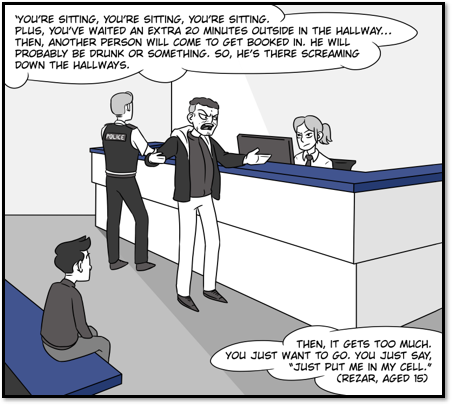
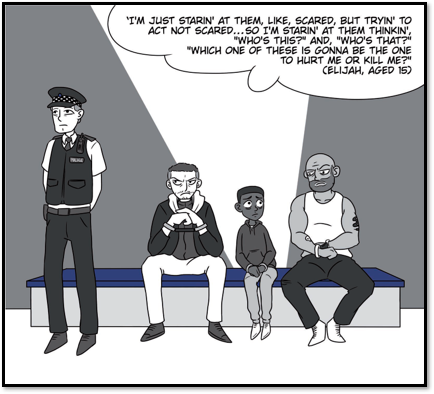
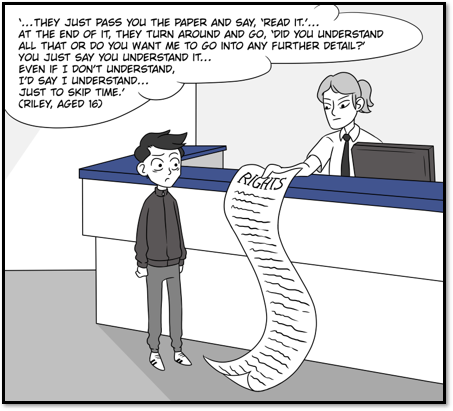
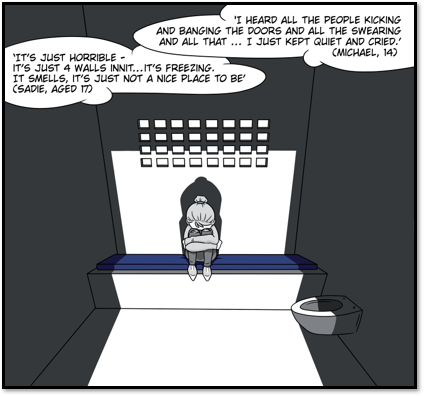
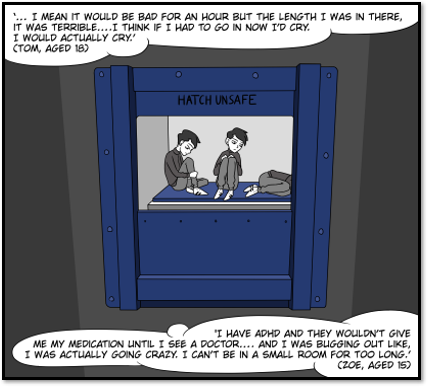
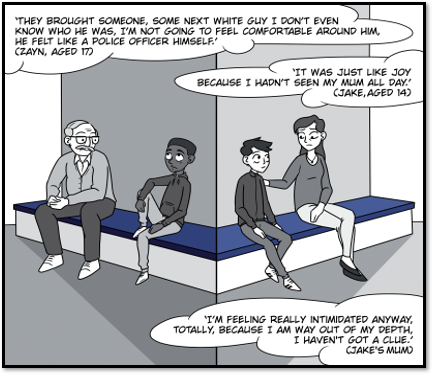
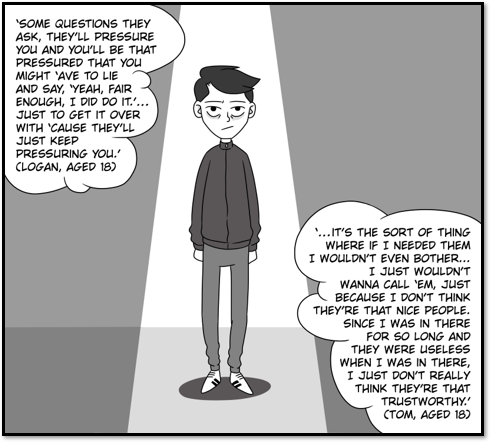
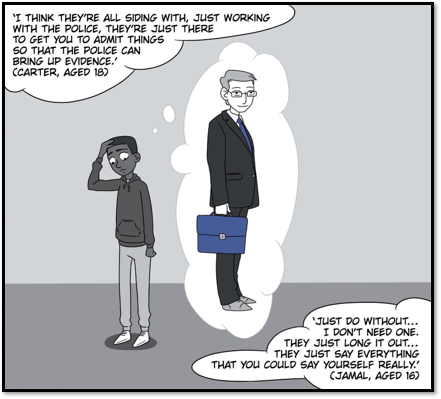
Illustrations by Johanna Falkenhagen. Orginally commissioned by Dr Miranda Bevan. 

  • Legal advice barriers

    1/8

  • Overwhelm

    2/8

  • Fear & bravado

    3/8

  • Complexity & acquiescence

    4/8

  • Traumatic environment

    5/8

  • Long detention times

    6/8

  • Feeling alone

    7/8

  • Pressure

    8/8

  • 1. Children: The most vulnerable of the vulnerable

    HM Inspectorate of Probation has described children in police detention as "the most vulnerable of the vulnerable and least able to represent their own interests." Research by the Children's Commissioner found that on average, police waited 7.7 hours after a child's arrest before even requesting an appropriate adult. Children spent the vast majority of their time in custody alone in a cell, without any independent adult support. In 2025/26, where forces recorded the information, no appropriate adult was present in around one in six stop and search searches that expoosed the intimate body parts of a child. 

  • 2. The pains of child detention

    What children describe about time spent in police custody is stark: powerlessness, indignity, isolation, frustration, confusion, humiliation and fear, though they may conceal these feelings from police with bravado.

    Children who are questioned or searched as suspects (whether detained in police custody, attending a voluntary interview, or being searched under stop and search powers) need someone to protect their rights, safeguard their welfare, and help them participate in a process they may not understand.

  • 3. Compounded intersectional disadvantage

    The average human brain takes 25 years to develop. Yet at ten years old, a child in England and Wales is criminally responsible and may be required to make critical decisions, including whether to have legal advice.

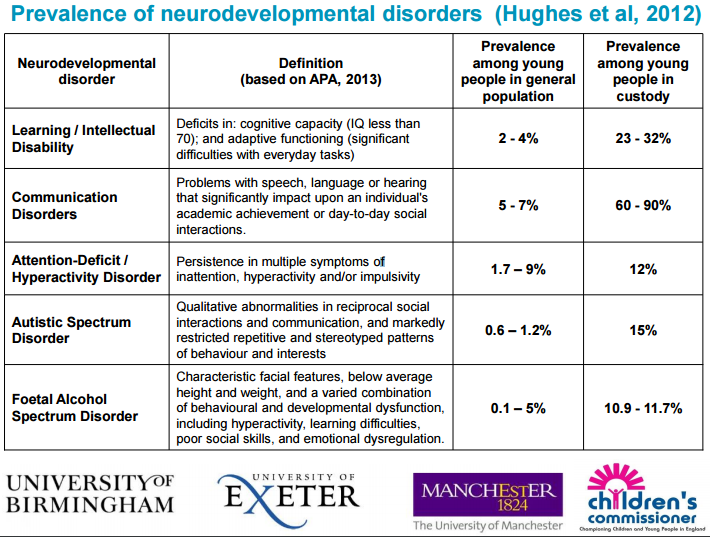
    Children in the justice system are not a representative cross-section: they are far more likely than other children to have a learning disability (up to 32%, compared to 4% in the general population), a communication disorder (up to 90%, compared to 7%), to be autistic (15%, compared to 1%), or to have suffered a significant head injury (18%, compared to 5%).

    Race, gender, abuse, neglect, trauma, school exclusion, and care experience compound these disadvantages. Much of this is invisible unless actively looked for. A child who appears to "know the ropes" may still be profoundly distressed and disadvantaged.

  • 4. Life-threatening risk

    The stakes are not abstract.

    The independent Angiolini Review into deaths and serious incidents in police custody documented three cases that changed the law. Edward Thornber hanged himself in a park after being detained and given a warning for possession of a small amount of cannabis; he was later mistakenly sent a court summons, which was found near his body. Joe Lawton was arrested for drink driving and kept overnight in a police station; he took his own life two days later. Kesia Leatherbarrow was held in custody over a weekend and taken to court on Monday; she was not seen by her family again. All three were 17 years old.

    Because 17-year-olds were not then treated as children in custody, none was entitled to an appropriate adult and none had their parents informed of their arrest. The law has since been changed, but only after these deaths demonstrated, at the highest cost, what happens when the safeguard is absent.

Vulnerable people

  • 1. Vulnerability is contextual

    In this context 'vulnerability' is about the risks generated by a system that was not designed for everyone. 

    The law requires police to apply a functional test. A person of any age is vulnerable if there is reason to suspect they may:

    • not understand or be able to exercise their rights and entitlements
    • have difficulty understanding the implications of procedures and processes
    • have difficulty understanding or the significance of what they are told, of questions they are asked or of their replies
    • be highly suggestible or eager to please
    • become confused.

    In practice, some of the most common factors are:

    • mental illness
    • learning disabilities
    • brain injury
    • neurodivergence (e.g. autism, ADHD)

    Due to high prevalance of conditions amongst children in conflict with the law, many should still be receiving support as they become young adults.

  • 2. The pains of detention

    What vulnerable adults experience in custody is often deeply distressing.

    Research consistently finds that people report not understanding what was happening to them or why, being uncertain about what to say or do, and feeling alone with no one to turn to for support.

    Vulnerability is frequently invisible or misread: symptoms of mental illness can be interpreted as aggression or non-compliance, leading to restraint rather than support.

    Conditions may not be immediately apparent to officers, and without an appropriate adult to advocate, the person may not be able to articulate their own needs.

    These experiences can be compounded by gender. Police custody is an environment culturally and materially designed around adult men; from the physical layout of cells, to the staffing, to the assumptions embedded in risk assessment. Women and girls can be left exposed to particular harms: the indignity of managing menstruation without privacy or adequate facilities, or the risk that trauma histories linked to abuse are retriggered by the custody environment itself. Women in custody are recorded as vulnerable at higher rates than men, meaning the appropriate adult safeguard is disproportionately important to women as a group.

    The Angiolini Review into deaths and serious incidents in police custody documented cases where officers perceived distressed or mentally unwell detainees as deliberately non-compliant or dangerous, with fatal consequences.

  • 3. Nobody is responsible for ensuring support

    The causes of this systemic failure are the 40 year absence of a statutory duty, diminishing funding, and a lack of clarity over who is responsible.

    For children, the answer is clear: local authorities have a statutory duty under the Crime and Disorder Act 1998. For vulnerable adults, there is no equivalent duty; no agency in England and Wales is legally responsible for making sure those protections are available.

    Local authorities have increasingly withdrawn appropriate adult services for vulnerable adults, citing financial pressures and the non-statutory nature of the provision. Approximately three-quarters of police force areas now rely on Police and Crime Commissioner funding for vulnerable adult AA provision, an arrangement that raises serious concerns about the independence of a safeguard that is supposed to be independent of policing, and one that is now further threatened by the planned abolition of PCCs.

    As Professor the Lord Patel, former Chair of Social Work England and the Mental Health Act Commission, has observed: the non-statutory nature of the provision means that areas with a service are defenceless in the face of budget cuts, and vulnerable adults slip through the cracks between agency responsibilities.

  • 4. Many (most) vulnerable people don't get support

    NAAN's There to Help research series, downloaded over 19,500 times and cited in more than 44 academic publications, has found that an estimated 160,000 or more adult detentions and voluntary interviews of vulnerable people take place every year without an appropriate adult, even though one is required by law.

    The force-by-force variation in identification rates is stark: in 2024/25, rates ranged from 2.6% to 20%.

    Police are half as likely to record that a suspect is vulnerable in areas where no organised appropriate adult provision exists.

    That difference reflects how the system operates, not the needs of the population.

The people asked to protect

  • When the system works

    When the system works, every person asked to act as an appropriate adult (whether a parent arriving at a custody suite for the first time, a support worker accompanying a client, or a trained volunteer on their hundredth call-out) has the knowledge, confidence, and support to do the role effectively. They understand what is happening, know what they can and should do, and are equipped to speak up.

  • When the system fails

    The reality is that many people are asked to fulfil this critical role with little or no preparation, in circumstances that are stressful, unfamiliar, and sometimes frightening.

    When the system fails, the consequences can be devastating: miscarriages of justice, criminal records that follow people for life, deterioration of welfare, and in the worst cases, self-harm and suicide.

Parents, family and friends

  • 1. Asked to protect, without preparation

    When a child is arrested, the police will usually contact a parent or family member first. They are asked to come to the police station, often without warning and in the middle of the night, and act as the child's appropriate adult. Most have never been in a custody suite before. They receive no training, little information about what the role involves, and must navigate a complex legal process while managing their own fear and distress.

  • 2. A complex role with no training or guidance

    The law gives parents priority as appropriate adults for good reason: children value having someone familiar and trusted. But the role requires far more than simply being present. An appropriate adult must understand PACE, know the child's rights, facilitate communication with police and lawyers, observe whether procedures are being followed, and intervene if they are not. Research has found that parents frequently do not understand what they are supposed to do, and that some feel powerless in the face of police authority.

  • 3. In their own words

    As one parent told researchers: "I feel like I really let [my son] down with not knowing."

    Another described the experience: "You've just gotta go along with 'em cos it's the police innit."

  • 4. When support isn't available, outcomes suffer

    NAAN's theory of change identifies this problem directly: parents, family and professionals asked to be an appropriate adult are often unaware of the specific responsibilities and powers of the role, and this can create risks in excess of having no appropriate adult at all. An inappropriate intervention in an interview, a failure to secure legal advice, or a misunderstanding of the right to silence can have lasting consequences.

Professional and community workers

  • 1. Trusted relationships, unfamiliar territory

    Residential care staff, supported living workers, key workers in charities, youth workers, and social workers may be called upon to act as appropriate adult for someone they already support. For children, this group has the same legal standing as family in the PACE priority order. For vulnerable adults, they are often the first people police contact.

  • 2. A different legal framework, with no preparation

    These professionals bring an important advantage: they know the person. They understand their communication needs, their triggers, their history. But they do not necessarily understand the specific legal role of the appropriate adult in custody, which is distinct from their usual professional duties. A support worker who is excellent at advocacy in a hospital setting may not know how to intervene in a police interview, or understand the significance of the caution, or recognise when a strip search procedure is not being followed correctly.

  • 3. Standing alone in an unfamiliar system

    The custody environment is also unfamiliar. The power dynamics are different. The legal framework is PACE, not the Care Act or the Mental Health Act. Without preparation, even experienced professionals can find themselves unsure of what they should do, and uncertain whether they have the standing to challenge police decisions.

Appropriate adult practitioners

  • 1. A demanding role in a high-stakes environment

    The staff and volunteers who deliver the appropriate adult role within organised schemes (whether employed, sessional, or voluntary) are the backbone of the safeguard. They attend custody suites at all hours, build rapport with frightened children and confused adults, navigate complex legal processes, and advocate for people at their most vulnerable.
  • 2. Training, guidance and community are crtiical

    But they can only be effective if they are properly trained, have access to reliable and up-to-date guidance, and are part of a professional community that supports their development. The PACE Codes of Practice are large, complex, and not structured with appropriate adults in mind. Relevant law, case law, and operational guidance changes regularly. Many practitioners are the only person in their organisation with specialist knowledge of the role, with no colleague to turn to when a difficult situation arises at 3am.

  • 3. Without national infrastructure, every area starts from scratch

    Without a national infrastructure providing standardised training, practice guidance, a practitioner knowledgebase, and a professional network, every local area is left to reinvent the wheel. The result is inconsistency in the quality of the safeguard, which is the very thing that children and vulnerable adults cannot afford.


The system that has to make it work

  • When the system works

    When the system works, every area has appropriate adult provision that is consistently available, sustainably funded, quality-assured against national standards, and accountable to the people it serves. Commissioners and providers have the evidence, tools, and support they need to design and deliver effective services. Police understand the role, identify vulnerability accurately, and work constructively with appropriate adults. Effective appropriate adults also benefit the wider justice system: by enabling the fair and lawful investigation of children and vulnerable people, they reduce the risk of failed prosecutions, unreliable evidence, and miscarriages of justice. These are outcomes that matter to police, the Crown Prosecution Service, courts, victims, and the public.

  • When the system fails

    The reality is a patchwork. Provision varies enormously between areas. Funding is insecure. There is no statutory duty for vulnerable adults. And the people responsible for making the system work (scheme leaders, commissioners, and police) are often doing so with limited resources and limited specialist support.

Appropriate adult scheme leaders and managers

  • 1. Specialist work, often without specialist support

    The people who run organised appropriate adult provision (within youth justice services, charities, local authority teams, or contracted providers) are responsible for recruitment, training, quality assurance, operational management, and partnerships with police and other agencies. Many do this with very small teams. Some have only a few hours a week dedicated to appropriate adult work alongside other responsibilities.

  • 2. Isolated without a national network

    They need operational guidance, quality frameworks, peer support, and access to specialist advice on complex cases and legal questions. The specialist nature of the work means they are often isolated as the only person in their organisation who understands this area of law and practice. When a custody officer calls at midnight with an unusual situation, there is rarely anyone internally to consult.

Service developers and commissioners

  • 1. Commissioning decisions that shape whether the safeguard is available

    Youth justice services designing or redesigning their approach. Police and Crime Commissioners deciding how to fund adult provision. Local authorities considering their responsibilities. Combined authorities exploring regional models. All are making decisions that directly affect whether children and vulnerable adults get the protection they are entitled to.

    They need clear standards against which to commission, specification templates, benchmarking data, evidence of what works, and access to specialist consultancy. Without these, commissioning decisions are made in the dark, leading to specifications that are too narrow, contracts that do not reflect the realities of the role, and services that cannot deliver what PACE requires.

  • 2. What's possible with the right evidence and support

    The London experience illustrates both what is possible and why national infrastructure matters. When the Mayor's Office for Policing and Crime commissioned the first pan-London appropriate adult service for vulnerable adults (a £5.4 million investment covering all 32 boroughs plus the City of London, 24 hours a day, 365 days a year), NAAN provided the evidence base, the quality standards, and the commissioning expertise. But it took a major strategic authority stepping in with direct commissioning to achieve what the voluntary, non-statutory approach had failed to deliver in decades.

Police and other professionals

  • 1. If vulnerability isn't identified, no one is called

    Custody officers, investigators, healthcare professionals, and Liaison and Diversion staff are responsible for identifying vulnerability, requesting an appropriate adult, and enabling the role to function effectively. They are the gatekeepers of the safeguard: if vulnerability is not identified, no appropriate adult is called.

  • 2. Recognising needs that are not immediately visible

    They need to understand what vulnerability looks like, including the many forms that are not immediately visible, know when the safeguard applies, and be able to work constructively with appropriate adults when they arrive. This requires training, operational guidance, and a culture that treats the appropriate adult as a partner in ensuring fair and effective justice, not as an obstacle to getting through the workload.

  • 3. Variation driven by system design, not officer commitment

    NAAN's research has consistently found that the quality of identification varies enormously between forces and is influenced by local interpretation of PACE, the tools officers use, the availability of appropriate adult services, and the extent of training. Where police have access to structured vulnerability assessment tools and work alongside well-resourced appropriate adult schemes, identification rates rise and the safeguard works as intended.

  • 4. Fair investigations need consistent support

    Chief Constable Ivan Balhatchet, the NPCC's national lead for custody, has described the problem from the policing side: appropriate adults play a crucial role in the effective operation of not only custody but the criminal justice system as a whole, ensuring that any product of the custody process stands up to scrutiny in court. The absence of a statutory duty for vulnerable adults, he has said, has created an inconsistent and inadequate provision for some of the most vulnerable members of our society and a significant challenge for policing to comply with the law.

What you can do now

  • If you need an appropriate adult

    If you need an appropriate adult (for yourself, your child, or someone you support) you can find out about the role, how to act as an AA for a loved one, how AAs are found, who provides them in your area, and how to make a complaint if support wasn't provided.

  • If you lead or commission a service

    If you run or commission appropriate adult provision and want to improve your service, strengthen your standards, or connect with a national network of practitioners and commissioners, find out about NAAN membership.

  • If your team needs training

    If your team needs training, on understanding vulnerability or the appropriate adult role, explore our online and tutor-led training services and complete our enquiry form. 

  • If you can help to fund our work

    If you fund work that supports children or vulnerable people in the justice system and want to understand more about how NAAN works and what your support could achieve, contact us to discuss how we can work together.

Statistics used and their sources

  • 930,000 detained / 73,000+ voluntary interviews: Home Office PP&P 2024/25 (custody tables D_01; voluntary attendance VA_01)
  • 58,000 children arrested: Home Office PP&P 2024/25 arrests table A_01b
  • 60,000+ children detained: Home Office PP&P 2024/25 custody table D_01
  • 43% children detained overnight: Home Office PP&P 2024/25 table D_09a
  • 3,300+ children strip searched: Home Office PP&P 2024/25 table SS_02
  • 20–40% mental health prevalence: Angiolini Review (2017), citing police estimates to Home Affairs Committee and McKinnon & Grubin (2013)
  • 9% recorded as needing AA / 2.6%–20% force variation: Home Office PP&P statistics / VIT, 2024/25
  • Nearly half of deaths with mental health concerns: Angiolini Review (2017), five-year figure 2010/11–2015/16
  • Home Secretary quote: Theresa May (2015), cited in NAAN meeting notes for Angiolini Review and in the Review itself
  • Brain development to age 25: widely cited in developmental psychology;  IOPC Learning the Lessons 
  • Learning disability 32% vs 4%, communication disorder 90% vs 7%, autism 15% vs 1%, head injury 18% vs 5%: IOPC Learning the Lessons (Chris Bath article, 2020)
  • HMIP quote ("most vulnerable of the vulnerable"): Children's Commissioner A Night in the Cells (2017), citing HMIP 2011
  • 7.7 hours before AA requested: Children's Commissioner A Night in the Cells (2017) — mean delay from arrest to referral, excluding outliers
  • 160,000+ vulnerable adult detentions/VIs without AA: There to Help 3 (2020) — "159,718" at 22% prevalence assumption
  • 19,500+ downloads of There to Help series: website downloads analysis
  • Police half as likely to record vulnerability where no provision: There to Help (2015)
  • Three-quarters of forces rely on PCC funding: NAAN letter to Policing Minister, November 2025
  • Familial AA quotes: APPG evidence session, July 2023
  • Women recorded as vulnerable at higher rates than men (16% vs 12%): Home Office PP&P 2024/25 custody table D_03b
  • Police custody as a gendered space: Skinns, Smyth, Weir, Dehaghani, Hodgson, Munro & Sorsby (2026), Centre for Criminological Research, University of Sheffield, Occasional Paper 13

Continue reading

Our impact

NAAN doesn't provide appropriate adults.

We change the system.

We set the standards, build the evidence, shape the policy, and support the people who deliver the safeguard on the ground - whether they are staff, volunteers, or family members. 

Sometimes we lead, sometimes we contribute. 

Here are some examples of what has changed as a result.

More effective law and national policy

Accountability and quality infrastructure

Stronger and wider local provision

A broader and deeper evidence base

Families empowered to provide support

What others say about our impact

More effective law and national policy

  • A new legal definition of vulnerability, based on research evidence

    Police are increasingly identifying learning disability, mental illness, and neurodivergence.

    In 2012, police recorded the need for an appropriate adult in just 2.7% of adult detentions. In 2024/25, that figure reached 9.06%; a more than threefold increase, with the steepest rises following the legal changes NAAN helped secure. In some forces, the rate now exceeds 20%.

    PACE Code C was fundamentally rewritten in 2018 to include a broader, functional definition of vulnerability; a revised threshold for when the safeguard must apply; new duties on police to actively seek information about potential vulnerability; and confirmation that the safeguard covers voluntary interviews. The Home Office had originally proposed a narrower definition that would have reduced protections; the final version was, in the words of Dehaghani & Bath (Criminal Law Review, 2019), "very different indeed from the Home Office's original proposals."

    This chain of events began when the Home Secretary commissioned NAAN to investigate why so few vulnerable adults were receiving the safeguard. Our There to Help report (2015) established the scale of the problem for the first time. The Home Secretary publicly stated: "The status quo is clearly not acceptable." We then shaped the resulting Code changes with Dr Roxanna Dehaghani of Cardiff University, who submitted the collaboration as a REF Impact Case Study: "Improving protections for vulnerable people in police custody."

    The gap remains vast; research estimates 20–30% of adults in custody need support. But the direction of change is clear.

  • 17-year-olds recognised and treated as children in police custody

    Until 2013, the police and the Government did not treat 17 year olds in police custody as children, despite their wider legal status.

    75,000 17-year-olds a year were treated as adults in police custody; denied the right to an appropriate adult and the right to have their parents informed.

    That changed in stages: PACE Code C was amended by order of the Home Secretary (2013), and the Criminal Justice and Courts Act 2015 and Policing and Crime Act 2017 completed the change.

    The Earl of Listowel explicitly named NAAN in the House of Lords among the organisations whose contribution made the amendment possible.

    NAAN's distinctive role was maintaining the relationship with government from the inside. When the Home Office felt unable to engage with Just for Kids Law (who led the judicial review), they continued engaging with NAAN as a "strategic operational partner."

    NAAN's CEO provided a witness statement in the case and appeared on Sky News to build public pressure.

  • In-person support was protected during Covid-19

    We ensured the rights of children and vulnerable people were respected - even during a global pandemic global

    NAAN co-ordinated with its members to ensure that AAs continued to attend police custody in-person, throughout the pandemic. This included working with the NPCC and the Home Office to ensure that suitable health and safety measures were taken, that PPE was available, and that AAs were classed as key workers. 

    In March 2020, a national protocol introduced remote legal representation in police interviews with no safeguards for children or vulnerable adults.

    Over three years and five versions of that protocol, NAAN worked to ensure that cases involving children and vulnerable adults were exempted from these cases, so that they continued to be protected by in-person legal advice.

    NAAN co-authored Not Remotely with Transform Justice and Fair Trials International. Fair Trials secured a legal opinion from Joel Bennathan QC at Doughty Street Chambers, which concluded the protocol was unlawful. NAAN issued guidance to AA schemes across all five versions, and maintained pressure throughout.

    The Policing Minister wrote to NAAN: "Appropriate Adults are a vital part of the criminal justice system and perform a key role in keeping the system going and avoiding miscarriages of justice... you are protecting some of the most vulnerable people in society and ensuring their rights continue to be respected."

  • The first national police custody risk assessment is being adopted

    From postcode lottery to evidence-based tool

    Police custody risk assessments were designed to identify physical risks like self-harm and suicide; not to assess PACE vulnerability or the need for an appropriate adult.

    NAAN proposed a national, evidence-based assessment grounded in psychology, psychiatry and law, bringing together leading academics including Professor Gísli Gudjonsson CBE.

    The National Police Chiefs' Council (NPCC) took this forward, has explicitly acknowledged NAAN as the instigator, and invited NAAN to help govern its development.

    The framework is now with NPCC 'Chiefs' Council' for approval across all 43 forces.

  • There is national guidance for police forces on voluntary interviews

    Making the safeguards real - beyond custody

    The NPCC has published national guidance for all police forces on the conducting of voluntary interviews - full criminal interviews that take place without an arrest and detention. 

    The NPCC Voluntary Interview Guidance (2024) was co-written with NAAN and other key stakeholders. It includes dedicated sections on appropriate adults, children and vulnerability drafted by NAAN. It is held in the College of Policing Library. 

    This followed nearly a decade of research and engagement by NAAN, including the first national quantitative study of police use of voluntary interviews and appropriate adult safeguards.

    An estimated 145,000 voluntary interviews take place each year, including approximately 27,500 involving children. Adults were recorded as needing an appropriate adult in just 4.8% of voluntary interviews (compared to 8.7% in custody); a third of forces could not even report their volumes.

    While we continue to work with others to reduce the use of custody for children and vulnerable people, it was NAAN that noticed that the same safeguards were not being applied to voluntary interviews.

  • Strip search is under greater and better informed scrutiny

    NAAN's 2022 report Police searches of people was a direct response to the Child Q case, in which a Black girl was strip searched at school while menstruating and during a mock exam.

    The report was produced without specific funding because we recognised the racial justice and gender dimensions of the issue. It documents ethnic disproportionality in strip search, analyses adultification bias, and addresses the position of trans people being searched. The foreword was written by Saqib Deshmukh, a children's rights activist and member of the Child Q Core Review Group..

    By 2026, the report had been downloaded over 1,800 times, and cited in seven independent publications, including a peer-reviewed journal article (Ali & Dymond, 2026, Criminology & Criminal Justice), the Children's Legal Centre Wales, the APPG on Children in Police Custody, and the IOPC's national learning recommendations.

    NAAN used the report to engage directly in the Home Office's policy development process, and to support other child-focused organisations who lacked specialist knowledge. 

    The Association of Police and Crime Commissioners formally recognised our work on strip search scrutiny, with NAAN helping to shape questions for PCCs to ask of their local police forces.

    Following NAAN's substantial consultation submission, the Home Office has proposed revised PACE Code amendments, which are pending in 2026.

    Following the Supreme Court ruling on the meaning of sex in the Equality Act, NAAN developed guidance for appropriate adult schemes with direct input from a trans person who is an appropriate adult, and are supporting the development of local training for wider adoption.

  • There is wide support for statutory provision of AAs for vulnerable people

    A national framework for local responsibility

    Since 1984, police have been required to secure an appropriate adult for vulnerable adults; but no agency has ever been legally responsible for ensuring that appropriate adults are actually available.

    With local authority social care cuts biting, the last 15 years saw local scheme collapse like dominoes. Approximately three-quarters of police forces now rely on Police and Crime Commissioners for adult AA provision; by default, not by design.

    NAAN has led the case for statutory provision, building from a standing start to a position where every major stakeholder supports the change:

    • Chief Constable Ivan Balhatchet (NPCC lead for Custody, 2025): "I strongly support the call for a statutory provision of AAs for vulnerable adults."
    • Dame Anne Owers (Chair, ICVA, 2024): "For over 25 years it has been a statutory duty to provide AAs for children. As Chair of ICVA, I urge policymakers to act on NAAN's call to provide the same mandatory protection for vulnerable adults."
    • The Home Office (March 2026): "It is absolutely vital that there are functional safeguards in place for this group." Statutory provision "will be explored as part of the new local governance arrangements that will replace Police and Crime Commissioners in 2028."

    Scotland resolved this in 2019 by placing a statutory duty on local authorities for both children and adults. Northern Ireland has a scheme commissioned by the Department of Justice. 

  • Appropriate adults are embedded in national policy development

    NAAN has embedded the AA perspective in policy structures

    While the Home Office holds policy responsibility for policing, PACE, and appropriate adults, NAAN works across Government - particularly Home Office, Ministry of Justice, and Department of Health. 

    We hold a seat on the Home Office PACE Strategy Board, contribute to the NPCC Strategic Custody Board and the Ministry of Justice Quality of Advocacy Working Group, and are a founder member of the All Party Parliamentary Group on Children in Police Custody.

    We authored the Crown Prosecution Service's legal guidance on appropriate adults at CPS invitation.

    We secured a Legal Aid Agency rule change ensuring lawyers called on an AA's request could be guaranteed payment; without it, the provision was unworkable.

    We've worked in partnership with NHS England to build the capacity of Liaison & Diversion teams, and secure £500,000 of pathfinder funding for L&D assessments prior to voluntary interviews. 

    NAAN has been named in Parliament on multiple occasions spanning 20 years, and since 2012 has responded to every significant PACE and custody consultation; our responses have been downloaded over 5,700 times.

Increased accountability and quality infrastructure

  • Clear and respected national standards define what good look like

    Before NAAN, there was no framework for defining, commissioning or assessing appropriate adult provision. NAAN created the National Standards; the only framework of its kind, against which services are now developed, commissioned, inspected and held accountable across England and Wales. No other body develops or maintains them.

    First published in 2006, formally approved by the Home Office and Department of Health in 2011, and substantially revised in 2018 with 56 evidence references and input from 17 organisations. The 2018 revision was the first time people with lived experience of police custody (as a child or vulnerable person) were formally paid to shape the standards.

    The standards are endorsed by the Youth Justice Board, the Association of Directors of Adult Social Services, and the Association of Police and Crime Commissioners. Their authority has grown: the Ministry of Justice's Standards for Children in the Youth Justice System (2019) now requires every youth offending team management board to ensure provision complies with NAAN's standards.

    In 2025/26, 100% of newly published appropriate adult contracts specified compliance. 91% of surveyed members reported using the standards; 90% said they were effective. The standards suite -which includes a National Standards Self Assessment tool, has been downloaded over 9,500 times.

  • Youth justice inspections now assess appropriate adult provision

    From 2025, appropriate adult provision is an explicit element of youth justice service inspections. Previously it was not assessed at all. As one YOT Manager told us: "AA provision was very much at the back of my mind because it was not part of the YOT inspections."

    NAAN secured this inclusion through five years of engagement with HM Inspectorate of Probation, working with our trustees with direct youth justice operational experience to develop a practical inspection methodology in line with HMIP resources, and training inspectors.

    The combination of ministerially-set standards requiring NAAN's standards compliance, and independent inspection assessing that compliance, creates a chain of accountability for children's appropriate adult provision that did not exist before.

  • Appropriate adult schemes now have a voice in police inspections

    HMICFRS inspections previously relied solely on what police told inspectors about AA provision, which could result in inaccurate or incomplete characterisations of provision. One published report noted that "some services were not supplying AAs in the middle of the night" without reflecting that the provider was not contractually required to do so.

    NAAN engaged with HMICFRS, inviting them to meet with our members. This event generated and agreement that the inspectorate would send a proforma to AA schemes before an inspection, giving them a direct voice in the process for the first time. 

    This improves public transparency and accountability. 

  • National commissioning infrastructure

    We provide the national infrastructure that enables effective commissioning of appropriate adult services:

    • commissioning guidance
    • adaptable specification template 
    • bespoke advice and support for local areas
    • a Dynamic Purchasing System in partnership with publicly-owned purchasing body YPO.

    Over 30 contracts have been commissioned through the DPS since its launch.

    95% of published tenders in 2025/26 required NAAN membership or training; 80% of specifications (2021–2023) required NAAN standards compliance.

    We have directly advised 17 local commissioning projects, ensuring that budgets are used to deliver the best possible outcomes for children and vulnerable people.

Stronger and wider provision

  • The whole system is better informed, with access to a shared centre of expertise

    We respond to and average of 22 support cases per month

    Over nine years, NAAN has responded to 2,353 queries: from scheme leaders navigating complex legal and operational questions (41%), non-members (24%), prospective AAs (20%), vulnerable people and their families (12%), and commissioners (3%).

    More than 110 member organisations across England, Wales and Northern Ireland make up the network. Members report 100% satisfaction with NAAN's advice and support .

    These queries range from PACE Code interpretation to counter-terrorism provisions, from strip search protocols to custody record access.

    In many cases our intervention resolves a local problem directly. In others, the intelligence feeds into our national policy work; turning frontline experience into evidence for system change.

    Documented outcomes include immediate practice changes at a Youth Justice Service, resolution of custody record disputes, and a real-world tragedy on the day NAAN's CEO was at the Home Office PACE Strategy Board that became direct policy evidence. The advice service is the intelligence loop that connects frontline experience to national policy.

  • Appropriate adult schemes now have access to standardised training

    Before NAAN, there was no nationally standardised training for appropriate adults. Each scheme developed its own materials, or had none.

    NAAN has maintained and developed national training over a 20-year trajectory, from the first National Training Pack (2006) to the National Training Course (NTC) launched in 2025.

    In its first year, 612 AAs were trained via the NTC,  more than double our target. An independent evaluation found 90% strongly agreed it improved their development. Experienced AAs with five or more years in the role reported learning things they had never known before.


  • Police and health staff teams in custody understand vulnerability

    Increasing the system's ability to identify and respond to vulnerability

    NAAN's PACE vulnerability training videos have been adopted by at least 12 police forces and viewed over 2,730 times (61% year-on-year increase in 2025/26). 74% of police officers surveyed said they would apply the appropriate adult safeguard to more or different people after watching . 83% said resulting changes in their practice would lead to more vulnerable people being identified.

    The videos were based on a tutor-led seminar developed by NAAN for police officers, custody healthcare, and Liaison and Diversion teams. That slide deck has been downloaded from NAAN's website over 8,740 times. NHS England asked NAAN to deliver the seminar to 90 Liaison and Diversion service leads nationally.

    The College of Policing asked NAAN to review its immersive 'Hydra' custody vulnerability training scenarios and, as a result, amended it to promote deeper consideration of AA need.

    The proportion of detentions in which police recorded the person as vulnerable and needing the support of an AA has more than tripled between 2012/13 and 2024/25.

  • Police forces have been prevented from running unlawful AA schemes

    When local authority provision has retrenched, police forces have in some cases attempted to set up their own appropriate adult services; a direct conflict with PACE Code C's requirement that AAs be independent of police. NAAN has intervened in each and every case.

    In West Yorkshire (2024), a detailed letter from NAAN's Chief Executive stopped the force from implementing an unlawful scheme, redirecting commissioning responsibility to the Combined Authority; which then published a specification explicitly shaped by NAAN's standards.

    NAAN is the only body with both the expertise and the relationship with forces to identify and resolve these problems.

  • London now has universal appropriate adult provision for vulnerable adults

    Before 2018, appropriate adult provision for vulnerable adults across London was, in the words of HMICFRS, "generally chaotic." Many boroughs had no service at all.

    In the continued absence of a statutory responsibility, NAAN supported the development of a tri-partite funding agreement between MOPAC, NHS England London Region, and individual London councils. Over five years this resulted in provision in 19 boroughs. But where there was no history of provision, councils did not feel able to fund even one-third of the costs. NHS England did not re-affirm its involvement after the five year project.

    In 2023, MOPAC partnered with NAAN as a consultant adviser, first to develop an options appraisal, and then to secure funds for a fully MOPAC-funded scheme.

    The result: a £5.4 million centralised commission covering every borough; the first universal appropriate adult provision for vulnerable adults at this scale anywhere in England and Wales. Three providers now deliver 24/7 coverage across all 32 boroughs. 

  • The independence of the safeguard is now nationally protected

    Policing had increasingly sought to apply police vetting to appropriate adults; a process that was legally inappropriate, threatened the role's independence, and repeatedly excluded people with old or minor criminal records.

    In July 2021, the NPCC wrote to all 43 chief constables confirming that police vetting does not apply to appropriate adults and that the role "is, and must remain, entirely independent from policing."

    The College of Policing's Authorised Professional Practice (2025) now explicitly names appropriate adults as not requiring police vetting.

    NAAN led this: we identified the problem through member intelligence, produced the legal analysis, engaged the NPCC leads, and contributed to successive drafts of the national letter.

A broader and deeper evidence base

  • Creating the first national dataset on appropriate adults

    Before 2015, no national data existed on the need for appropriate adults for vulnerable adults. NAAN created it from scratch through Freedom of Information requests to every police force, eventually achieving a 100% response rate.

    Our There to Help series (2015, 2019, 2020) remains the primary evidence source; downloaded approximately 19,500 times, cited in 44+ academic publications, and featured in The Guardian.

    Key findings:

    • Police five times more likely to identify vulnerability where an organised AA scheme existed (2015).
    • Over 200,000 vulnerable adult suspects per year were not recorded as needing an AA (2020).
    • Only one in five people identified as vulnerable by NHS Liaison and Diversion services was getting an appropriate adult, despite 69% having a mental illness (2019).
  • National data collection is now permanent and mandatory

    From 2022/23, police forces are required to report appropriate adult data to the Home Office through the Annual Data Requirement. Previously, NAAN relied on FOI requests.

    NAAN advocated for this inclusion as the Home Office conducted a competitive formal review process for additional data inclusion.

    This is a permanent system-level change: NAAN created the accountability infrastructure that now produces the official statistics on custody, vulnerability, and AA support for both vulnerable people and all children.

  • Force-by-force variation is now visible and trackable

    NAAN's Vulnerability Identification Tracker; the only long-run time series on police identification of vulnerability in adult custody; is a publicly accessible dashboard covering almost six million detentions.

    The VIT enables the force-by-force comparisons that drive improvement and expose inconsistency.

    In 2024/25, rates ranged from 2.6% (North Yorkshire) to 20.0% (Lincolnshire and Cleveland). Lincolnshire rose from 7.5% to 20.0% in a single year.

    This has driven discussion and action within police forces, including between forces with the same IT systems but vastly different AA rates. It has also driven systemic action, including the move towards a national custody risk assessment.  

  • NAAN's research has shaped academic and policy thinking

    NAAN is a named institutional partner in an ESRC-funded Doctoral Training Partnership with Cardiff University, with NAAN's Chief Executive co-supervising the PhD.

    In 2026, NAAN launched AARC - the Appropriate Adult Research Community; the first dedicated research network for the role; now spanning seven academic institutions.

    NAAN own research publications have been downloaded approximately 30,000 times, and cited in 40+ academic publications across criminology, law, social work, health and policing.

    Our strip search report has been cited in seven independent publications, including academic journals, the Children's Legal Centre Wales, the APPG on Children in Police Custody, and by the Independent Office for Police Conduct.

    The NAAN/Dehaghani collaboration was submitted by Cardiff University as a REF Impact Case Study.

    CEO Chris Bath and Dr Dehaghani co-authored a peer-reviewed paper in the Criminal Law Review (2019) and a Wiley-Blackwell textbook chapter (2025).

    Effective Practice Manager Grev Wallington is contributing to a forthcoming academic book edited by Dr Donna Peacock.

Families empowered to support their loved ones 

  • Supporting families who act as appropriate adults

    Despite having no public helpline, NAAN has supported around 30 vulnerable people and their family members each year.

    Whether it is the parents of autistic children, an adult with a mental health conditions, or families who felt their relative was mistreated, NAAN has responded to every one with care and empathy.

    Many appropriate adults are family members or close friends. The law requires police to prioritise parents for children, and they act as AA in the majority of cases.

    NAAN's written guides for family AAs have been downloaded over 2,300 times.

  • Family AAs have access to independent information

    NAAN developed an animated video guide for family appropriate adults in partnership with Dr Miranda Bevan (then at the LSE), funded by the ESRC; the first resource of its kind aimed directly at parents arriving at a police station. Over 150 appropriate adults provided feedback on drafts. The subtitles have been translated into seven languages. 

    The NPCC has disseminated the animation to all force heads of custody. Eight police forces have confirmed adoption. Greater Manchester Police displays NAAN materials in custody facilities. The Metropolitan Police is automating the sending of a link by SMS to parents of children in custody. In Parliament (March 2022), Minister Rachel Maclean described the animation as "groundbreaking" and committed the Home Office to working "to raise its profile through as wide a dissemination as possible."

    NAAN worked with the Home Office to develop a "Being an appropriate adult" page on Gov.uk to help family AAs understand their role and find NAAN's video and written resources. 

    The video has been viewed over 3,500 times.

What others say about our impact

  • Andrea Brazier

    Head of Youth Inspection Programme, HM Inspectorate of Probation

    "NAAN has been instrumental in improving our knowledge in relation to all things for appropriate adults. It has supported us in developing our victims standard, helped us shape what we can include and guided us as to how best to include a focus on appropriate adults in our inspection programme."

  • Sherry Ralph

    Chief Executive, ICVA / Chair, National Preventive Mechanism

    "We work closely together on many issues covering police custody, and NAAN's resources are invaluable. As organisations we are stronger together and NAAN is a fantastic organisation, dedicated to the effective protection of vulnerable suspects in police custody."

  • Chief Constable Ivan Balhatchet

    Custody Portfolio Lead, National Police Chiefs' Council

    "NAAN is a national capability of ongoing importance to policing, providing a high level of impact through a small, specialist function that is not otherwise available to forces."

  • From our members

    Source: NAAN member surveys

    "NAAN's support to members is truly invaluable."

    “The support is outstanding and even if NAAN don't know the answer they will always find out.”

    “I continue to be pleased to be a member. I enjoy every event I have attended... connecting the dots from policy makers to volunteers.”

    “NAAN has given me the tools to develop the somewhat haphazard list of volunteers into a trained and supported provision.”

    “Being able to contact NAAN by email or phone when I have queries and to get a prompt response makes my role much easier.”

Continue reading

Practice

Guidance for appropriate adults on supporting children and adults, safeguarding, rights, and good practice in different settings.

Browse Practice Guidance →

Leadership

Guidance for scheme leaders and managers on governance, quality assurance, workforce development, and service delivery.

Browse Leadership Guidance →

Commissioning

Guidance for commissioners on designing, funding, and overseeing appropriate adult services.

Browse Commissioning Guidance →

Evidence

Plain-English summaries of academic research, translated into practical implications for practice, leadership, commissioning, and scrutiny.

Browse Evidence →

Child First Pilot (Surrey)

An academic evaluation of Surrey Police’s child first custody pilot (referred to by the acronym “CHILD”) highlights the importance and impact of appropriate adults for children. 

Below we share our reflections on the implications of the evaluation for AA provision, and highlight links to key national standards. 

About the report

Read the report

The CHILD mnemonic

Previously used in the Metropolitan Police Service this approach, which aims to make custody more child-focused and less harmful, has 5 elements.

  • Change the presumption of legal representation
  • Have a conversation with the parent, guardian, and appropriate adult
  • Inform the local authority
  • Limit the PACE clock to 12 hours
  • Direct the investigation without delay.

Key findings

The report is encouraging for AAs. It shows that when police leadership and custody culture focus on children: AAs are brought in earlier; children get better support sooner; AA access becomes more meaningful; AA services are recognised as critical infrastructure; but consistency and resourcing still matter.

  1. The AA scheme is a strength in the system
  2. A 12-hour clock makes AA support more focused
  3. High vulnerability levels justify strong AA safeguards
  4. Early AA contact made a visible difference
  5. Trained AAs were already driving the “presumption of legal advice”
  6. Access to AA support during detention
  7. Policing culture, detention and voluntary interviews
  8. Challenges for AAs around resources and standardisation

    1. The AA scheme is a strength in the system

    The Surrey Appropriate Adult Volunteer Service (SAAVS) comes across very positively:

    • 24/7 cover
    • expectation to attend quickly (aiming for within an hour)
    • willingness to attend overnight (including for rights and samples).
    • attendance not just for interview.

    Custody staff repeatedly praised SAAVS, which is notable because reports often highlight AA delays rather than strong AA practice.

    National Standard 5.2 (Hours of operation)

    Indicator (a): Provision is structured and fully resourced to ensure the availability of an effective AA 24 hours a day, 7 days a week, 365/6 days a year.

      2. A 12-hour clock makes AA support more focused

      Even though it’s not an AA-specific measure, the 12-hour clock is the report’s standout success:

      • shorter detentions overall
      • fewer very long detentions
      • fewer overnight detentions
      • stronger pressure on investigators to move cases along.

      It clearly increases the effectiveness and efficiency of AAs, with less prolonged waiting and fewer situations where children are left in limbo. This reduces purely custodial AA time, making the AA’s support more meaningful rather than being treated as ‘babysitting’ and distraction during delay. By reducing average detention times, the 12-hour clock increases the proportion of the child’s detention time for which the AA is present. This is a clear example of how AA effectiveness is linked to system design, not just AA behaviour.

      National Standard 5.10 (Scope of support in custody)

      "Children (under 18) and vulnerable persons are supported throughout a detention episode".

        3. High vulnerability levels justify strong AA safeguards

        The report highlights high rates of vulnerability indicators (self-harm, suicidality, child protection issues, etc.) and says these likely understate the true picture (especially in terms of neurodivergence). This strongly supports the need to ensure that both adult and child AA practice must be underpinned by knowledge and skills related to vulnerability. It also highlights opportunities for AAs to work closely with Liaison and Diversion, and for the improvement of real-time information flows with youth justice services and children’s services.

        National Standard 3.9 (Mental vulnerability)

        "AAs are able to recognise the needs of a child or adult who is mentally vulnerable and ensure that they are met".

          4.    Early AA contact made a visible difference

          Researchers felt that Surrey’s custody teams had clearly absorbed the expectation that they should identify and contact the child’s AA/parent as early as possible, often at the point of arrest, not later in the custody process. Staff described this as a major practical shift.

          The report is explicit that this improved children’s experience, with quicker AA attendance, earlier support, and more chance of the child being treated as a child, not just “processed”.

          This is despite AAs reporting long waits for solicitors (up to 2 or 3 hours), and officers echoing this (especially “stacking” multiple cases and refusing to hand them back). AAs recognised lawyers were part of a “system that’s under resourced”.

          It links to any earlier recommendation from the researchersthat Code C should require AAs to attend as soon as possible and physically meet the child within one hour of request.

          National Standard 5.3 (Response times)

          "Children and vulnerable persons receive AA support with the shortest possible delay. Indicator (b): In case of arrest and detention, AAs arrive as soon as possible after the police request is made, normally within one hour and always within two hours (schemes are not responsible for any delay in a request being made by police)".

            5. Trained AAs already drive the “presumption of legal advice”

            A key finding is that for children supported by SAAVS, the pilot’s “presumption of legal representation” didn’t change much in practice because SAAVS AAs already insist on a lawyer being called. Custody staff described this as effectively standard practice where SAAVS is involved.

            However, family AA cases are a weak spot. The report suggests the “reversed presumption” worked less well with family AAs, partly because the pilot wording was unclear about what “opt out” meant (opting out of call-out vs opting out of seeing the lawyer once called). The authors recommend much clearer wording if forces want this to work properly.

            National Standard 6.4 (Securing legal representation)

            "AAs ensure that a legal representative is requested for the person they are supporting (in custody or voluntary interview) whenever it is in that person’s best interests".

              6. Access to AA support during detention

              Surrey often allows children to sit out with their AA (especially parents/family) in consultation rooms while waiting, reducing time isolated in cells. Staff linked this to reduced distress and risk.  This was embedded in the CHILD approach to the point that officers said they now have to justify putting a child in a cell on the checklist - a meaningful cultural change.  However, the report also notes barriers:

              • too few consultation rooms
              • busy suites
              • “sit out” practice is less commonly expected when the AA is a SAAVS volunteer rather than a family member/social worker (creating a two tier experience)
              • sometimes children don’t want to sit for hours with an unfamiliar volunteer AA.

              Where AAs were not a continuous presence, researchers felt that Surrey’s approach to enabling children to speak privately to their AA by phone was better than what previous research found elsewhere. Some staff described it as straightforward to arrange a private call. But practice still varied across suites, and one officer indicated “at any time” access wasn’t routine in their suite. So Surrey is not fully consistent yet.

              However, the report confirms a familiar problem with regard to the outcome stage. While AAs are always present for interview, whether they stay through to decisions around charge and bail depends on delay length. Some AAs deliberately stay based on their judgment of what the individual child needs in terms of support at discharge. Lawyers often leave immediately after interview. This reinforces the AA role as not just an interview safeguard, but often the only independent person still actively supporting the child at the end of the custody process.

              National Standard 6.9 (Minimising detention)

              Indicator (g): "AAs seek to ensure children are never placed in cells with adults and are only placed in cells when no other secure accommodation is available in the station and it is not practicable to supervise them out of cell or a cell provides the most comfortable secure accommodation".

              National Standard 5.14 (Remote support)

              "Remote support is only ever used to enhance and not replace the physical presence of an AA and only where it is clearly in the best interests of a person who is in custody. (Indicators (a)-(g) are all highly relevant)"  

              National Standard 5.10 (Scope of support in custody)

              Indicator (i): "The scheme is structured and resourced appropriately to ensure that an AA is available in good time when required for the processes defined in the PACE Act and its Codes, including but not limited to: charging / disposals and related actions, including decisions about bail, local authority transfers and cautions or conditional cautions".

                7. Policing culture, detention and voluntary interviews

                Notably, where a child was brought in for a low-level arrest in the late evening, and it was not possible to progress the case immediately, custody officers described using ‘short bail’ in appropriate cases to avoid lengthy detention. Researchers felt this was preferable to ‘bedding down’ a child overnight, but raised the question about whether detention was necessary at all.

                Researchers found Surrey already made comparatively strong use of voluntary interviews (VI), yet the CHILD pilot did not lead to an increase. Officers described VI as more appropriate for children and often more productive, but frontline practice frequently defaulted to arrest because it was perceived as simpler, more familiar, or required to access certain investigative powers and safeguarding routes that are only triggered by detention. This tendency is reinforced when inexperienced officers lack confidence in managing complex situations without the structure of custody.

                The report highlights how policing culture shapes these decisions. Most officers embraced the child‑centred ethos of the pilot, but a minority expressed punitive attitudes, seeing custody as a deterrent and arguing against treating children differently from adults. Such views increase the likelihood that children will be brought into custody, particularly for low‑level matters.

                These cultural dynamics matter for AA schemes. When arrest is used by default, it is open to the AA to challenge unnecessary detention, ensuring alternatives are considered, and helping the child navigate an environment shaped as much by culture as by policy. AAs can support and encourage a diversion-focused culture, and is essential in challenging punitive instincts.

                National Standard 6.9 (Minimising detention)

                "A person who is detained is dealt with expeditiously with no unnecessary delays. They are released as soon as the need for detention no longer applies and, in the case of children (under 18) are transferred to alternative accommodation as required by law".

                8. Challenges for AAs

                The report also identifies familiar challenges for AA provision:

                • travel distances
                • capacity and resources to scale up when police activities drive up demand
                • some AAs preferring not to attend until interview
                • police custody perceptions that SAAVS is stretched
                • members of the custody team sometimes treating AAs “as if they work for us”
                National Standard 1.4 (Finance)

                "The scheme is appropriately resourced in order to operate sustainably and in adherence with all relevant legislation, codes and standards".

                National Standard 1.8 (Relationship with police)

                "The scheme has a positive working relationship with the police force based on mutual understanding and clear independence from one another".

                National Standard 3.5 (Need and purpose)

                "AAs understand the need for an AA, the overall purpose of the role, and the importance of actual and perceived independence from policing". 

                Want to know more...?

                Vulnerability

                Policy

                We're are not just working on identification. Did you know that while local authorities have a legal duty to provide an appropriate adult for children, there's no equivalent duty to provide one for vulnerable adults?

                Click below to find out more, and catch up on our latest activities, updates and media.

                Read more

                Our priorities

                Policy

                We're working on a wide range of policy and practical issues, including:

                • Vulnerable adults
                • Children
                • Voluntary interviews
                • Strip and intimate searches
                • Remote legal advice
                • Accountability 

                Read more

                About AAs

                Information

                The role of the appropriate adult is to safeguard the interests, rights, entitlements and welfare of children and vulnerable people who are suspected of a criminal offence, by ensuring that they are treated in a fair and just manner, and are able to participate effectively.

                Read more

                Continue reading

                Non-PACE detentions

                NAAN is working to clarify how safeguards for children and vulnerable people apply in police custody when detention is under non-PACE powers.

                This includes the role of appropriate adults, the application of PACE Code C, and the need for clearer national guidance.

                The issue

                • Not all detentions are for criminal investigations

                  Police custody is regularly used for detentions that are not part of a standard PACE criminal investigation. These include (for example) some Bail Act matters, Mental Health Act detentions, extradition-related detentions, prison-related detentions, and other routes into police custody.

                  This creates a serious and under-examined safeguarding question: When a child or vulnerable person is in police custody under a non-PACE power, does the appropriate adult safeguard apply? And if so, how?

                • Why this matters

                  PACE Code C is clear in some places, but ambiguous in others when it comes to non-PACE detentions. Your reading of the Code can lead in different directions depending on which provisions you focus on.

                  That ambiguity matters because the consequences are significant:

                  • If appropriate adults are not required, there may be major gaps in protection for children and vulnerable people in police custody.
                  • If appropriate adults are required more widely, police forces and AA schemes may face substantial demand, with implications for commissioning, availability and guidance.

                  In short: this is not just a technical legal issue. It is a frontline safeguarding, policy and capacity issue.

                Our position

                • The current position

                  NAAN’s view is that this is an area where national clarification is needed.

                  There are strong arguments that key custody safeguards apply broadly to people in police custody, even where the detention power is not a standard PACE investigative detention.

                  At the same time, parts of Code C are clearly drafted around suspects, interviews and criminal investigation processes, which creates uncertainty in practice.

                  There is also very limited national data on current practice, although available indications suggest that practice is variable between forces and custody settings.

                  We have prepared a short policy paper for the Home Office setting out the issue in more detail, including legal analysis and practical implications.

                • Why NAAN has raised this

                  Appropriate adults are a core safeguard for:

                  • protecting rights and entitlements

                  • supporting communication and participation

                  • helping ensure fair treatment in custody

                  Where custody is used outside the standard PACE pathway, these needs do not disappear. In some cases, they may become less visible — and therefore easier to miss.

                  Our paper sets out:

                  • the scale and relevance of non-PACE detentions in police custody

                  • how PACE Code C appears to apply (and where the ambiguity lies)

                  • why the AA safeguard question is not straightforward

                  • the policy and operational implications of different interpretations

                  • why clearer guidance is needed for police, AA services and commissioners

                Read the NAAN paper

                Next steps

                What needs to happen next

                This issue needs a clearer national response.

                At a minimum, police forces, custody leaders, commissioners and AA schemes need clearer guidance on:

                • when and how AA safeguards apply in non-PACE detentions

                • which Code C protections should be treated as minimum standards

                • what this means for local AA service capacity and commissioning

                NAAN will continue to raise this issue in policy discussions and support members to identify and document practice issues where they arise.

                Continue reading

                Our research community

                The appropriate adult research community (AARC) is a dedicated space within the NAAN membership, for people engaged in research related to appropriate adults (AAs), including practioners, students and academics. 

                Our aim is to connect people working in this field, fostering a collaborative environment where members can exchange knowledge, network, and support each other.

                Whether you're exploring AA research, following current debates, or actively conducting a study, AARC offers a platform to engage with peers and grow your understanding.

                Events

                • AARC Networking Meeting: 20 October | 6:00pm – 7:00pm
                • Work in Progress – Session 2 | 17 November 1:00pm-2:00pm
                • AARC Writing Group – Our First One! 9 December | 9:30am – 12:30pm

                These events are for AARC members only. Please email This email address is being protected from spambots. You need JavaScript enabled to view it. if you'd like to join!

                Join the community

                • Individuals

                  Whether you're an academic, an appropriate adult, or both, you can become part of AARC simply by joining NAAN as an individual academic member at the silver tier.

                  This route is open whether or not you are an AA for a NAAN member AA scheme.

                  Membership fees will be allocated to an AARC specific fund, to support the work of the community. 

                • Organisations

                  When your organisation joins NAAN as a silver or gold member, it will get:

                  • Up to 2 places within AARC*
                  • Access to AARC online events for all your AAs.   

                  *These are available for the primary/secondary contacts or their nominated person. If AAs (or others in your organisation) wish to become AARC members themselves, they are very welcome to apply for individual NAAN membership.

                Meet AARC's founders

                • Sarah Connelly

                  I am the current Chair of the Appropriate Adult Research Community (AARC).

                  I am a researcher and practitioner working across academic and practice-based settings. I work as a Lecturer in Criminology at the University of Sunderland and study as a PhD student at Newcastle University exploring the social processes constructed around the term ‘vulnerable’ within a custody setting.

                  In practice, I manage and lead the appropriate adult (AA) scheme for vulnerable adults (18+) within the jurisdiction of Northumbria Police and serve as a trustee for the National Appropriate Adult Network (NAAN).  My practice directly informs my research with my research interests being grounded in real-world contexts and observations. Current projects explore blurred lines between policy and practice, such as how professionals navigate gendered spaces and support transgender and non-binary detainees, as well as decision-making around the actioning of the AA, and how vulnerability is socially constructed and understood.

                  My work bridges higher education and frontline practice and I contribute to projects that aim to enhance practice and support collaboration. I feed this into my role as Chair of our network, where I work with fellow founders and members to create space for knowledge exchange, network building, and the practical application of research. 

                • Chloe Macdonald

                  I am a former AA volunteer and former AA Scheme Manager, which was for a busy volunteer service supporting both children and vulnerable adults. I am also an Associate Trainer with NAAN, delivering training on the AA role to different AA services.

                  I became interested in exploring the AA role through research by studying BSc Psychology and then went on to explore the role further in an MSc Forensic and Investigative Psychology, and MSc in Social Science Research Methods. My interest in researching the role stems from my practitioner experiences as volunteer and manager.  

                  I am currently studying a PhD in Law, focused on the effectiveness on the Appropriate adult safeguard. My former research projects around the AA role include exploring understanding the AA role from a volunteer's perspective, the perceptions and interventions made by AA’s and Police officers, and mapping where AA schemes are across England and Wales and how they operate.  

                • Scarlett Pickford

                  I am a practitioner-researcher with previous experience volunteering as an appropriate adult, supporting both children and vulnerable adults.

                  I began volunteering as an appropriate adult whilst studying BA Criminology at University as I felt the role provided an optimal opportunity to help others and make a difference whilst investing in my personal and professional development. The combination of practical experience and academic exploration of how vulnerability intersects with the criminal justice system harnessed my desire to pursue research into the Appropriate Adult safeguard. 

                  Specifically, my research interests centre around themes of welfare and wellbeing; not only of the vulnerable individuals being supported in police custody, but also of the Appropriate Adults supporting them. My BA research specifically explored the often-overlooked welfare role of appropriate adults from the perspective of volunteer appropriate adults, police, and custody staff. More recently, my MSc research, led by the guiding philosophy that ‘you cannot pour from an empty cup’, explored the subjective wellbeing and lived experience of volunteer appropriate adults, how they are affected by their role, and they can be best supported.  

                The importance of AARC

                At the heart of NAAN’s work is a simple belief: more effective appropriate adults create a fairer justice system.

                NAAN was founded 30 years ago by appropriate adult practitioners working alongside organisations including Mind, Mencap and Revolving Doors. From the outset, the charity brought together practitioners, managers, police, local government and academics. The purpose was twofold: to define what good appropriate adult practice looks like, and to share that knowledge nationally so that each area did not have to start from scratch. Practitioners themselves were central to that ambition.

                That role remains unchanged today. NAAN exists to build knowledge about appropriate adult practice and to ensure it is shared and used.

                Doing that well requires more than professional experience alone. It raises fundamental questions about what “effective” appropriate adult support really means in practice; how different people experience the role, including the child or adult being supported, the police and legal advisers; and what training, tools and working conditions make good practice possible. These are not questions that can be answered by intuition alone. They require evidence.

                Research on appropriate adults is not always comfortable to read, but it is essential. It challenges assumptions, exposes weaknesses and forces the system to look honestly at how the role operates in practice. For NAAN, the task is not to defend the status quo but to remain curious, reflective and open to critique. Where research is inaccurate, it should be corrected; where it reveals problems, it should be learned from.

                As understanding of the appropriate adult role grows, so does interest from the academic community. More researchers are beginning to study appropriate adults, and others are discovering the role for the first time. This matters because high-quality, practice-informed research strengthens NAAN’s ability to translate evidence into practical support for those doing the work on the ground.

                Appropriate adults are where change becomes real. Their actions determine whether children and vulnerable adults can understand their rights, participate effectively and be treated fairly in police custody. A stronger research base makes that work more effective.

                This is why AARC matters to NAAN. By bringing together researchers and practitioners, it helps to build the evidence needed to improve practice, influence policy and strengthen the appropriate adult role nationally. It supports NAAN’s core mission: to promote fairness in the justice system through more effective appropriate adult practice.

                Chris Bath
                Chief Executive, NAAN

                Take part in research

                Why participate?

                Research about appropriate adults is limited, and what does exist often doesn't involve appropriate adults. We want you to help us to change that, by sharing your experiences with researchers. 

                Your insight is vital to developing a deeper understanding of how things work in the real-world. Your contributions will help to strengthen the evidence base around the AA role, and ensure your perspectives are represented in academic research. 

                Read about the active studies in which you can take part, and share this page with your AA colleagues.

                Call for support to AA Managers - Can you help me hear every voice in police custody?

                Sarah Connelly

                I am in the final round of my PhD interviews and I’m looking to book the last few to make sure all custody professions are heard.

                My research brings together the voices of custody sergeants, appropriate adults, detention officers, Liaison and Diversion practitioners and healthcare professionals. It examines how vulnerability is understood, how we respond to it operationally, and what that looks like in practice for vulnerable adults.

                How you can help:

                • Would you like to take part yourself?
                • Could you share this with your AAs?
                • Do you have a contact in custody, such as a sergeant, L&D practitioner or HCP? Please pass on my details.

                Who I’d like to speak with:

                • Custody sergeants
                • Detention officers
                • Appropriate adults
                • Appropriate adult scheme managers
                • Liaison and Diversion practitioners
                • Custody trainers
                • Healthcare professionals working in or alongside police custody

                I’m also keen to hear from people who have left these roles within the last five years, as part of the research looks at retention and experiences within roles such as policing and appropriate adult provision.

                What taking part involves

                • Informal, conversational interviews held on Teams, booked whenever suits you
                • A focus on your professional understanding and experience of how vulnerable adults are processed, supported and navigated through police custody across England and Wales
                • Participation on an individual basis, not on behalf of your current or previous organisation
                • Transcripts anonymised and aggregated, with localised and geographical details removed

                Get in touch: This email address is being protected from spambots. You need JavaScript enabled to view it. OR This email address is being protected from spambots. You need JavaScript enabled to view it.

                Continue reading

                National training course evaluation

                Introduction

                Please find below information regarding two surveys that are for Appropriate adults (AA’s) who are undertaking the National Training Course (NTC).

                The first survey is intended for AA’s to complete before starting the NTC. The second survey is intended for AA’s to complete after the NTC (but please only complete the post survey if you have previously completed the pre survey).

                Links to the survey as well as more information about them can be found below.

                Access to Surveys

                Please find below the links to the pre training (to be completed before starting the NTC) and post training (to be completed after the NTC) surveys. For more information on the surveys please read the below FAQ’s.

                Pre training survey:  https://app.onlinesurveys.jisc.ac.uk/s/cardiff/pre-training-aa-survey

                Note – please only complete this survey before you have completed the NTC.

                Post training survey: https://app.onlinesurveys.jisc.ac.uk/s/cardiff/post-training-aa-survey

                Note – please only complete this survey after you have completed the NTC.

                Frequently Asked Questions (FAQ’s)

                Who is conducting this research?

                My name is Chloe Macdonald and I am undertaking a PhD with Cardiff University. The research is focused on the effectiveness of the AA safeguard. I am interested in exploring the impact of the new National Training Course (NTC) on the effectiveness of AAs.

                I am a NAAN member and Associate Trainer, previously ran an AA scheme, and was a volunteer AA before that.

                What is this research about?

                The appropriate adult (AA) is an important safeguard for vulnerable suspects in police custody. The role of the AA is to protect vulnerable suspects’ (i.e. a child or an adult who meets the vulnerability requirements as set out in the Police and Criminal Evidence Act Codes of Practice) rights, entitlements, welfare and effective participation.

                Previous research on the AA role has not fully considered how role is understood by the AA and others who encounter the AA (such as police officers and solicitors). Additionally, previous research has not explored if, how, and in what ways the AA is an ‘effective’ safeguard for vulnerable suspects.

                Specifically, this current project sits within the wider PhD study and explores AA attitudes, knowledge and understanding before and after completing the National Training Course (NTC), which will offer insight into how the NTC impacts AA effectiveness.

                What will my involvement in the research be?

                You will be asked to participate in two surveys on your thoughts, feelings and experiences relating to training: one before undertaking the NTC, and one after completing it. The surveys will each take you approximately 10 - 15 minutes to complete.

                The information you share will be recorded in this research. If you agree, that data will be securely stored in line with GDPR requirements. Only the researcher will have access to the data. You will not be identified in the research.

                This research may be published in, e.g., policy reports/evidence submissions, academic journals/books, presentation at conferences, and blogs.

                Before you start the NTC, you will be invited to take part in the pre training survey. After you have completed the NTC you will be invited to take part in the post training survey.

                Why have I been invited to take part?

                As an appropriate adult, who is due to start the NTC, you are eligible to complete the pre and post survey questionnaires.

                If you have recently completed the NTC, you are also eligible to complete the post survey questionnaire, but only if you have completed the pre survey questionnaire previously.

                Do I have to take part?

                No, your participation in this research project is entirely voluntary. It is up to you to decide whether or not to take part. Both surveys will provide more information so that you can give informed consent before you start the survey/s.

                What happens if I wish to withdraw?

                Participation in this project is voluntary. You can withdraw up until two weeks after completing the survey.

                To withdraw your responses, you will have to email the researcher no later than two weeks after participating in the study. Please contact the researcher at This email address is being protected from spambots. You need JavaScript enabled to view it..

                Will I be paid for taking part?

                No. You will receive no payment for taking part.

                What are the possible benefits of taking part?

                Your participation in this project will enable an understanding of if, how and in what ways the new National Training Course impacts the effectiveness of Appropriate adults, providing the first opportunity to do so.

                The National Appropriate Adult Network will use the findings to improve the course.

                It is intended that the findings will help to inform a picture of AA effectiveness which will help those undertaking the role, encountering the role, as well as those who receive the protection of the role in police custody.

                What are the possible risks of taking part?

                There are no foreseeable discomforts, risks, or disadvantages as a consequence of your participation in this project.

                Will my taking part in this research project be kept confidential?

                All information collected from (or about) you during the research project will be kept confidential. Any personal information you provide will be managed in accordance with data protection legislation.

                Please see ‘What will happen to my Personal Data?’ (below) for further information.

                What will happen to my personal data?

                Personal data, according to the General Data Protection Regulation (GDPR) means any information relating to an identifiable living person who can be directly or indirectly identified in particular by reference to an identifier. This may include information such as an individual's name, address, email address or date of birth.

                We will collect some forms of personal data, namely your name and email address which you will be asked to state in the surveys. This information will be accessible to the researcher only.

                Once the survey data has been downloaded, all personal information will be removed and be anonymised.

                Cardiff University is the Data Controller and is committed to respecting and protecting your personal data in accordance with your expectations and Data Protection legislation. Further information about Data Protection, including:

                • your rights
                • the legal basis under which Cardiff University processes your personal data for research
                • Cardiff University’s Data Protection Policy
                • how to contact the Cardiff University Data Protection Officer
                • how to contact the Information Commissioner’s Office

                may be found at https://www.cardiff.ac.uk/public-information/policies-and-procedures/data-protection

                Thank you for your participation in this project.

                Continue reading

                APPG on Children in Police Custody

                The All Party Parliamentary Group on Children in Police Custody is conducting a Select Committee style inquiry into Achieving the Rights of Children in Police Custody.

                As part of our children's policy and research work, NAAN was a founder external member of the APPG. We have provided both verbal and written evidence to the inquiry. Both of which can be found on this page.

                Our verbal evidence

                About the appropriate adult safeguard

                • Introduction

                  I realised that the last time I gave evidence about children in the police station to an APPG was 10 years ago. That was an uncomfortable realisation given the continuing issues. Thank you to Miranda and the APPG for the opportunity to talk. I just want to put on record, my thanks to circa 2000 appropriate adults who carried on working or volunteering through COVID. I promised them that I wouldn't let it be forgotten that they continued supporting children and vulnerable people in police custody in person, when many others moved to remote working.

                • About NAAN

                  I am the chief executive of the National Appropriate Adult Network, which is a national charity. It is a membership organisation of about 100 member organisations, who are mostly the providers of appropriate adult schemes for children and vulnerable people – for children that is Youth Offending Teams, plus the organisations that they commission to deliver that service. NAAN is not a provider. Our mission is making sure that every single appropriate adult is effective, creating the result that every child’s rights, entitlements and welfare, and their effective participation, are secured.

                • The purpose of the appropriate adult

                  The role is about safeguarding the interests of children. This includes their rights, entitlements and welfare – effective participation being a right. Children are disadvantaged in a system built for adults. The AA is a partial role rather than an impartial role - the AA is on the side of the child. The outcome that they are seeking is fair justice. That means the avoidance of miscarriages of justice. But it also means inclusion - including people who otherwise would have had difficulty going through the justice system. That means the avoidance of failed prosecutions of genuinely guilty people, as much as miscarriages of justice being avoided

                • Key powers

                  Miranda has already outlined the ways in which AAs safeguard children’s interests: general support, advice, assistance; help with communication and understanding; protecting rights by watching and intervening. Just to highlight some of the appropriate adult’s key powers: they have the power to insist on a legal representative being called to the police station, even if that right has been waived. Bearing in mind, our starting point here is 10-year-olds, because of our age of criminal responsibility, which is so low internationally speaking. Appropriate adults can access the custody record to see what's happened to that child so far, and to make sure that what's recorded by the police is also the child's experience of what has happened. Appropriate adults are expected to intervene actively in the interview. But much more broadly, outside of the interviews, they have the power to make representations. That might be representations at the formal reviews of detention that an inspector must do after a set number of hours. It might even be questioning the grounds for detention and whether they still stand, bearing in mind the UN Convention on the Rights of the Child requires using detention for a minimum period and only when necessary. In addition, the child has a right to a private consultation with their appropriate adult at any time during their detention.

                • Scope of AA involvement

                  In theory, the scope of this role is broad, going all the way through from rights and entitlements being explained to somebody (initially at the point of their detention being authorised) all the way through to bail and charge and all the related actions. In reality, PACE is full of caveats, exclusions and limitations. And between the letter of the law and the culture, oftentimes the breadth of the role is compressed. For example, an appropriate adult must be present under PACE when the police explain the child's rights and entitlements, unless they're not already present at the police station, in which case, they don't have to be present, but it must be repeated when they are present. Of course, that's meant to allow for the fact that you can't instantaneously beam a parent into custody. But the way it is used means it can become 12 hours in custody for the child before they see their appropriate adult, their rights and entitlements are re-read, and then they go into interview - which can obviously completely undermine the whole point of it.

                • Scheme appropriate adults

                  We think in something like a third to half of cases, parents are unavailable, unsuitable or uninterested. There are lots of reasons why parents might want to do the role, but are unable to, for lots of practical reasons. Youth Offending Teams (YOTs) have a duty to step in at that point and provide an appropriate adult, but they have freedom in how they deliver that. Some appropriate adult schemes are delivered directly by YOT workers, other YOTs run teams of volunteers or commission services, who then use employees or sessional staff or volunteers, depending on what they do.

                • Lay role

                  Another point I want to highlight, is that appropriate adults are not lawyers, they are not legally trained. They are not medical professionals or healthcare professionals, they are not speech and language therapists or forensic psychologists. They are not ‘capital p’ professionals. I don't think that this undermines the role, in the sense that there are lots of very important roles that are lay roles. But if we start to judge appropriate adults as if they are performing a different role, I think that's when we have deep problems. An appropriate adult is not a cheap solicitor or a cheap intermediary.

                • Key knowledge and skills

                  Obviously, effectiveness requires a knowledge of the law and procedure, of mental health and learning disability, neurodiversity and related issues. NAAN publish set of 72 national standards, 12 of those standards relate to the initial training for appropriate adults. It's worthwhile reiterating that YOTs have a statutory duty of to ensure the provision of appropriate adults for children and, under the Youth Justice Board’s Standards for Children in the Youth Justice System, they are expected to do so in line with the NAAN national standards.

                • Key qualities

                  Aside from the knowledge and skills, I think it is really important to think about qualities. And in focus groups with people who have lived experience of going through police custody and having appropriate adults, the point about qualities comes through. The message is: Yes, we want these people to know what they're talking about. But we also want (and I read here directly from what people have said): good listener, good communicator, people person, honest, trustworthy, calming, calm and kind, respectful of diversity (including race and gender), assertive, confident, protective and not afraid to challenge and demand respect from the police.

                Challenges

                • Delays and access

                  The biggest problem we have is the percentage of the custody episode duration for which the child gets the appropriate adult support. And there are two parts to that. One is the delay before the appropriate adult arrives, and the other one is how quickly they may leave.

                  On the first one, some research conducted by the Children's Commissioner, identified that the biggest contributor to that delay is the police not calling the appropriate adult scheme until quite late in the process. I think the procedural focus for the police has already been touched on, but I would reiterate, the interview is for them the critical process.

                  It's the evidence the police want to capture – for them this is what the reliability and therefore the admissibility of evidence is about.
                  In a survey of our members, only 21% of organisations said that the police were asking them to attend as soon as possible. So, the majority are not asking appropriate adults to attend as soon as possible. We've started to see some improvement in that from some forces. But our national standards are very clear that we expect to see 24/7 365-day services. The YOT’s statutory duty under Section 38(4) of the Crime and Disorder Act 1998, is not time limited. And our standards also talk about the shortest possible delay, generally under an hour and always under two hours, in terms of attending. Obviously, neither the schemes nor the parents can control how late into the process that call is made by the police. And it is also true to say, and this is not just a police issue because it is a YOT duty - some still don't have 24/7 cover. Or they have it in theory, because ‘out of hours’ provision is the responsibility of local authority Emergency Duty Teams which, in our experience tend to have other priorities than children in police stations, who I think are perceived as being ‘safe’ relative to the other cases they are managing.

                  So I would say that most of our members say they are meeting the standards and getting there as quickly as they can. But some talk about responding to ‘agreed times’ that the police have asked them to attend. And there is also mention of not attending until the lawyer is ready. There is this tripartite professional issue where the lawyer, the officer in the case, and the appropriate adult will be triangulating around each other to arrive at the same time, so that no professional’s time is wasted.

                  Meanwhile, the child experiences perhaps 6-10 hours with nobody. And since we are starting from the premise that children need support around understanding and executing their rights and entitlements, then turning up 10 hours into the process is rather missing the point.

                  A number of members have said to me, and it's come up in Dr Vicky Kemp’s research as well, that there's no point an appropriate adult arriving early, because the police will not always allow access to the child. That has become a settled kind of culture, perhaps not challenged enough, but that's the reality. And the police do control custody, you can't force your way in or out.

                • After the interview

                  In relation to leaving, we do have this system-wide culture of focusing on the interview. While many AAs are spending hours with children, I believe it is not uncommon for AAs to be expected to leave shortly after the interview. There are long waits for CPS charging decisions and all sorts of gaps in these processes. I think average pre-charge detention times for children are some 11 and a half hours. Then where there is a charge and refusal of bail, we've got the post-charge detention until court. So are we asking the appropriate adults to be in custody for 18 hours, 20, 24 hours? Is that a system that we want, and believe would ever be funded? Some YOTs have commissioned out their AA provision. Interestingly, I've discovered that some commissioners are making their contracted providers justify in detail every single time they spend more than two and a half hours in custody with a child on a call out. And from the commissioners’ perspective it is understandable because they need to control the costs of the services that they've contracted out. Once you've commissioned someone to do something, and if they're in control of how much time they're charging you for, you can see how that happens. But from a child’s perspective, we're putting a cap of roughly two and a half hours out of what we know is likely to be 12 hours plus of detention time.

                • Shortage of appropriate adults

                  There is a massive national volunteer shortage across all areas of community work. We have inflation. We have pay as an issue. I found the other day that an Aldi cleaner is now paid £14 per hour, which is significantly more than the daytime rate paid to appropriate adults in those areas that have the paid, zero-hours contact, sessional model, for this complex role. What that means is that even services that have been relatively effective in the past, are now missing performance expectations. I would say it's not possible to meet the expected demand, and therefore enable police to comply with the law, within the current resources. In general, AA provision is significantly under-resourced. An example is that organised schemes are generally not in a position to ensure that appropriate adults are the same sex as a child, which causes all sorts of problems – for example around strip searching.

                • Accountability

                  We don't have enough data on the effectiveness of appropriate adults in terms of the difference they make. There is no inspection of AA services. HM Inspectorate of Probation conducts youth offending services inspections. However, appropriate adult services are not inside of the scope of their inspections despite it being a statutory duty of YOTs. And I have it from the horse's mouth (from a YOT manager) that appropriate adult schemes are not sufficiently on their radar because they know they're not going to get inspected on it.

                • Diversity

                  Our standards require AA provision reflects the diversity of the community it serves. I've spoken to our members and obtained some data around diversity. Interestingly, most members feel the areas where they feel they are most diverse are around age and ethnicity. The areas where they feel least diverse are class and wealth, and lived experience of criminal justice. That's not to say that the sector doesn’t have problems around race and ethnicity, I think we do. I know that some of our members recognise that, and they're trying to do more. I think there is an interesting question about whether the paid and volunteer models have any impact on diversity.

                • Standards for training

                  Another point that I would make is that there are no legal requirements for training – admittedly difficult given parents are the priority. At NAAN, our national standards indicate a minimum of 20 hours of training. We have a seventy-thousand-word national training pack. We've launched OFQUAL-accredited qualifications for appropriate adults rated at 40 guided learning hours. And we are currently working on creating a national e-learning course. Where services are commissioned, we encourage commissioners to require training. But all of that is non-statutory. There's no requirement for training or qualifications whatsoever. And it can be hard to local schemes to find the resources to pay for training and qualifications.

                • Information flows

                  Unless YOT staff are attending themselves, appropriate adults are typically not given access to the child's information before they attend, even if the child is already known to services. And oftentimes, while ‘management information’ will be produced, the specific information that the appropriate adult has gathered about the child, having potentially spent hours with them, doesn't flow back to the YOT, which I think is really problematic.

                How can we make things better?

                • Community alternatives

                  One idea is community alternatives - everything that just keeps children out of police custody. Investment in education, health, social care. The concept of a place in the community that police can take a child to, that hosts multiple agencies, which gives police a practical alternative to going into custody. I've become convinced over the last decade that we can't make police-led custody child friendly. I think we need a different space. And if I was feeling very radical, I would move responsibility for custody away from the police.

                • Authorisation of detention

                  While it does remain with the police, I think the focus needs to be on more rigorous authorisation of detentions by custody sergeants, pushing back more on the authorisation of detention, with more support for voluntary attendance (although we could have a whole APPG about the challenges of voluntary attendance). Inspector’s not rubber stamping reviews of detention, and bringing the average detention time down to about six hours for children (which the Met police has done a lot of work around). We need better compliance with PACE.

                • A PACE clock for children

                  I think we should halve the PACE clock for children to make it very, very clear that children are not adults.

                • Independent information for family AAs

                  I think it should be mandatory to give parents independent information and support, part of the YOT’s statutory duty, not left to the police. And I absolutely concur with Miranda's point about a partnership approach between organised schemes, supporting and working with parents. It should not be a case of, ‘Do you want to be the appropriate adult?’, ‘No I don't.’ ‘Then you can't talk to your child for the next 24 hours and you'll find out what happens at the end.’

                • Accountability of AA services

                  Overall, appropriate adult provision needs to be a bigger priority for YOTs. Funding is required, obviously. But the way that we measure the impact of AAs is really important. We need real time information flows and better compliance with standards. Our national standards are mandatory for YOTs under the standards for youth justice set by the Minister of State. But because they don't have any inspection, it's very hard to see what's happening in terms of compliance.

                • Maintaining independence

                  The last point I would make, because I know it is discussed often, there are undoubtedly some benefits to the idea of embedding appropriate adults inside police custody. But on balance, I come down very strongly against it. While there are practical benefits, including instant availability, my view is that the biggest risk here is monoculture. Speed is not everything. We need people coming from outside. If you swim in a culture too long, you just don't see it anymore. You don’t perceive the problems. It has happened that appropriate adults have ended up having cups of tea behind the charge desk with the custody sergeants. I call it ‘#team’ – tough shift today but together we got the job done. Sometimes it's not the right thing to do to have shared objectives. And when you are in an adversarial criminal justice system, it is one of those times.

                Our written evidence

                Q 1. How do you think policy and/or practice should be changed (if at all) to prevent children being brought unnecessarily into police custody?

                • Early intervention and support

                  The starting point must be considering the changes that could be made upstream from the point of custody. This includes:

                  • Broad investment and change across public services (principally early years support for children and families, education, welfare, health and social care) to tackle income, social, and racial inequalities and minimise adverse childhood experiences / trauma and its effects.
                  • A move away from dealing with the results of child trauma through the lens of an adversarial criminal justice system, refocusing through a genuine safeguarding lens which delivers the principles set out in the UN Convention on the Rights of the Child. This would for example mean treating children suffering from child criminal exploitation (CCE) as victims and not as offenders, recognising their behaviour as the result of grooming rather than lifestyle choice.
                  • Where accountability, consequences and support are needed by children, the offering of practical alternatives to policing by other (and potentially new) agencies.
                  • Practical amendments to policing practice in relation to children in communities, whether ‘on the street’ or reviewing the involvement of police in schools.
                • Voluntary interviews

                  Where a child is dealt with as a suspect in the criminal justice system, the key alternative to custody is the use of voluntary interview (VI). This presents an opportunity for police to obtain evidence via questioning without the unnecessary traumatic impact of state detention (which is supposed to be used for children only when absolutely necessary). 

                  There are other benefits to the VI approach. A scheduled interview provides opportunity for public agencies, including but not limited to the police, to gather information about the child before proceeding. This may result in alternative approaches being taken, as a child’s needs and circumstances become apparent. Alternatively, it may result in reasonable adjustments being made to ensure that the child can effectively participate in the interview process, protecting the integrity of the justice system and increasing the quality of any evidence obtained. 

                  However, there are also risks that are particular to the use of voluntary interviews, for suspects, police and the wider justice system. These include the potential for:

                  • Disparities in how the decision to offer a voluntary interview is taken and communicated, including a lack of clarity over the ‘voluntariness’ of the interview
                  • Lack of access to services (e.g. appropriate adults, legal advice, liaison and diversion, healthcare professionals, interpreters), the child’s understanding of the seriousness of the interview and the legal jeopardy they face, and the overall fairness of the interview
                  • Lack of oversight (as delivered by the custody officer in custody)
                  • Less effective assessment of risk and need. Although not related to children specifically, NAAN research looking at the year 2018/19 found that the proportion of adult suspects identified as vulnerable (e.g. mental ill health, learning disability, neurodivergence, brain injury) was significantly lower in voluntary interviews (3.5%) compared to custody (6.2%).
                  • Loss of opportunity to ensure that legal rights are understood, and procedural safeguards applied, if interviews are allowed to be conducted contemporaneously (at the site of the incident) using body worn cameras.
                  • Ineffective or non-existent administrative record keeping, impacting on oversight by policing leaders, Government, Parliament, HMICFRS, IOPC, and civil society.
                  • Use of inappropriate locations and contemporaneous PACE interviews at the site of an incident.

                  These risks apply generally but also disproportionately to children. As recognised by PACE, all children are vulnerable due to their age and are particularly prone in certain circumstances to providing information that may be unreliable, misleading or self- incriminating, including giving false confessions. Younger children are particularly likely to waive their right to free legal advice and representation. As a minimum, steps should be taken to ensure the application of the existing procedural safeguards, both to protect children and the integrity and effectiveness of the justice system.

                • Community alternatives to custody

                  The police are held accountable for keeping the public safe, and custody is the only secure environment that is available to them for this purpose. For as long as the system is based on bringing children into police custody, the police will be in an impossible situation. They will face continuous demands to make police custody ‘child friendly’. Their best efforts, whether it be staff training or murals on walls, seem doomed to failure because, while it is possible to make police custody less traumatic, it is not possible to make it child friendly. Thus, the police are set up to fail.

                  Notwithstanding evidence of over-use of custody, it is hard to foresee a time when there will be no circumstances in which a secure environment (one from which a child is prevented from leaving) is required.

                  Therefore, practical alternatives are required if we are to expect police not to use police custody for children. These could come in many forms. One option is the physical manifestation of the MASH (multi-agency safeguarding hub) approach, where health, social care, youth services, youth justice services are located, and make decisions based on best interests. It is worth noting that the statutory youth justice services are already multi-agency themselves and have a relevant remit.

                  There are a range of approaches to this depending on the scale of ambition and appetite for change. These sites could be non-secure (no detention function) and simply provide a triage function, with some children ultimately being transferred to police custody. Or a commitment could be made that no child ever be detained in police custody – in which case these alternative sites would need to have the facilities and legal powers to hold a child securely. The principle of non-police detention for the purposes of PACE already exists by way of PACE 1984 s.38(6) wherein the legal power to detain (and the associated duties, responsibilities, and accountability) is transferred from police to local authority. This would necessitate moving responsibility for authorising detention of a child in such a place away from police.

                • Authorisation of detention

                  When an officer arrests a person of any age, they must bring them to a police station as soon as possible. The custody officer must then decide whether they will authorise that person’s detention. This decision is entirely separate in law from the decision made by the arresting officer. There are circumstances in which the decision to arrest was entirely justified but in which it is not necessary to detain a person.  

                  Research by Transform Justice found that 99% of detentions were authorised. This suggests either that police are only arresting those whose detention is necessary, or that consideration of the authorisation of detention is not always sufficiently rigorous.

                  Our experience suggests that some custody officers understand the nature of this decision and make considered determinations which challenge arresting officers to justify the need for detention. There can be a particular concern amongst custody officers to keep children out of custody – both to reduce risk to the child and reduce risk to the police. We are aware of some forces (e.g. Kent) in which custody officers and arresting officers are empowered to have conversations in advance of transport to custody about the appropriateness of custody, resulting in some children being de-arrested before being transported. It should be noted that, according to Home Office statistics, arrests of child aged 10-17 reduced from 351,644 in 2006/07 to 50,505 in 2020/21. The scale of this change cannot possibly be simply the result of less crime – it must be a result of choices made by adults working in the system, including police. This evidences the potential for strategic change to have a direct impact on the number of children coming into custody. Though it should be noted that this fall coincided with reductions in police workforce numbers.

                  However, child arrest numbers began to rise again in 2021/22, and rose further again 2022/23. This happened at the same time as police workforce numbers were rising again. Child arrest numbers are nowhere near where they were the last time police workforce levels were at the current level. However, poor record keeping in relation to voluntary interviews makes it difficult to assess how many of these cases switched to being dealt with by this alternative method.

                  Our experience suggests that authorisations of detention decisions are not always rigorous, sometimes appearing to be a ‘rubber stamp’ with possible reasons including:

                  • Police custody officers who apply the law correctly coming under pressure from senior police leaders for: being ‘too risk averse’; acting as a barrier to wider policing objectives; and reducing the efficiency police investigations
                  • Police custody officers being aware that senior police leaders can move them out of custody into different roles if their lawful decisions challenge or interfere with wider objectives.
                  • Lack of investment in training, leading to lack of awareness of the importance the authorisation decision, and the distinction between it and the decision to arrest.
                  • Lack of investment in skilled supervisors with the time and mandate to provide oversight, including a trend towards the use of remote technology for oversight by Inspectors (reportedly ‘unavoidable’ due to changes in the police custody estate and workforce levels).
                  • Low morale leading to custody officers not wishing to further demoralise officers by refusing custody, especially combined with the longer distances being travelled due to the closure of many local custody suites in favour of larger, centralised detention facilities. Asked whether he ever refused detention, one officer told us, “Morale is so low in the force, I couldn’t do that to a colleague”.
                  • A culture which prioritises ‘efficiency’ over effectiveness.
                  • Lack of involvement of third parties (e.g. legal representatives, appropriate adults) in the decision-making process. Code C requires that appropriate adults are informed of the grounds for detention, and that police give them an opportunity to make representations at Inspector’s reviews. Given this, and the appropriate adult’s role in safeguarding the rights of the child (which include detaining only when necessary) there is an obvious role for them in making representations regarding the authorisation of detention. Yet this does not appear to be common practice.
                • Community justice custody

                  A more profound change would be to transfer responsibility custody from policing. While the decision to arrest is clearly a policing decision, the authorisation of detention is effectively a justice decision. The police custody officer is exercising power that is in many ways magisterial. Another example of this is the police application of out of court disposals, some of which do not require the involvement of youth justice services. At the same time, the police custody suite has become a multi-agency space, one used variously by healthcare, liaison and diversion, lawyers, appropriate adults, interpreters, drugs and alcohol teams, diversion programmes, peer support workers, etc. Albeit one which is very much owned and controlled by the police and heavily influenced by police culture. It is not uncommon to hear custody sergeants refer to themselves as ‘basically running a secure A&E’. Though this is said with a touch of dark humour, it carries more than a touch of truth - and potentially points the way to different approach. It is possible to envision a situation in which ‘custody’ is a more neutral (though still secure) justice space which belongs to the community and of which the police are users.

                • Assessing needs

                  Closely associated to the issue of authorising detention is the issue of assessing needs. The current risk assessments used by police forces are somewhat variable, but broadly similar. Our own research has demonstrated that current tools are ineffective in identifying everything that police are expected to manage in custody. They are focused on physical risks (e.g. of self-harm or suicide) rather than identifying needs that might generate non-physical risks (such as how a lack of cognitive development and/or communication differences might result in unreliable evidence).

                  Training for the police to help them identify vulnerabilities and needs is extremely limited. The College of Policing has invested heavily in a new “Hydra” package on vulnerability in custody which is welcome and will be impactful for any force adopting it – thought it does not focus specifically on children or the risks of unreliable evidence set out in Code C. 

                  The police have access to very limited information when they make the decision to authorise detention. There are poor (or non-existent) flows of information from outside sources such as health, social care, children’s services and youth justice services. All of which enable them to make more informed decisions, taking into account particular needs and vulnerabilities. Liaison and diversion services offer a source of important information, but are seen by some forces and officers as being relevant only much later in the process, even after interview, with the limited purpose of informing what happens after custody, rather than what happens in it.   

                  Improving access to information about a child’s particular circumstances and needs will lead to better decision-making about whether detention is necessary, appropriate, and in the best interests of the child. While it is important that custody officers have direct access to this information, it is also important that other key actors also have access, and share it proactively with police (even where police access already exists). This includes appropriate adults, youth justice service officers, solicitors and legal representatives, liaison and diversion staff, healthcare professionals, and forensic physicians – anyone in a position to inform, contextualise, make representations, or offer alternatives. 

                Q 2.  What do you understand to be the impact of long detention periods on children and their families/communities, and on their relationship with the police?

                We understand the feelings of children in police custody to include powerlessness, indignity, isolation, frustration, confusion, humiliation and fear. We are aware that these can be effectively concealed from olice with bravado. These feelings create risk not only for the child but for the police.

                When individuals feel powerless, they may be more likely to comply with authority figures, such as police officers. This power imbalance can lead to a sense of helplessness, making the person more susceptible to providing false information in an attempt to gain some control or appease those in authority.

                Experiencing indignity during questioning can damage a person's self-esteem and sense of worth. This emotional distress may lead them to say what they believe the police want to hear in an effort to regain a sense of dignity or avoid further humiliation. 

                Being isolated during questioning can increase feelings of loneliness and vulnerability. The absence of social support makes individuals more dependent on the police for interaction and support, increasing the likelihood that they might provide false information to seek relief from the isolation. 

                Frustration can arise when individuals feel that their needs or desires are not being met. This emotional state may push them towards making false confessions to end the frustration and remove the stress and pressure of the detention and questioning. 

                Confusion can impair cognitive functioning, making it difficult for individuals to fully comprehend the situation or the consequences of their statements. In a state of confusion, individuals may inadvertently provide inaccurate information or agree to suggestions made by a police interviewer, leading to a false confession. 

                Experiencing humiliation during questioning can lead to a desire to escape the negative emotions associated with shame. Some individuals may confess falsely in an attempt to end the interview quickly and alleviate the feelings of humiliation. 

                Fear of consequences, whether real or perceived, can be a powerful motivator for providing false information. Individuals may believe that confessing falsely is the only way to avoid harsher treatment, punishment, or further harm. 

                In summary, the combination of these psychological factors can create a highly stressful and coercive environment during police questioning. This environment increases the vulnerability of children or vulnerable individuals, making them more susceptible to providing false confessions as a coping mechanism or as a means to mitigate the negative emotions associated with the detention and questioning process. It emphasises the importance of ensuring that detention and interviews are conducted in a fair, ethical, supportive and procedurally just manner to minimise the risk of false confessions and protect the rights of the individuals involved.

                Q 3. What changes do you think should be made to policy and/or practice (if any) to reduce the time spent by children in police custody?

                • Provide police with clarity that minimising the detention period is more important that ‘dealing with the matter in the first instance’ (they are currently given mixed messages).
                • Halve the PACE clock for children to 12 hours (before a Superintendent’s extension must be requested)
                • Prohibit the use of remote technology for Inspector’s reviews for children (if necessary including a limited ‘in extremis’ exclusion covering flood, snow etc, but not under-investment in workforce)
                • Mandatory legal representation for children (rather than relying on family or other untrained AAs being aware of Code C 6.5A)
                • Higher funding levels for legal advisors for children’s cases, combined with mandatory training/certification on the children’s legal framework
                • Sufficient funding for appropriate adult services to ensure 24/7 availability, swift response times, and the ability to support children throughout their detention period.
                • A requirement that independent information about the appropriate adult role is available to anyone acting in the role.
                • A right for parents to remain informed/involved in their child’s detention even where they do not take on the role of appropriate adult.
                • A requirement to alert the youth justice service that a child is in custody immediately, with a clear mandate and resources to enable the YJS to work proactively to secure release at the earliest opportunity, including providing information and alternatives to police (e.g. pre-charge bail support)
                • A review of the potential grounds to refuse bail (enabling police remand), taking into consideration the recently amended grounds available to courts for remand, with a view to increasing alignment.
                • Meaningful provision of local authority accommodation for children refused bail after charge. This system, which in legislation requires the transfer of children, has not worked in practice for many years. The primary (although not only) reason for this is the lack of local authority accommodation for this purpose. While the focus is on the PACE clock, we must also consider detention after charge.

                Q4. In your view, what knowledge, skills and qualities are required for a person to be an effective appropriate adult for a child?

                • The evidence-based national standards for appropriate adults, set out in detail the training expectations for those employed or volunteering as appropriate adults.

                  However, in summary, to be equipped to practice the interests of children in custody or voluntary interviews, appropriate adults need to be:

                  • competent
                  • confident
                  • caring.

                   They need the knowledge to be able to:

                  • explain the law, rights and responsibilities and standards that inform their role.
                  • articulate the history and context in which their role sits within the justice system
                  • identify the key actors they will work with when fulfilling their role.

                   They should have the understanding to:

                  • be able to explain the theory behind what they do, from cognitive and child development to trauma informed practice
                  • understand the vulnerabilities and diverse contexts of the people they support, and how that impacts the way they work together.
                  • appreciate the environment they are working in, including the custody suite and pressures on police and professionals
                  • identify the limits of their own role and competency, and be able to make representations to police about what additional professional support with be needed to ensure a fair profess and effective participation.

                  In terms of skills they should continually develop:

                  • the self awareness and soft skills to build compassionate, empathetic relationships with vulnerable people and children.
                  • the confidence, communication, negotiation and advocacy skills to build relationships of mutual respect with other professionals and the police, to best protect the interests of vulnerable people and children.

                  The national standards also stress:

                  • the importance of actual and perceived independence from policing, from the governance and funding level to the practice level
                  • the active management of any conflict of interest.
                  • the importance of considering people’s motivations and attitudes when recruiting and vetting potential appropriate adults.

                   Assertiveness is critical. Having all the knowledge in the world is useless if an appropriate adult does not open their mouth – whether to intervene in interview or make representations at a review of detention.

                  Attitudes are also influential in terms of shaping the effectiveness of appropriate adults. This includes attitudes towards police, children in conflict with the law, people experiencing mental distress, people suspected of offences, and people suspected of particular types of offence. Recent academic research by Chloe Macdonald (unpublished) has demonstrated how pre-existing attitudes shape perceptions of vulnerability, and determine the interventions made by police officers and appropriate adults.

                  Macdonald (unpublished) conducted assessments using the Juvenile Offending Stereotype Scale (JOSS), Public Attitudes Towards Violent Offenders (PATVO), and Attitudes towards Mentally Disordered Offenders (MEN-D) tools. She found where the stereotypes held were lower, more help was given. 

                  Jessiman and Cameron (2017) conducted two focus groups with people with experience of police custody and (a) mental ill health and (learning disability). Although this related to adults, the table below provides an important insight into the attributes of the ideal appropriate adult as defined by the people to whom it is applied.

                • Table: Jessiman, T., & Cameron, A. (2017). The role of the appropriate adult in supporting vulnerable adults in custody: Comparing the perspectives of service users and service providers. British Journal of Learning Disabilities 45(4), 246-252.

                Q5. How successfully do you think the particular needs and vulnerabilities of individual children are identified in police custody?

                The average human brain takes 25 years to develop. Yet at just ten, a child is criminally responsible and must make key decisions, such as whether to have legal advice. But children in custody are disadvantaged by more than cognitive development. They are much more likely than other children to have poor mental health, a learning disability (up to 32% versus 4%), communication disorder (up to 90% versus 7%), be autistic (15% versus 1%), or have suffered a head injury with loss of consciousness for more than 20 minutes (18% versus 5%). Race, gender, abuse, neglect, trauma, exclusion, and ‘looked after’ status can also compound disadvantage. 

                Much of this is invisible. We know from our own research that every month, thousands of adults with additional needs go unidentified when detained or questioned by police in England and Wales. This means many people, including those with learning disabilities, mental illnesses, and neurodiverse people, do not get the support of an appropriate adult as required by law. Clinical research (McKinnon and Grubin, 2013) has shown that of detentions of adults by the Metropolitan Police Service 39% involved a person with a mental disorder. Yet the latest data obtained from police forces by NAAN, indicates that only 8.6% are identified as vulnerable (requiring an appropriate adult). This indicates that there are likely issues with the effectiveness of current risk assessment processes (see Assessment of need above).

                With adult suspects, the identification is critical to the decision as to whether an appropriate adult is required. With children, the AA is mandatory due to age, without the need for further consideration. While this is positive in many senses, there is perhaps a risk that there is no ‘trigger’ for police to further consider the individual vulnerabilities of a child, despite the need to deliver the PACE Codes in a manner consistent with the Equality Act 2010.

                Children who are detained regularly may be seen to ‘know the ropes’ causing their distress and disadvantage to go unrecognised and unaddressed. Evidence of ‘adultification’ particularly affecting Black children is a part of this.

                Liaison and diversion services have provided an opportunity to improve the identification of need. Assuming those services are effective, the critical questions are what police do with the additional information, and what services/interventions are available to them. Our research has shown that less than 1 in 5 adults identified as vulnerable by liaison and diversion services in England were provided with an appropriate adult. It also indicates that police are around half as likely to record an adult suspect as requiring an appropriate adult in police forces areas which have limited (or no) access to organised appropriate adult schemes.

                Q 6. In your view, how well does the appropriate adult safeguard currently meet the needs of children?

                • A challenging question

                  This is a challenging question to answer for several reasons: 

                  • The first is that the academic evidence on appropriate adult effectiveness is underdeveloped. As an organisation that strives to be evidence based, we feel that there are insufficient studies, with extremely little reflecting current practices. Existing studies often do not take into account the full breadth of the role, tending to focus on interventions in interviews.
                  • The second reason (to which the first may in some part be related) is that a large part of the effectiveness is the absence of negatives – something that is difficult to evidence.
                  • The third is that the question can either be answered in relation to the role’s legal definition, how it is conceptualised by the various parties involved, or how it is delivered in practice.
                  • The fourth is that it is difficult to do the question justice within the confines of a relatively short submission.
                • The positive

                  In our view, the existence of the appropriate adult safeguard increases the fairness of the justice system in England and Wales for children. At the simplest level, if appropriate adults were removed from the system tomorrow, the system would be less effective at protecting children’s rights and the risks of custody would be greater. Children would be worse off, the quality of policing would degrade, with consequent effects on the integrity and efficiency of the justice system. 

                  “Appropriate adults provide vital support and help to de-mystify what can be an intimidating and threatening experience”. Theresa May, Home Secretary, Policing and Mental Health Summit, 2014

                   NAAN is currently working in partnership with Cardiff University to co-supervise PhD research precisely on the question of appropriate adult effectiveness, conducted by a former practitioner.

                  While the current research evidence is not as broad and deep as we would like, there is relatively recent evidence about the value that appropriate adults bring. For example:

                  • HMIC (2015) found that people who have had an AA said that AAs make a positive difference to the custody experience and outcome by making people feel more relaxed, able to understand and communicate better, more able to exercise their rights, and by challenging unprofessional conduct and inaccurate information.
                  • Medford S, Gudjonsson G, Pearse J (2003) found that the mere presence during the police interview has three important effects. First, it can increase the likelihood that a legal representative will be present. Second, it is associated with less interrogative pressure in interview. Third, in the presence of an AA, the legal representative takes on a more active role. This is a rare example of evidencing the ‘absence of negative’ impact of AAs. We also note that Kemp et al (2023) found that 80% of children now have legal advice (a significant increase) and that this figure includes where a child declined legal advice but their AA either dealt effectively with their objections or requested legal advice on their behalf under PACE Code C 6.5A).
                  • Macdonald (unpublished) found that appropriate adults were more effective than police at identifying and responding to ‘covert’ vulnerability.
                  • Jessiman and Cameron (2017) found that trained appropriate adults understand and care about their role in: due process; protecting welfare; providing emotional support. And that ‘service users’ valued having someone who can explain what is happening to them, enable communication with the police, and provide emotional support during what for many was a confusing and humiliating experience (in many cases, attributed to their race or gender).

                  The most powerful evidence of the difference that appropriate adults make will of course come directly from the practitioners and children themselves. We have shared the opportunity to contribute to this inquiry across our network, and hope that many appropriate adults will have had the time to share their experiences and impact, as well as their challenges. 

                  But NAAN will not let it be forgotten that when Covid-19 arrived, a global pandemic of then unknown seriousness, organised appropriate adult schemes continued to operate – and to do so in-person. This was the case across the public, private and charity sector schemes. It was the case across paid and volunteer appropriate adults. There were of course individuals at high risk who needed to step away for a time, but scheme leaders, even some provider chief executives, donned PPE to put children in custody ahead of their own interests. This demonstrated a culture, a set of values, a commitment to children, which must be recognised and should be supported.

                  While the role of the appropriate adult is quite different from that of the solicitor or the intermediary, the absence of these professionals from the custody suite makes the AA role even more important. In the case of the intermediary, by absence we mean the lack of any established scheme by which their involvement might be arranged and funded. In the case of the solicitor, we mean the funding model that has seen their presence narrowed to the shortest possible time with a client, including ‘stacking’ multiple simultaneous cases to make that model function in a financially sustainable way – albeit as a ‘loss leader’ for cases proceeding to court.


                • Professional status, power and control

                  As the national membership body, the most common challenge cited by our members, relates to working with the police. The quality of support and facilitation provided by the police is critical to the effectiveness of the safeguard.

                  The custody suite is owned and controlled by the police. PACE requires police to tell the AA and secure their attendance as soon as is practicable. Children have a right to consult privately with their AA at any time. But in practice the police have significant discretion over who they call to act as appropriate adult and when. The custody officer has complete control over access to the suite. This means they have complete control over the ability of the AA to access the child, the child’ ability to access their AA, and how, whether, and where they communicate and spend time together. Research has found police delaying referrals and limiting access to children. The extent to which an appropriate adult’s representations have impact (at least at the time) is unavoidably impacted by the police officer’s understanding of, and attitude towards, the AA safeguard. 

                  These issues are of course not unique to appropriate adults. Solicitors often express their frustration with the police, particularly in relation to communication. However, appropriate adults sometimes feel that their lack of professional status means that their views attract less respect. The challenges facing the AA safeguard are not all of the police’s making. By law, AAs must be completely independent of the police force, and the therefore the police are explicitly not responsible for the quality or availability of AA services. 

                  The attitudes of all professionals towards appropriate adults - not justice police - influences the efficacy of the AA safeguard. This works both ways. The greater the respect and understanding of each other’s roles the more effective the system of safeguards will be. 

                  A prime example is the variation with solicitors and legal representatives approach the right of the client to choose whether they have their appropriate adult in the legal consultation. This is not to suggest that there are not risks to consider. The UNICEF Guidelines on Child-Friendly Legal Aid (2018) provide the following advice to lawyers:

                  • Professional confidentiality does not apply to conversations with family members
                  • Even with younger children, communication should be directed at the child, though supplemented by communication with the adults supporting them as appropriate. Sometimes it may be necessary to ask supporting adults to wait outside so that a child can speak more freely (and vice versa)
                  • Practitioners need to be aware of the power dynamics in adult and child relationships, and to be alert to the possibility that a child is being manipulated or intimidated. It is important that the interests of others such as parents or siblings, who may be more articulate and vocal, do not conflict with or take priority over the interests of a child client.

                  But concerns around these issues can actually mean children are not always put in a position to make an informed and empowered decision. Rather the decision is sometimes taken for them (and the AA given rather short shrift). There are risks both ways, and there is not always a full understanding of the fact that AA are bound by legal privilege when involved in the legally privileged consultation. 

                  How the AA is treated, and how they navigate their relationship with all professionals (including police) is a challenge, balancing good working relationships with independence and focus on their set objectives.

                • Insufficient prioritisation and resource allocation

                  To our knowledge, there is no service in England and Wales that is funded or commissioned in such a way as to be able to fully comply with the national standards.

                  Since 1998, provision of appropriate adults for children has been a statutory youth justice service. This means that Youth Justice Services (the more modern term for Youth Offending Teams) hold responsibility. Prior to this, responsibility would have fallen to local authority children’s social workers. 

                  This statutory duty on local authorities is a welcome contrast to the lack of legal any authority to provide the same service for vulnerable adults. However. It does not guarantee sufficient resource or management prioritisation. 

                  Legislation and standards make it clear that local authority AA provision must be available at any time. Nevertheless, availability is a common frustration. Despite clear national standards, some schemes are still not able to operate 24/7, respond quickly enough, support the entire custody process, or support voluntary interviews. 

                  There is some evidence to suggest that children in the police station, and the provision of appropriate adults, are not always a high priority for youth justice service managers. The absence of any inspection of appropriate adult provision is notable in this regard. The National Appropriate Adult Network has been working with HMI Probation towards the inclusion of appropriate adult provision inside the Future Inspection Framework for Youth Offending Teams. 

                  Youth justice services are part of wider local authority services, which have of course seen significant cuts to funding over recent years. While we have seen a welcome reduction in the number of children arrested, the last two years have shown increases. And this of course does not account for the numbers of voluntary interviews taking place without arrest – for which appropriate adults are also required. 

                  The appropriate adult provider sector is facing a significant workforce challenge - arguably a crisis. This applies whether the service is provided by the public, private or charitable sector. Post-Covid, there is a national shortage of volunteers. Appropriate adults who work on a sessional basis are typically paid around £10-£11 per hour in the day. This compares poorly to the £14 an hour that supermarket Aldi pays its cleaning staff.

                • Focus on the interview

                  While many children receive rapid, extensive and excellent support, some only get an AA immediately before an interview. They spend hours without support, significantly increasing risks to justice.

                  Under PACE, the AA role stretches from explanation of rights and entitlements, to involvement in reviews, to out of court disposals. And of course, a child has a right to a private consultation with their AA at any time. 

                  However, the interview has seemingly remained the focus of the custody process, despite arguably decline in relative importance over time. This is certainly true from a police perspective, but can also be true of the way that AA provision is delivered. 

                  In practice, the involvement of the AA is too often ‘crushed’ into the time around the interview. Based on what we have heard from our members we believe the average time spent by AAs in police custody to be between 2.5 and 3 hours. This must be set against Dr Vicky Kemp’s recent finding that average detention times were around 11.5 hours. 

                  The low percentage of a detention for which AAs are present seems to be caused by several factors including:

                  • Delays in the police making a referral (sometimes due to seeking to prioritise parents in the first instance, but otherwise due to not acting expeditiously – perhaps due to their own workforce issues).
                  • Availability of AA services (while many areas now have 24/7 AA services this is still not universal).
                  • The booking of AAs to arrive immediately prior to interview (in some cases supported by the AA, while in other cases the AA is told they will not be allowed to enter custody if they come earlier)
                  • Slow responses to referral requests (NAAN members tend to report arrival times within 45-60 minutes of referral, though this is somewhat complicated by the booking issue above)
                  • Departure of the AA shortly after interview, particularly where a CPS decision is being sought due to long waits with no further PACE procedures and no suitable accommodation for the AA and child to share.
                  • Contractual and funding arrangements whereby AA schemes are required to justify in writing whenever they spend more than 2.5 hours in detention with a child (effectively triaging to manage limited resources and avoid overspend).
                  • Lack of appropriate facilities for appropriate adults to remain present. We note that the arrangements in Wiltshire Police custody allow the AA and child to sit in a dedicated room in custody (which includes a sofa). Other force areas have rooms which allow appropriate adults (and other professionals) to wait in or near custody without needing to ‘float around’.

                  This ‘crushing’ effect limits the ability of the appropriate adult to safeguard the interests of a child, and of the child to exercise their rights (including the right to a private consultation at any time). Specifically, it:

                  • Makes it difficult for appropriate adults to engage in discussions about the grounds and necessity of detention
                  • Leaves a scarce amount of time to establish a detainee’s needs or develop rapport.
                  • Increases the risk that strip searches that expose intimate parts are carried out without an AA present under the ‘urgency’ provisions in Code C.
                  • May reduce the likelihood that AAs are enabled to make representations at Inspector reviews (or Superintendent’s authorisations) because they are dependent on the police informing them when a review is likely to take place and contact being established, and that those representations are as effective as they might be in person
                  • May reduce the ability of the AA to inform consideration at the point that a charge (or other outcomes) is considered, including the application of bail, the appropriateness (and understanding) of conditions etc.
                • Lack of consistency and continuity

                  The AA role is sometimes ‘chopped up’ between different people even within one detention episode. The focus on procedure over person, and the concerns about budgets, have led in some cases to a single child experiencing three AAs within one custody experience:

                  • AA 1: Rights and entitlements and other initial procedures
                  • AA 2: Interview.
                  • AA 3: Charge and related actions (sometimes delivered remotely)

                  There are, of course, times when a change of AA is required, for example to maintain fairness for the child, or the alertness of an AA. However, this should be rare and supported by effective handovers.

                  But as ‘business as usual’ it is hard to see how this can be justified based on the best interests of a child. It is challenging for a child and AA to establish a basic bond of trust (assuming they do not already have a pre-existing positive relationship). Asking a child to do this several times undermines the effectiveness of the core AA role, as well as the role they share with other professionals in contributing to wider safeguarding.

                  The reality is that it is happening because (a) detention times are too long and (b) the system has a focus on procedure over people and (c) it is seen as the most cost-efficient way to ensure that there is technical compliance with the PACE Codes. We reject the latter even on its own logic, since the PACE Codes require more than simply AA presence at discrete procedures – the role has an over-arching responsibility.

                • People with existing relationships and Dedicated AAs

                  The Royal Commission that led to PACE envisaged that in the absence of a child’s parent or guardian, the AA would be a social worker.

                  PACE 1984 prioritises parents as AAs (unless involved in the case), and many children will value someone familiar and trusted who understands them. Yet, in emotional circumstances, parents must interpret PACE, understand their role, and challenge police appropriately, while relying on them for information. A review of the literature highlights that the use of family members as AAs for children is fraught with difficulty. Problems with the use of parents as AAs for children include (NAAN, 2015 citing: Dixon et al, 1990; Brown et al, 1992; Evans, 1993; Littlechild, 1995; Bean, 1997; Bucke and Brown, 1997; Williams, 2000; Nemitz & Bean, 2001; Pierpoint, 2006, Dhami and Garcia-Retamero, 2014):

                  • a misunderstanding of the AA role
                  • the threat of physical violence towards their child
                  • pressure on their child to confess
                  • aggression towards police and their involvement in ongoing family conflicts.

                  An adult contributing to research by Jessiman and Cameron (2017) said:

                  “But because my mum, it was the first time she had ever been in a situation like that, she felt uncomfortable about it… She wasn’t able to help me, because she didn’t have the tools and the experience to do it. I felt bad that I’d put mum through that.”

                  NAAN (2015) found that “The police, service users and providers alike have raised concerns about the suitability of using family members as AAs – who are unlikely to be trained or have any knowledge relating to the AA role,

                  and are sometimes over-involved with or, conversely, antagonistic towards the suspect. In contrast, it has also been recognised that an AA’s familiarity with the suspect and capacity to offer personal, emotional support can be of benefit”.

                  An experiment by Dhami and Sim (2014) found that the AA role is too complex for the short explanation that a busy custody officer can deliver to an untrained person and a small amount of information about the role can render a person less effective than if they had none.

                  The inclusion of the AA role as part of a social worker’s responsibilities has been replaced with the system of dedicated AAs. As recognised by the Home Office and Audit Commission in the mid-1990s the move to volunteers had many positives, including improved response times and longer periods spent with a child in custody. A system of dedicated AAs also allows people to train more extensively and to practice much more regularly.

                  Today the complexity of AA provision is greatly increased, with local authorities both delivering and commissioning services. It is rare for social workers to act as an AA.

                  Well trained AAs (volunteers or paid) have the knowledge and experience to challenge without obstructing an investigation and, in theory, could be subject to inspection or regulation. The literature is supportive of a preference for trained individuals over parents (NAAN, 2015 citing: HM Inspectorate of Probation, 2013; Pierpoint 2000, 2001): 

                  • If the appropriate adult system is to be fit for purpose, it must be staffed by workers/ volunteers who have received appropriate training
                  • The effectiveness of volunteer AAs was found to be contingent on good selection and preparation, improved training and monitoring practices, and effective regulation and guidance.

                  However, one thing that is lost because of this specialisation is continuity pre and post detention. The child does not have support from the same person before, during and after police custody.

                  Some may see this as beneficial (with the power of the social worker and their professional responsibilities at risk of conflicting with the AA role). However, it undoubtedly presents a challenge in terms of relationships, rapport and information flows.

                  In current practice trained appropriate adult are almost always unknown to the child and often known nothing about them. No matter skilled in building rapport, this may not meet the child’s needs as effectively as someone who loves them, cares about them, and knows about them (assuming such a person exists and is willing and available).

                  It is of course also possible for the AA to be a person who is known to the person in a ‘professional’ capacity e.g. a support worker. In theory, this group holds the potential to bring both an existing relationship of trust, and have been trained (though perhaps not the regular practice). Studies suggest that the AA role is too complex for the short explanation that a busy custody officer can deliver to an untrained individual, and that a very limited amount of information about the role can render AAs even less effective than if they had none (NAAN, 2015). Jessiman and Cameron found (in relation to adults) that, “Experiences of having an AA were mixed, with those who had a family member in the role unclear that this had been helpful. Echoing earlier research (Leggett et al., 2007), there was no consensus over whether a family member (or other known individual) or trained professional was best suited to the role”.

                • Variable quality

                  Another recurring theme in past research is the variability in quality of AAs (NAAN 2015). In particular, that they have inconsistent knowledge and skills, don’t always fully understand role and are not always sufficiently assertive. Research is often focused passivity at the interview stage (e.g., Farrugia and Gabbert 2019).

                  In many cases, this reflects the wide range of backgrounds from which AAs come into the role, including family and professionals with no training or experience of the justice system.

                  Judging the quality of dedicated appropriate adults provided by schemes is fraught with difficulty. It is not something that NAAN has the resources to undertake. However, based on our general experience, we believe that the consistency of quality across those schemes could be significantly increased.

                  We do not believe that the training requirements defined in the national standards are always being met, despite this being a requirement under the national standards for youth justice, set by the Secretary of State.

                  Even where training is delivered according to national standards, there is no system of independently assessing whether the necessary learning has taken place. While an OFQUAL accredited level 2 qualification exists, and supported by NAAN, there is no requirement for this to be completed by appropriate adults.

                • Communication and effective participation

                  The role of the appropriate adult in facilitating communication warrants specific mention. While often well regarded in the literature in its capacity as ‘supportive’ function, the AA has been considered to be problematic when it comes to facilitating communication.

                  Many children who come into police custody, perhaps an increasing percentage, will have additional vulnerabilities beyond age; with 60-90% of children who offend having communication disorders (Hughes et al, 2012).

                  It is important to remember that the appropriate adult role (with or without training) is constructed as that of a lay person. The scheme AA or social worker replaces the family member, not a forensic psychologist or speech and language therapist. The AA is expected to be the Swiss Army Knife of procedural safeguards. By definition, it requires a broad but relatively shallow set of ‘professional knowledge’, deployed via high interpersonal skills.

                References

                • Dhami M and Sim MPY (2014), Measuring the Effectiveness of Appropriate Adult Presentation
                • Farrugia, L and Gabbert, F. 2019. The ‘appropriate adult’: what they do and what they should do in police interviews with mentally disordered suspects. Criminal Behaviour & Mental Health, 29(3), pp. 134-141. ISSN 0957-9664 [Article]
                • Her Majesty’s Inspectorate of Constabulary (HMIC) (2015), The welfare of vulnerable people in police custody. London: HMIC
                • National Appropriate Adult Network (2015) The Home Secretary’s Commission on Appropriate Adults: There to help: Ensuring provision of appropriate adults for mentally vulnerable adults detained or interviewed by police. London: NAAN
                • Hughes et al (2012) Nobody made the connection: The prevalence of neurodisability in young people who offend. London: The Childrens’ Commissioner
                • Kemp et al (2023 Examining the impact of PACE on the detention and questioning of child suspects. University of Nottingham
                • Medford S, Gudjonsson G, Pearse J (2003) The efficacy of the appropriate adult safeguard during police interviewing. Legal and Criminological Psychology 8(2): 253–266.

                Want to know more...?

                Children

                Policy

                NAAN is engaged with a range of policy issues affecting children and young people who experience police custody or voluntary interviews.

                We work closely with organisations and individuals involved with children's rights and the criminal justice system.

                Read more

                Our priorities

                Policy

                We're working on a wide range of policy and practical issues, including:

                • Vulnerable adults
                • Children
                • Voluntary interviews
                • Strip and intimate searches
                • Remote legal advice
                • Accountability 

                Read more

                About AAs

                Information

                The role of the appropriate adult is to safeguard the interests, rights, entitlements and welfare of children and vulnerable people who are suspected of a criminal offence, by ensuring that they are treated in a fair and just manner, and are able to participate effectively.

                Read more

                Continue reading