Public articles

Voluntary interviews

Police increasingly deal with people they suspect of a criminal offence via a voluntary interview, rather than in police custody.

There are clear benefits for children and vulnerable adults in being dealt with in this way. However, there are also increased risks that the process will not be fair. There are solutions to the problems, but it requires policing to develop robust strategies, procedures and oversight. 
Download our report

Outcome update

In July 2024, the National Police Chiefs' Council (NPCC) published the first national guidance on voluntary interviews. 

NAAN was a partner in the working group that developed the guidance. We were asked to draft the sections on appropriate adults and children, and contributed to the chapter on risk asessment and vulnerability. 

Opportunities
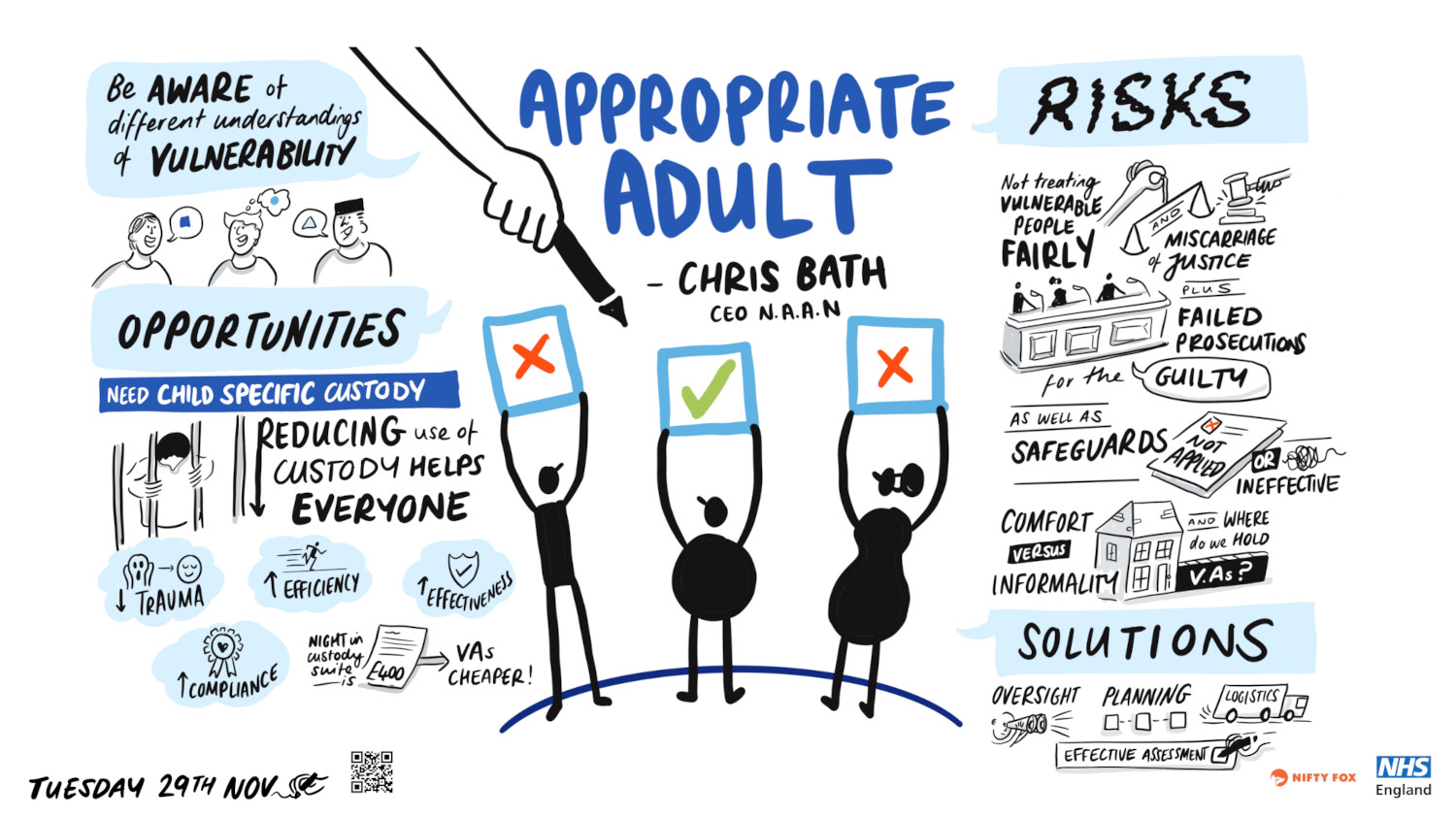
Image: Nifty Fox at the NHS England voluntary interview conference 2022

Voluntary interviews have the potential to support compliance with international human rights standards, domestic legislation and the expectations of courts, including:

  • the use of detention only when necessary
  • the making of adjustments to meet individual need.

Voluntary interviews avoid the costs and risks associated with police custody, including financial, psychological, and physical. 

Risks

Voluntary interviews also present risks and challenges of their own, including:

  • Inadequate assessment of needs
  • Lower identification of PACE vulnerability 
  • Failure to apply procedural safeguards
  • Lack of access to services (e.g. healthcare) 
  • Lack of consistency in invitations and delivery
  • Potential informality
  • Variable understanding of their legal status and consequences
  • Lack of oversight equivalent to the custody sergeant
  • Ensuring sufficient officer training on PACE safeguards
  • Logistical challenges (e.g. for AA schemes)

Together, these issues present risks to the integrity of the process, and may even contribute to false confessions.

Video: NAAN at the NPCC/NHS voluntary rountable 2017

  • Independent oversight

    In police custody, the role of the custody officer is independent of the investigating officer.  In voluntary interviews, the investigating officer is responsible for everything; both investigating and ensuring the PACE safeguards against themselves - a risky tension.

  • Knowledge and skills

    Custody officers deal with the PACE safeguards around questioning vulnerable suspects all day every day. Investigating officers are less likely to be familiar with the relevant rules, and the identification of vulnerable people.

  • Fairness

    Children and vulnerable people may not fully appreciate that voluntary interviews are full PACE interview, with the same legal risks as an interview in custody. They may perceive it as an informal conversation and may be less likely to obtain legal advice.

Solutions

We are working collaboratively to minimise the risks and maximise the opportunities of voluntary interviews. 

  • AA schemes

    Since 2015, we've been conducting research and raising awareness of the issue of AA coverage of voluntary interviews

  • Custody Visitors

    In 2016, we worked with ICVA on a paper presented to Home Office PACE Strategy Board on the use of voluntary interviews and safeguards 

  • Policing

    In 2017 we helped the National Police Chiefs' Council develop national guidance on voluntary interviews. In 2023 we're working together again on a new version.

  • Home Office

    In 2018, we secured significant updates to PACE Act 1984 statutory Code C, which provide greater clarity and detail for police officers on the applicabilty of PACE safeguards under voluntary interview.

  • Commissioners

    In 2020, we updated our national guidance to ensure that commissioners of AA provision are aware of the need to include coverage for voluntary interviews within specifications and budgets.

  • NHS

    In 2022, we presented on the risks, challenges and solutions at voluntary interview conferences run by NHS England Liaison & Diversion.

Interested in knowing more ...?

Identifying vulnerability

Policy

Every month, thousands of people with additional needs go unidentified when detained or questioned by police in England and Wales.

This means many people, including those with learning disabilities, mental illnesses, and neurodiverse people, do not get the support of an appropriate adult as required by law.

Read more

Vulnerable people

Policy

We're are not just working on identification. Did you know that while local authorities have a legal duty to provide an appropriate adult for children, there's no equivalent duty to provide one for vulnerable adults?

Click below to find out more, and catch up on our latest activities, updates and media.

Read more

About AAs

Information

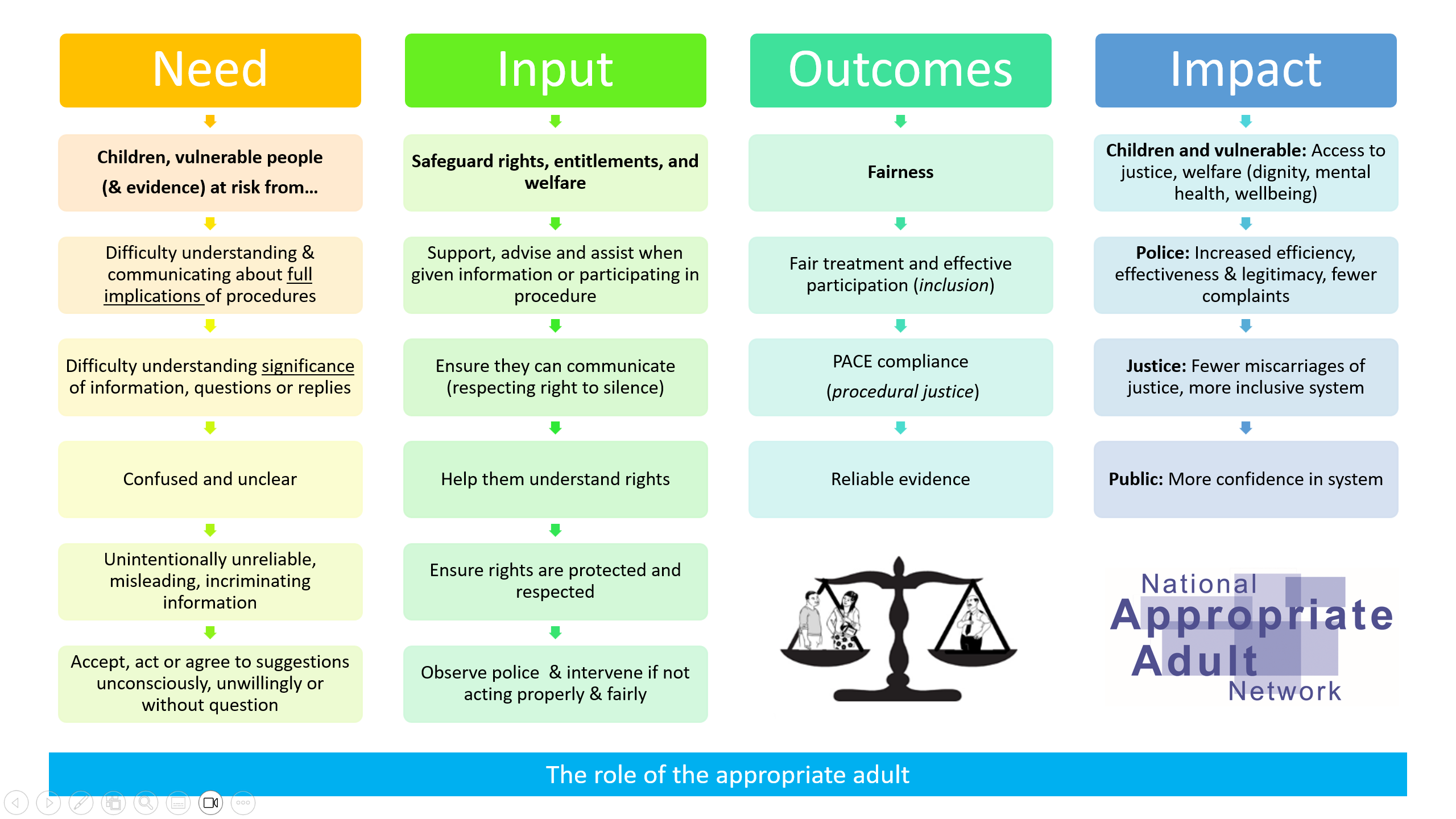
The role of the appropriate adult is to safeguard the interests, rights, entitlements and welfare of children and vulnerable people who are suspected of a criminal offence, by ensuring that they are treated in a fair and just manner, and are able to participate effectively.

Discover more about the appropriate adult role, and find your local scheme.

Read more

Continue reading

Get involved

Interested in supporting our work?

Here are a few ways you can get involved.

  • Become a donor

    • Help us achieve our mission
    • Enable us to reclaim gift-aid on your contribution (donations by UK tax-payers are boosted 25p for every £1 you donate).

    Most suitable for: People who are in a position to help financially

    Donate

  • Become a member

    • Help us achieve our mission
    • Access to guidance for scheme coordinators
    • Access to the iKAAN practitioner guidance for all your organisation's AAs 
    • Support by phone and email
    • Regular e-updates straight to your inbox
    • Up to 2 x free tickets to every NAAN Professional Development Day + access to speaker videos and presentations
    • Applications are considered by the Board of Trustees and acceptance is at their discretion

    Most suitable for: Organisations who comission, run or have an interest in organised AA schemes, researchers 

    Discover membership

  • Volunteer as an appropriate adult

    • Provide support to individual children and vulnerable adults
    • Attend police custody suites and interviews
    • Volunteer as an AA for one of our local member organisations 

    Most suitable for: People who want to help individuals in their local area

    Volunteer as an AA

  • Take part in research

    • Give your expertise to members of our research community

    Take part in research

  • Work for NAAN

    • Join our small national team

    Current vacancies

  • Volunteer for NAAN

    • Support NAAN's national work (e.g. fundraising, professional advice, research) 
    • Volunteer from home by email and phone

    Most suitable for: People who want to help at the national level

    Volunteer for NAAN

  • Become a trustee

    • As a charity, NAAN is governed by a board of voluntary trustees

    Put yourself forward

Continue reading

About appropriate adults

The role of the appropriate adult is to safeguard the interests, rights, entitlements and welfare of children and vulnerable people who are suspected of a criminal offence, ensuring that they are treated in a fair and just manner, and are able to participate effectively.

Video summaries

About AAs

Watch this short video to find out:

  • What is the role of an appropriate adult?
  • Why was the appropriate adult role created?
  • What can appropriate adults do?
  • How long do appropriate adults spend in custody?
  • Are appropriate adults really necessary?

Use the chapter function to skip to any question.

Being an AA

This video was developed to inform people who have been asked to be an appropriate adult for someone they know. Use the chapter function to skip to any part.

'Being an AA' was created by Dr Miranda Bevan (London School of Economics / Economic and Social Research Council) and the National Appropriate Adult Network. For more see our information for family and other supporters.  

Frequently asked questions

Why do appropriate adults exist?

Public concern over the Maxwell Confait murder case in 1972 led Parliament, via a Royal Commission, to pass the Police and Criminal Evidence Act 1984 (PACE) and its Codes of Practice.

PACE set out the rules and safeguards for policing in England and Wales including role of the appropriate adult (AA).

The principal intention of the AA safeguard was to reduce the risk of miscarriages of justice as a result of evidence being obtained from vulnerable suspects which, by virtue of their vulnerability, led to unsafe and unjust convictions.

Where the suspect is a child or vulnerable person, PACE requires the presence of an AA for many procedures.

  • Police & Criminal Evidence Act 1984

    Code C 1.7

    The role of the appropriate adult is "to safeguard the rights, entitlements and welfare of juveniles and vulnerable persons to whom the provisions of this and any other Code of Practice apply”.

  • Crime & Disorder Act 1998

    Section 38(4)

    The role of the appropriate adult is "to safeguard the interests of children and young persons detained or questioned by police officers”.

What difference do appropriate adults make?

Outcomes for children and vulnerable people

The main outcomes for children and vulnerable people are that they are:

  • treated fairly with respect for their rights and entitlements
  • able to participate effectively in procedures related to the investigation and/or their detention.

In addition, research with people who have been supported by appropriate adults has indicated benefits to mental health, emotional wellbeing, personal dignity and freedom from abuse. For example, research by Bristol University found that service users felt supported emotionally, and more protected against mockery, intimidation, fear, dehumanising, bullying and isolation. People appreciated the support for reasons other than those defined in PACE (identifying other personal factors such as gender or ethnicity as important in generating vulnerability).

Moreover, the positive impact of such support systems extends into the realm of physical health, particularly in terms of managing stress-related conditions.

Outcomes for the justice system

From a wider justice system perspective, the AA safeguard means greater integrity, including a better quality of evidence. This reduces both the risk of evidence being excluded at trial and the risk of miscarriages of justice. It is not in the interests of justice for guilty people not to be held account, or for innocent people to be punished.

What can appropriate adults do?

Many police processes cannot take place without an appropriate adult. Appropriate adults are expected to be an active participant. In order to be effective, they need to be assertive, speak up and intervene - not simply be a passive observer. 

PACE Code C 1.7A states that the appropriate adult is expected, amongst other things, to:

  • support, advise and assist them when, in accordance with this Code or any other Code of Practice, they are given or asked to provide information or participate in any procedure;
  • observe whether the police are acting properly and fairly to respect their rights and entitlements, and inform an officer of the rank of inspector or above if they consider that they are not;
  • assist them to communicate with the police whilst respecting their right to say nothing unless they want to as set out in the terms of the caution;
  • help them to understand their rights and ensure that those rights are protected and respected."

Click an action to find out more.

  • 1. Advise, support and assist

    In relation to information and procedures, AAs have a role in helping children and vulnerable people to:

    • understand their rights;
    • use their rights;
    • participate effectively.

    This involves: 

    • checking whether a person understands the meaning and significance of information provided to them;
    • checking whether a person understands the meaning and significance of questions asked of them, and their own replies, including when they are asked to give their consent to procedures;
    • helping a person to understand the meaning and significance of information and questions; 
    • providing general, non-legal, advice about custody procedures and their rights, including on the scope and limit of the AA role vs accessing legal advice.

    Importantly, AAs may not give legal advice. This is the role of the solicitor or police station legal representative. However, the AA can require a solicitor to attend, even if a person has waived their right to legal representation. 

  • 2. Observe and inform

    AAs have a role in:

    • ensuring police are treating a person in compliance with their rights and entitlements;
    • observing whether a person’s condition/state has deteriorated or otherwise changed;
    • escalting issues that have not been resolved by investigating officers, detention officers or custody sergeant to higher ranked officers;
    • ensuring any issues are recorded on the interview and/or custody record so that this information is available to courts.
  • 3. Assist communication

    AAs have a role in helping people to understand, and be understood, when they are detained or questioned. This includes helping them to maintain their right to silence if that's what they want to do.

    AAs may not:

    • assist the interviewer in getting information or confessions that the person does not wish to give. The AA role was developed as a safeguard in response to concerns about false confessions. If the AA acts as an 'agent of the interrogation', they are not acting as independent of the police and courts are likely to question the reliability of evidence gained.
    • be able to meet very significant speech, language and communication needs. In some cases it may be neccessary to appoint a qualified professional (e.g. an intermediary) to conduct a formal assessment and potentially provide additional support with communication. 
  • 4. Protect rights

    AAs have a role in:

    • checking that people understand their rights, entitlements and the caution, including by asking them questions to test understanding;
    • asking police officers to provide further explanation where required;
    • providing information or explanations about rights, entitlements and the caution;
    • talking to people who waive their right to free legal advice about any misconceptions they may have;
    • requiring a solicitor to attend where they believe it to be in the best interests of a vulnerable suspect; 
    • intervening in interviews to protect rights;
    • making representations in relation to rights, such as during reviews of detention; 
    • engaging with police, lawyers and medical professionals in the interests of protecting a person's rights.
  • Police and Criminal Evidence Act 1984

Who do appropriate adults support?

Appropriate adults support suspects who are detained and/or interviewed by police under PACE. The police custody sergeant is responsible for identifying people who require an AA. These fall into two categories, described below. Once the need has been identified, many police processes can not take place without an appropriate adult. 

Children

This includes anyone who appears to be under 18.

At NAAN we use the term 'children' for people aged under 18. PACE uses the term 'juvenile'. Other areas of law refer to 'children and young people'. However, since 2013 when 17 year olds were finally recognised as juveniles, these have all meant the same thing. 

The minimum age of criminal responsbility in England and Wales is 10 years old (one of the lowest in the world). 

Vulnerable people

The definition of vulnerability in PACE was changed in July 2018. 

Put simply, a person is now vulnerable if a police officer has any reason to suspect the person may:

  • have difficulty understanding the full implications or communicating effectively about anything to do with their detention; or
  • have difficulty understanding the significance or things they are told, questions, or their own answers; or
  • may be prone to confusion, suggestibility, or compliance
  • may be prone to providing unintentionally unreliable, misleading or self-incriminating information.

Find out more about PACE vulnerability

Relevant conditions include (but are not limited to):

  • mental illness
  • learning disabilities
  • autism
  • brain injury.

The requirement for an AA still applies if: 

  • there is no formal medical diagnosis or opinion from a heathcare professional
  • it is a minor offence
  • it is a terrorism offence
  • there is a legal advisor present
  • there is no organised AA scheme in the area
  • the person says they do not want an appropriate adult

The requirement for an AA does not apply if there is "clear evidence to dispel" the police officer's reason to suspect. 

Are appropriate adults required for 'voluntary interviews'?

The simple answer is yes.

Some people can find it frustrating to be told they need an appropriate adult. It can make people feel like they are being told there is something wrong with them, or that they are child-like in some way. So it is important that the requirement on police to involve an AA is clearly and correctly explained. 

Unlike legal advice, the AA is not one of our 'rights' if we are suspected of a crime and we are a child or a vulnerable person. Instead, it is a 'procedural safeguard' that is imposed on police when dealing with any child or person about whom there reason to suspect they may be vulnerable (as defined by PACE Code C 1.13(d) in the video above). This means that, unlike rights such as legal advice, it cannot be waived by either children or vulnerable adults. It does not matter whether the person has 'capacity' to make decisions for themselves. They are not being asked to make a decision. Although this can feel difficult for the AA's relationship, and contrary to the idea of individual empowerment, it is a legal requirement and is intended to protect people. 

Police & Criminal Evidence Act 1984

Code C 1.7

  • the police custody officer or custody staff  shall determine whether the detainee is a juvenile and/or vulnerable and therefore requires an appropriate adult (paragraphs 3.5); and
  • if so they must, as soon as practicable, ensure that the appropriate adult is informed of the grounds for their detention; their whereabouts; and the attendance of the appropriate adult at the police station to see the detainee is secure (paragraph 3.15). 

Do the police have to involve an appropriate adult?

Police interviews

Police increasingly deal with people they suspect of a criminal offence via a 'voluntary interview' under caution, rather than in police custody.

This means they are not under arrest when interviewed and they do not have to attend. Otherwise, the same rules and safeguards apply - appropriate adults are required for voluntary interviews of children and vulnerable adults who are suspected of an offence.

The police can use any evidence they get from the interview in the same way as they would if the interview was in custody. 

Find out more about the benefits and risks of police voluntary interviews.

Non-police interviews

If you have been invited to an interview under caution by a non-police interviewer things are a little more confusing.

They still have to follow PACE Code C, so the need for an AA and the right to legal advice still apply. But if they don't have their own legal power of arrest then you have to arrange (and pay for) your own solicitor.

And because there is no legal duty on anyone to provide an appropriate adult for these interviews, most AA schemes do not cover them. If you have been invited to interview and do not have someone who you'd like to be your AA, you should make them aware of any reason to suspect you may be vulnerable, and ask them what provision they will make for an appropriate adult. 

Other investigative bodies that follow PACE Code C:

  • Health and Safety Executive (HSE)
  • Environment Agency
  • Trading Standards
  • Care Quality Comission (CQC)
  • NHS counter-fraud
  • Local Authorities
  • His Majesty's Revenue and Customs (HMRC)
  • Department for Work and Pensions (DWP)

Do appropriate adults support children and vulnerable adults in court?

The appropriate adult role, as defined by the Police and Criminal Evidence (PACE) Act 1984, does not continue on into the court stage.

This applies even if a 'virtual court' is used while the person is still in the police station. 

However, there are some circumstances in which children and vulnerable adults can have support in a court. These are covered in the Criminal Practice Directions and highlighted here.

  • Welfare responsibilities

    The police must notify the court that "any required appropriate adult has been notified and is available" (Criminal Practice Directions II paragraph 7A.5(a)(iv)).  

    Confusingly, this doesn't mean the same thing as "appropriate adult" under PACE. It means a person with ongoing welfare responsibilities towards the defendant such as their parent, relative or social worker. They may have been the AA during the police investigation but there is no requirement for it to be the same person. 

    This does not apply to an appropriate adult provided by an organised AA scheme or any other independent AAs whose attendance at the police station was arranged in the absence of any parent, relative or social worker. In the courts' view, no such person in that category is likely to be required by the court in the way that a parent, relative or social worker, etc. may be required.

  • Intermediary

    Defendants with a high level of communication needs may be provided with a communications specialist known as an 'intermediary'.

    However, it is up to the court to decide whether one is needed. There is no presumption that they'll get one. Even even where they think an intermediary would improve the trial process, they don't have to appoint one. The appointment of intermediary happens 'rarely' (Criminal Practice Directions, paragraph 3F.12).

    The intermediary provides an independent, professional assessment and clear recommendations to the court. They may be provided for part of the trial or all of it.

    The intermediary role is not the same as an AA. They are impartial (they are not 'on the person's side'). They provide specialist professional communication support only. They do not provide advice or welfare support. 

    Providers of intermediaries include: Communicourt; Intermediaries for Justice; Triangle.

  • Appropriate companion

    While courts will only rarely appoint an intermediary, they do have another option if the person needs more help to follow the proceedings than their legal representatives can give. 

    According to the Criminal Practice Directions, paragraph 3F.12,the court should consider "sympathetically" any application for the defendant to be accompanied throughout the trial by a "support worker or other appropriate companion".   

    There are no guidelines for this role. It is not the same as either an appropriate adult under PACE, or an intermediary. 

Do appropriate adults support vulnerable victims or witnesses?

No, it is not the role of the appropriate adult to support victims or witnesses.

Appropriate adults have not been required in witness interviews since the PACE Codes revision of 1st April 2003, when ‘witness statements’ were removed from the list of circumstances in which an appropriate adult is needed during interviews in Code C paragraph 11.15. However, Ministry of Justice guidance includes the role of 'interview supporters' as distinct from AAs.

There are also a range of services for victims. 

Support for victims and witnesses

Do appropriate adults support children in age assessments?

Local authority age asessment interviews (of unaccompanied asylum-seeking children) require an 'appropriate adult' to be present.

However, these interviews are part of the immigration system, not the the criminal justice system. 

The role of an appropriate adult is not the same and NAAN does not provide guidance for the AA role in age assessments. 

Who can act as an appropriate adult?

The appropriate adult role is filled by many different types of people, including: 

  • parents or other family members
  • friends or carers
  • social workers
  • charity workers
  • specialist trained appropriate adults (either paid or voluntary). 

Local authorities have a legal duty to ensure provision of an appropriate adult for a child (under 18)  who is detained or questioned by police. However, there is no legal duty to ensure provision of an appropriate adult for a vulnerable person. This is something that NAAN is working to change. 

Who the police have to ask to be the appropriate adult first is different for children and vulnerable adults. They have to follow the rules in PACE Code C 1.7.

  • Who police should ask for children

    PACE Code C 1.7(a)

    (i) the parent, guardian or, if the juvenile is in the care of a local authority or voluntary organisation, a person representing that authority or organisation;

    (ii) a social worker of a local authority; 

    (iii) failing these, some other responsible adult aged 18 or over who is not:

    • a police officer;
    • employed by the police;
    • under the direction or control of the chief officer of a police force; or
    • a person who provides services under contractual arrangements (but without being employed by the chief officer of a police force), to assist that force in relation to the discharge of its chief officer’s functions.

  • Who police should ask for vulnerable people

    PACE Code C 1.7(b)

    (i) a relative, guardian or other person responsible for their care or custody;

    (ii) someone experienced in dealing with vulnerable persons but who is not:

    • a police officer;
    • employed by the police;
    • under the direction or control of the chief officer of a police force; or
    • a person who provides services under contractual arrangements (but without being employed by the chief officer of a police force), to assist that force in relation to the discharge of its chief officer’s functions,

    whether or not they are on duty at the time;

    (iii) failing these, some other responsible adult aged 18 or over who is other than a person described in the bullet points in sub-paragraph (ii) above.

    PACE Code C Note 1D explains that, where a vulnerable person prefers a relative to a better qualified stranger, or objects to a particular person, their wishes should if practicable be respected.

Who cannot act as an appropriate adult?

Under the PACE Codes, people are not allowed to be an appropriate adult if they are: 
  • under the age of 18; or
  • connected to the police, 

unless they are:

  • the parent or guardian (supporting a child), or
  • a relative, guardian, or carer (supprting a vulnerable person).

See the panels on PACE Code C 1.7 above for more information. 

The PACE Codes also state that people (including parents and guardians) should not be an appropriate adult if they: 
  • may be a suspect, victim, witness or otherwise involved in the investigation 
  • have received admissions from the person, or were present when they were given, prior to acting as their AA 
  • are a parent who is estranged from a child and the child expressly and specifically objects to their presence.
  • are a solicitor or independent custody visitor who is at the police station in those capacities
  • are suspected of involvement in the commission, preparation or instigation of terrorism (only if the person is being held under terrorism laws).
People with other roles also need to be cautious: 
  • If a child is interviewed at their educational establishment, the principal of the establishment (or someone they nominate) can act as their AA but only if (a) waiting for the parent or alternative AA would cause 'unreasonable delay' and (b) the offence is not against that establishment.
  • A magistrate can be an appropriate adult, but there are important conditions. They will usually need to do it in a different local justice area from the one they sit in, and they cannot be on the youth panel for the area where they act as an AA. Eligibility is decided by their local advisory committee.
  • Any person should think carefully about whether they have any potential conflict of interest with the person they are being asked to support (such as having a professional duty that conflicts with confidentiality, or even simply already knowing and disliking them).

Does a criminal record stop you being an appropriate adult?

No. Nothing in the PACE Codes prevents a person with a criminal record from being an appropriate adult.

Family AAs

Ultimately, it is the custody officer who decides whether you are suitable. However, beyond the situations set out in in this section, the PACE Codes give them no criteria to apply. There is no exclusion for criminal records in PACE. A police officer may not run a Police National Computer check on you unless it is for a 'policing purpose'. 

Scheme AAs

People who wish to join local appropriate adult schemes are vetted by the organisation (e.g. council or charity). They are not subject to police vetting. 

If you want to join an appropriate adult scheme, the scheme will carry out DBS (criminal record) checks before you start. NAAN's National Standards set out what level of DBS check is legally permitted for each kind of role. They also say that schemes should have a written policy on criminal records, should not ask about convictions on the application form, and should give applicants the chance to explain the circumstances of any record and what has happened since. DBS checks are not pass/fail. 

Direct personal experience can be a powerful asset in the role. A criminal record does not disqualify you, and NAAN encourages schemes to recruit people with lived experience of the criminal justice system. We provide detailed guidance for members on DBS checks and vetting. 

How do I become an appropriate adult?

Appropriate adults are organised at a local level. Recruitment is carried out by local AA schemes.

NAAN does not recruit appropriate adults.

However, as the national membership charity for local AA schemes (and anyone else interested in appropriate adults) we offer information about the role and can help you find a local scheme.

To find out more

Visit our becoming an AA section.

Continue reading

Every service has its terms. These are ours.

These Terms of Service ("Terms") govern your access to and use of the National Appropriate Adult Network (NAAN) website, products and services ("Products"). Please read these Terms carefully and contact us if you have any questions. By accessing or using our Products, you agree to be bound by these Terms.

You can only use iKAAN for free if you are currently an AA for current member of NAAN

You can only use our Products in compliance with these Terms and all applicable laws. When you create your account, you must provide us with accurate and complete information. You must certify that you are currently an appropriate adult for a scheme that holds an active NAAN membership. NAAN will make checks and will remove accounts that do not meet this requirement. If your organisation is not a current member and you would like access, you can contact us as This email address is being protected from spambots. You need JavaScript enabled to view it..

Your account is just for you.

Subject to these Terms and our policies, we grant you a limited, non-exclusive, non-transferable and revocable licence to use our Products. NAAN may terminate or suspend this licence at any time, with or without cause or notice to you.

You can’t use our products and services to provide training or consultancy for money

If you want to use our Products for commercial purposes (such as providing training or consultancy to third parties), you need to get our agreement first. For the avoidance of doubt, iKAAN is intended to help individual appropriate adults be effective in their role, irrespective of whether they are based in the public, private or charitable sector.

We will look after your data carefully and only use it for certain purposes

All data is securely held by the National Appropriate Adult Network (NAAN) under the terms of the Data Protection Act and will be treated with the utmost care and respect. NAAN will hold your personal data securely in accordance with the Act under which it is fully registered.

Data that you give to NAAN will be used by NAAN staff and agents contracted by NAAN for purposes directly related to the interests of NAAN. NAAN reserves the right to use external vendors to operate its IT environments including the website within which iKAAN operates. Any or all data provided to NAAN might be transported and stored outside the UK, but such movement and storage will be performed under appropriate safeguards and security provisions such as, for example, in the USA under the EU–US Privacy Shield. Data will not be disclosed to external organisations other than those acting as agents for NAAN with the exception that NAAN reserves the right to share limited personal data with your AA scheme for the following purposes:

  • Confirming that you are currently an AA with that scheme
  • Informing the scheme which of its AAs are registered with iKAAN

We may communicate with you by email and your data may be used for the following purposes:

  • the distribution of publications
  • the sending of emails, which will be tracked and stored and analysed to ensure that we are better able to tailor our communications
  • fundraising operations except where the individual has expressed a preference not to be included
  • the promotion of benefits and services
  • notification of events, and of programmes
  • information about training courses and professional development opportunities
  • requests to complete relevant surveys
  • research and audit purposes by NAAN and its agents
  • and for any other use deemed to sit within our data protection statement

The Data Protection Act gives you the right to request that your data is not used for any of the above purposes. If you do not wish your personal details to be used by NAAN for any or all of the above purposes, you can let us know at any time by emailing This email address is being protected from spambots. You need JavaScript enabled to view it.

If you do not wish your personal details to be held by us we will remove contact details from your record. You can let us know at any time by emailing This email address is being protected from spambots. You need JavaScript enabled to view it.. Please note that unless we hold your name and a valid email address, some products and services will not be avalable to you.

Under the Data Protection Act you have the right to be told whether information exists about you, and the right to receive the information.

We can use your suggestions to make things better.

We value hearing from our users and we are always interested in learning about how we can make iKAAN better. If you choose to submit comments, ideas or feedback, you agree that we are free to use them without any restriction or compensation to you. By accepting your submission, NAAN does not waive any rights to use similar or related feedback previously known to NAAN, or developed by its employees, or obtained from sources other than you.

We all need to respect copyright

NAAN respects the intellectual property rights of others and we expect our users to do the same. All the information on our website is copyrighted. You may make printed copies of the content for your own use. Fair use of the content (copying done for a limited and transformative purpose, such as to comment upon or criticize) is acceptable, subject to the other terms in this agreement. We will close the accounts of people who infringe copyright.

Where we link to content outside of NAAN we're not responsible for it.

Our Products may contain links to third-party websites that are not owned or controlled by NAAN. We do not endorse or assume any responsibility for any such third-party sites, information, materials, products or services. If you access any third-party website, service or content from our website, you do so at your own risk and you agree that NAAN will have no liability arising from your use of or access to any third-party website, service or content.

If you or your organisation are sued because you acted on the basis of content on our site, we are not liable.

You agree to indemnify and hold harmless NAAN and its respective officers, directors, employees and agents, from and against any claims, suits, proceedings, disputes, demands, liabilities, damages, losses, costs and expenses, including, without limitation, reasonable legal and accounting fees (including costs of defence of claims, suits or proceedings brought by third parties), in any way related to your access to or use of our Products.

To the maximum extent permitted by law, NAAN shall not be liable for any indirect, incidental, special, consequential or punitive damages, or any loss of profits or revenues, whether incurred directly or indirectly, or any loss of data, use, goodwill or other intangible losses resulting from your access to or use of or inability to access or use the products. In no event shall NAAN's aggregate liability for all claims relating to the products exceed one hundred pounds sterling (£100.00).

We try hard but we cannot guarantee the accuracy of information

All included content is provided on an "as is" basis without warranty of any kind, whether express or implied.

Personal data we may collect from you

We collect and process the following data about you:

  • Information that you provide by filling in forms on our website (our site) . This includes information provided at the time of making a donation, applying for membership, completing a training or general enquiry form, or registering for an iKAAN account. We may also ask you for information if you report a problem with our site.
  • Information or material that you post or contribute to our site.
  • Information provided by you in correspondence (for example when you contact us with a query)
  • Information you provide when booking onto one of our events, training courses or qualifications.
  • Information you provide when responding to a consultation or survey.

Where we store your personal data

NAAN reserves the right to use external vendors to operate its IT environments including our website(s) and elements within them (e.g. iKAAN). The data that we collect from you may be transferred to, and stored at, a destination outside the UK, EU or European Economic Area ("EEA"). It may also be processed by staff operating outside those areas who work for one of our suppliers. Such movement and storage will be performed under appropriate safeguards and security provisions such as, for example, in the USA under the EU–US Privacy Shield. Such staff may be engaged in, among other things, the fulfilment of your order or the provision of support services. By submitting your personal data, you agree to this transfer, storing or processing. We will take all steps reasonably necessary to ensure that your data is treated securely and in accordance with this privacy policy.

Security

All data is securely held by the National Appropriate Adult Network (NAAN) under the terms of the GDPR and Data Protection Act 2018 (‘the Act’) and will be treated with the utmost care and respect. NAAN is registered with the Information Commissioners Office and will hold your personal data securely in accordance with the Act

All information you provide to us via the website is stored on servers provided by our website hosting provider and/or our constituent relationship management (CRM) provider. Unfortunately, the transmission of information via the internet is not completely secure. Although we will do our best to protect your personal data, we cannot guarantee the security of your data transmitted to our site; any transmission is at your own risk. Once we have received your information, we will use strict procedures and security features to try to prevent unauthorised access, using only providers that have stated that their software is compliant with GDPR.

Where you have chosen a password which enables you to access certain parts of our site, you are responsible for keeping this password confidential. We ask you not to share a password with anyone.

How we use your personal data

Data that you give to NAAN will be used by NAAN staff and agents contracted by NAAN for purposes directly related to the interests of NAAN.

We may communicate with you by email, telephone, letter or other reasonable means and your data may be used for the following purposes:

  • To maintain our organisational records
  • To provide you with information concerning appropriate adults, children and vulnerable adults, related criminal justice matters and NAAN products and services
  • The distribution of publications
  • The sending of emails, which will be tracked and stored and analysed to ensure that we are better able to tailor our communications
  • Fundraising operations except where the individual has expressed a preference not to be included
  • The promotion of benefits and services
  • Notification of events, and of programmes
  • Information about training courses and professional development opportunities
  • Requests to complete relevant surveys
  • Research and audit purposes by NAAN and its agents
  • To allow you to participate in interactive features of our service and website
  • To notify you about changes to our service
  • Updates and information about goods and services that you request from us or which we feel may interest you
  • Any other use deemed to sit within our data protection statement.

The Data Protection Act gives you the right to request that your data is not used for any of the above purposes. If you do not wish your personal details to be used by NAAN for any or all of the above purposes, you can let us know at any time by emailing This email address is being protected from spambots. You need JavaScript enabled to view it.

Disclosure of your personal data

In order to invite you to member meetings, your email address may be disclosed to other members via the address bar in a calendar invitation.

If you register a scheme as a member of NAAN and you are the primary contact on that membership account, some of your personal information (e.g. name, email address and telephone number) may be publicly available on our Network Map. As the primary contact, your work email address may be revealed to other primary contacts via invitations to NAAN network meetings.

If you register a iKAAN account, data will not be disclosed to external organisations other than those acting as agents for NAAN with the exception that NAAN reserves the right to share limited personal data with your AA scheme for the following purposes:

  • Confirming that you are currently an AA with that scheme
  • Informing the scheme which of its AAs are registered with iKAAN

We will not otherwise disclose your information to a third party unless we have your explicit permission.

Access to your personal data

GDPR gives you various rights about the information held about you. You have the right to view, amend and delete the information we hold about you. You also have the right to restrict how we use this information and to object to us using the information at all. Your rights can be exercised at any time by emailing This email address is being protected from spambots. You need JavaScript enabled to view it.

Please note that deletion of certain personal data may result in some services becoming unavailable to you.

External links on our website

Our site often contains links to external websites. If you follow a link to any of these websites, please note that these websites have their own privacy policies and that we do not accept any responsibility or liability for these policies. Please check these policies before you submit any personal data to these websites.

Changes to our privacy policy

Any changes we may make to our privacy policy in the future will be posted on this page and, where appropriate, notified to you by email.

Contact

Questions, comments and requests regarding this privacy policy are welcomed and should be addressed to This email address is being protected from spambots. You need JavaScript enabled to view it.. If you no longer wish to be contacted by NAAN, please email This email address is being protected from spambots. You need JavaScript enabled to view it..

Complaints

Should you have a complaint or other concerns about NAAN’s information rights practices please contact NAAN in the first instance at This email address is being protected from spambots. You need JavaScript enabled to view it., or on 07739 904858. If our response proves unsatisfactory, you have the option of contacting the Information Commissioner’s Office. Please see https://ico.org.uk/concerns for more information

Cookies

Details of the cookies this website uses, and how to change your choices, are in our cookie policy.

Find an appropriate adult

Requests for an appropriate adult from a local scheme are made by the police

If you feel you need an appropriate adult, tell the police.

PACE Code C 1GA says information from people (and those who know them) is 'relevant information' when they are deciding whether someone may be a vulnerable person. 

What do the police have to do?

An appropriate adult is required for:

  • Every person under 18 
  • People aged 18 or over who may be 'vulnerable'. 

By law, the police must:

  • identify people who may be vulnerable (inculding by making 'reasonable enquiries')
  • secure an appropriate adult. 

The police are not allowed to provide the appropriate adult. This is because an appropriate adult must be indepedent from the police. They cannot be:

  • a police officer
  • a police employee
  • under contract to the poilce
  • under the control or direction of the police. 

Children

If a person is under 18, the police have to start by thinking about whether a parent or guardian can be the appropriate adult.

Adults

If a person is 18 or older, and would prefer a family member to be the appropriate adult, the police should respect their wishes if possible. 

When it can't be a family member

Sometimes it is not possible for a parent or other family member to be the appropriate adult. This might be because they: 

  • are caring for others
  • have work committments
  • may be involved in the investigation, such as being a victim or witness
  • a child objects to an estranged parent
  • an adult does not wish to have them involved. 

Alternatives to family

One alternative is for the appropriate adult to be someone who knows the child or adult professionally. For example, this could be a charity, community or social worker. 

Another alternative is using the local appropriate adult scheme. These are groups of people who are trained to be appropriate adults.

If you feel you need to get an appropriate adult for yourself, or for someone you know, you should tell the police why an appropriate adult is needed (see Who do appropriate adults support?). The police will have the contact details for the local organised scheme.

Please note that NAAN does not provide appropriate adults.

No schemes in your area?

For children

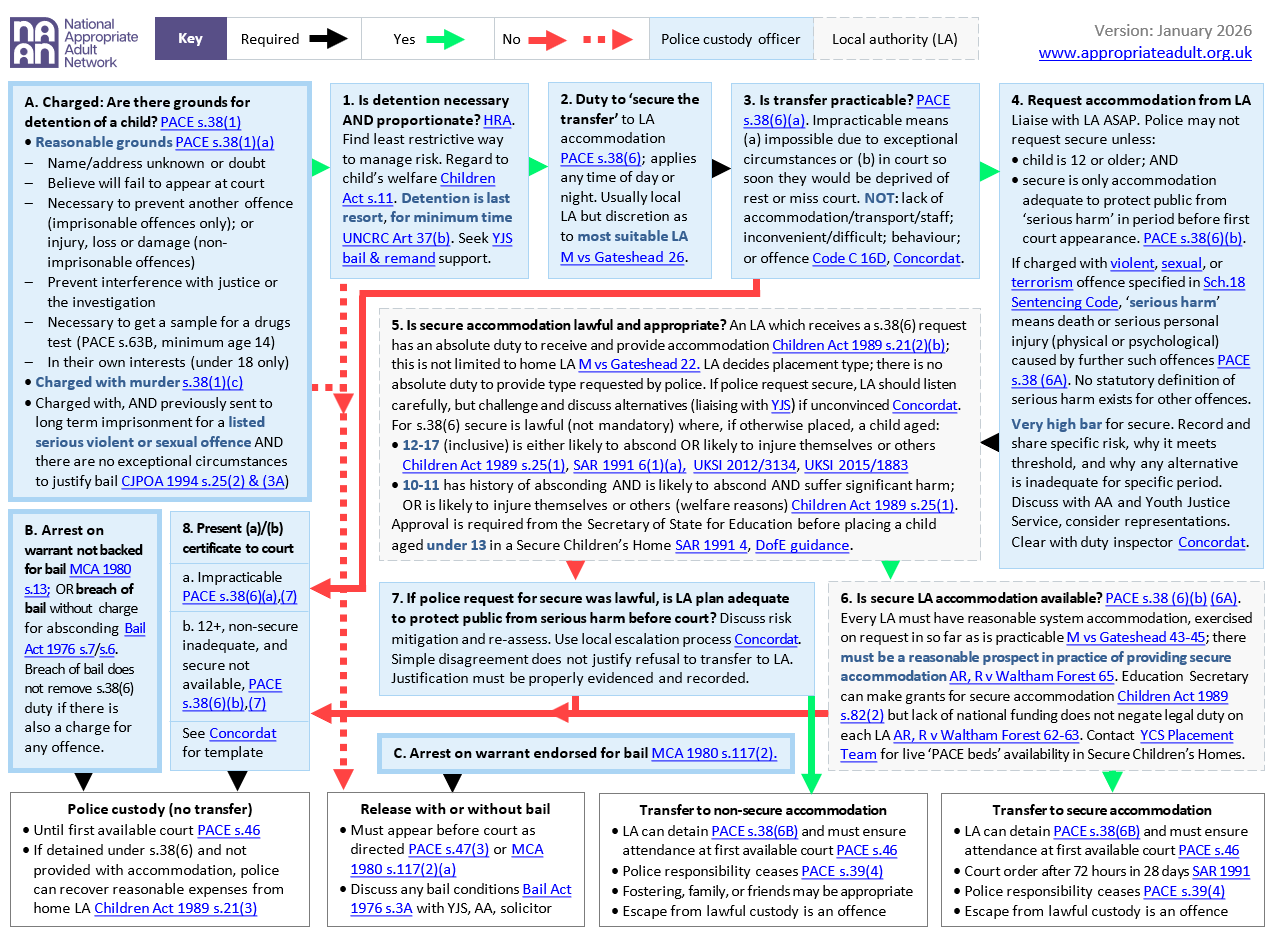
Local authorities have a legal duty under the Crime and Disorder Act 1998 (s.38) to ensure provision of an AA for children via their Youth Offending Team (YOT). Those operating to National Standards will be able to provide trained, vetted AAs.

If we do not have a member organisation in your area click here to contact your local Youth Offending Team.

For adults

Some areas do not have appropriate adult provision for vulnerable adults as nobody is legally required to provide it. However, in many areas organised services exist supported by a range of commisioners and funders.

You may wish to contact the local authority adult social care team in your area. 

Continue reading

For trained AAs

The National Practice Guidance for appropriate adults brings together:

  • legislation
  • case law
  • policy, and
  • best practice

on the treatment of children and vulnerable people who are detained or questioned by police.

How do I get a login?

If you are an appropriate adult

  • Your organisation is a NAAN member

    You can get free access to the National Practice Guidance.

    To get access:

    1. Ask your scheme leader for your Scheme Access Code
    2. Click "Create an account" below
    3. Read the instructions and complete the form
    4. Click "Register".

    Create an account     Enter guidance

  • Your organisation is not a NAAN member

    The National Practice Guidance is available to any appropriate adult whose organisation is a member of NAAN.

    If your organisation is not a NAAN member, it can apply for membership. You will not need to join NAAN.

    Individual membership is available for people who are not part of an organisation. 

    Apply for membership

If you lead an AA scheme

  • Your organisation is a NAAN member

    The National Practice Guidance is included in your membership.

    Just login using your normal account details.  

    Make sure to let all your AAs know your Scheme Access Code, so they can set up their own account.

    Enter guidance

  • Your organisation is not a NAAN member

    The National Practice Guidance is only available to member organisations.

    If your organisation is not a NAAN member, it can apply for membership.

    Apply for membership

Continue reading

Support with developing or commissioning AA provision

We know that high quality development and commissioning is critical to ensuring an effective AA scheme.

That's why we're working to help make that a reality in every area.

If you have responsibility for researching, developing or commissioning appropriate adult provision for your local area, we can help you get the best provision.

  • Guidance

    What is it?

    The National Commissioning Guidance supports anyone involved in:

    • commissioning of appropriate adult provision
    • developing an in-house scheme
    • a hybrid of both approaches.

    It provides practical information and guidance on achieving effective services for children and/or vulnerable adults that meet the national standards. 

    It includes a 50+ page national template specification developed by NAAN in line with the national standards, ready for you to tailor to local needs.

    How do I access it?
    Members

    Enter Guidance

    Non-members

  • Advice and support

    What is it?

    NAAN has years of experience advising commissioners as they research the market and develop their specifications.

    We can provide personalised, detailed and ongoing support with your development or commissioning project; including helping you to compare in-house, commissioned and hybrid provision. 

    How do I access it?
    Members
    • Silver and Gold members have inclusive commissioning advice hours. Just get in touch via the usual email address or number.
    • Bronze members can access the online national guidance. Contact us to discuss your need for support and our standard day rates.  
    Non members
    • Option 1: Apply for Silver or Gold associate membership for inclusive support hours, alongside access to the national commissioning guidance and other benefits
    • Option 2:  Commission us to support your project without joining as a member. We'll be happy to discuss your needs. Contact us. 

  • Connect with the market

    What is it?

    If you have a contract opportunity, and are looking to ensure you have a wide range of bidders, we help make sure the market is fully aware. 

    We have a membership of over 90 organisations, providing AA services across England, Wales and further afield. We can disseminate contract opportunities via our e-update system. 

    How do I access it?
    Members
    • This service is included for Silver and Gold members.
    • Bronze members can upgrade to Silver or Gold membership.
    • Just get in touch via the usual email address or number.
    Non members
  • Framework agreement

    What is it?

    Commissioners are under pressure to do more for less. You face huge challenges when sourcing products and services to help run efficient organisations. You are tasked with delivering value for money and positive community impact. It is important, complex, challenging and resource intensive; but it often feels impossible because budgets and time are so tight.

    NAAN has worked in partnership with YPO to develop the first Dynamic Purchasing System (DPS) for appropriate adult provision. YPO are a local authority-owned procurement organisation, that has vast experience both with the emergency services and health and social care services. 

    The AA framework agreement is ready-made for you to access. It is designed to deliver value for money and be quick and simple to use. 

    It includes a panel of pre-screened prospective providers.

    The YPO team is available to speak to any potential commissioner. 

    How do I access it?

Continue reading

Information on appropriate adults for other professions

In order to achieve their objectives, appropriate adults need to work effectively with a range of professionals.

The information below has been developed to support the development of effective working relationships.

Continue reading

Information for police

Appropriate adults work with police every day, in police environments. Independence from policing is a legal requirement of their role.

As the national body, we work with policing at the national level to increase understanding of the appropriate adult role.

Continue reading