Public articles

Training feedback

We ask learners for feedback after every training session we deliver. We do this because we want to know:

  • that our training makes a positive difference
  • how we can continuously improve our training.

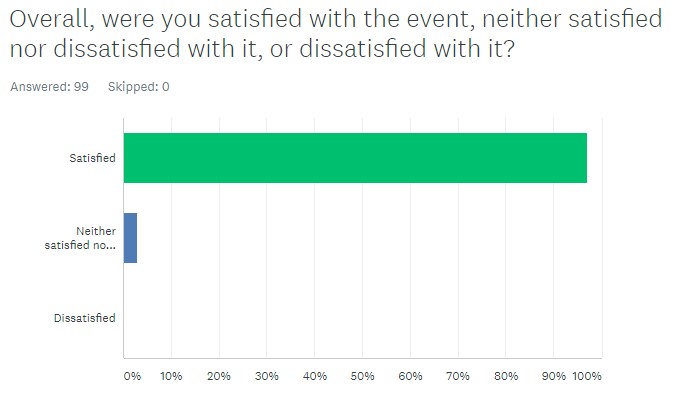
Here's a summary of overall satisfaction...

2019 survey training satisfied

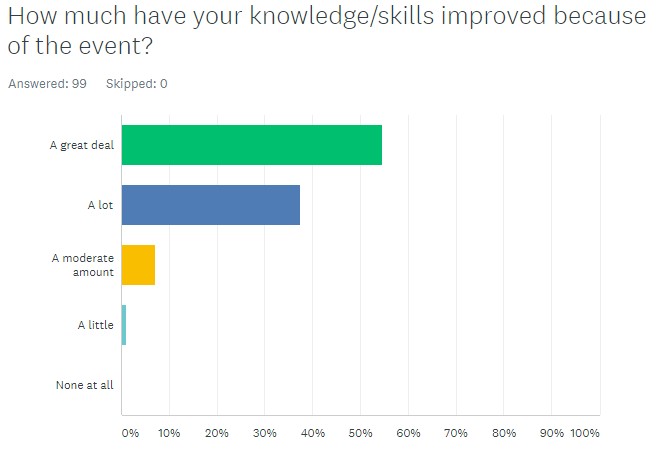
And a summary of how much people felt they learnt...

2019 survey training learning

To see more learner feedback please:

[widgetkit id=14]

Police must secure an appropriate adult whenever they arrest, or voluntarily interview, a person who they "have a reason to suspect may be a vulnerable person" (as defined by PACE Code C).

Across the country, police forces are increasingly developing and supporting card-based identification schemes. These cards can be helpful in assisting police to identify mental vulnerabilities. They are all voluntary.

Click on a card name below for more information. If you know of a scheme that's not listed, please tell us about it.

The National Police Autism Association also keeps a helpful list of police forces with links to alert cards.

Card name Police forces area
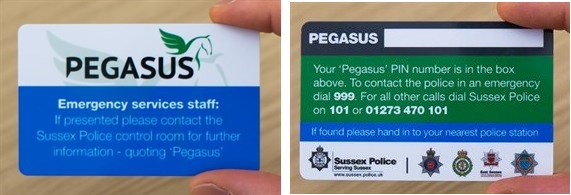
Pegasus Nottinghamshire, Lincolnshire, City of London, Surrey, Sussex, Bedfordshire, Hertfordshire and Cambridgeshire
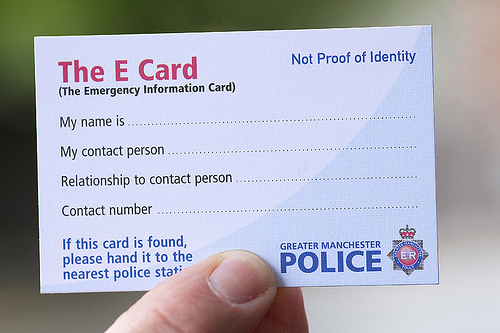
E-Card Greater Manchester
Keep Safe Cymru South Wales
Autism Alert National Autistic Society alert card - not a police scheme
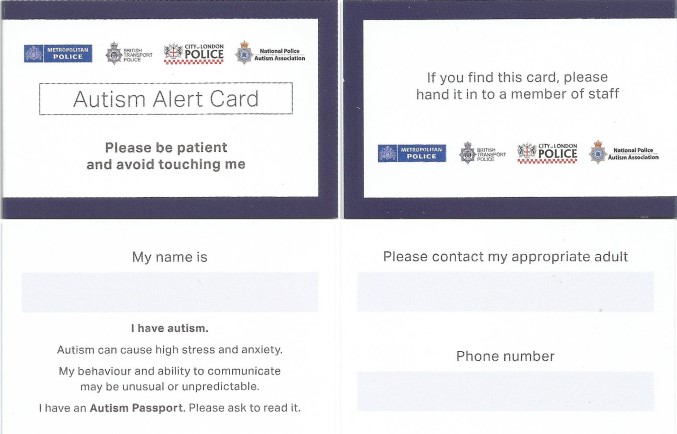
Autism Alert 1 Metropolitan, City, British Transport Police (London)
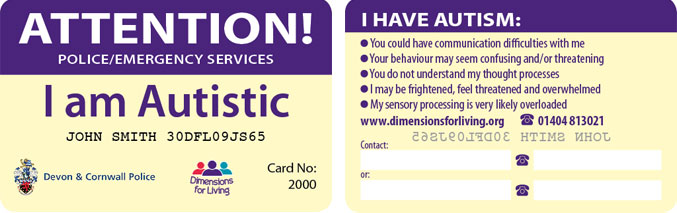
Autism Alert 2 Devon & Cornwall
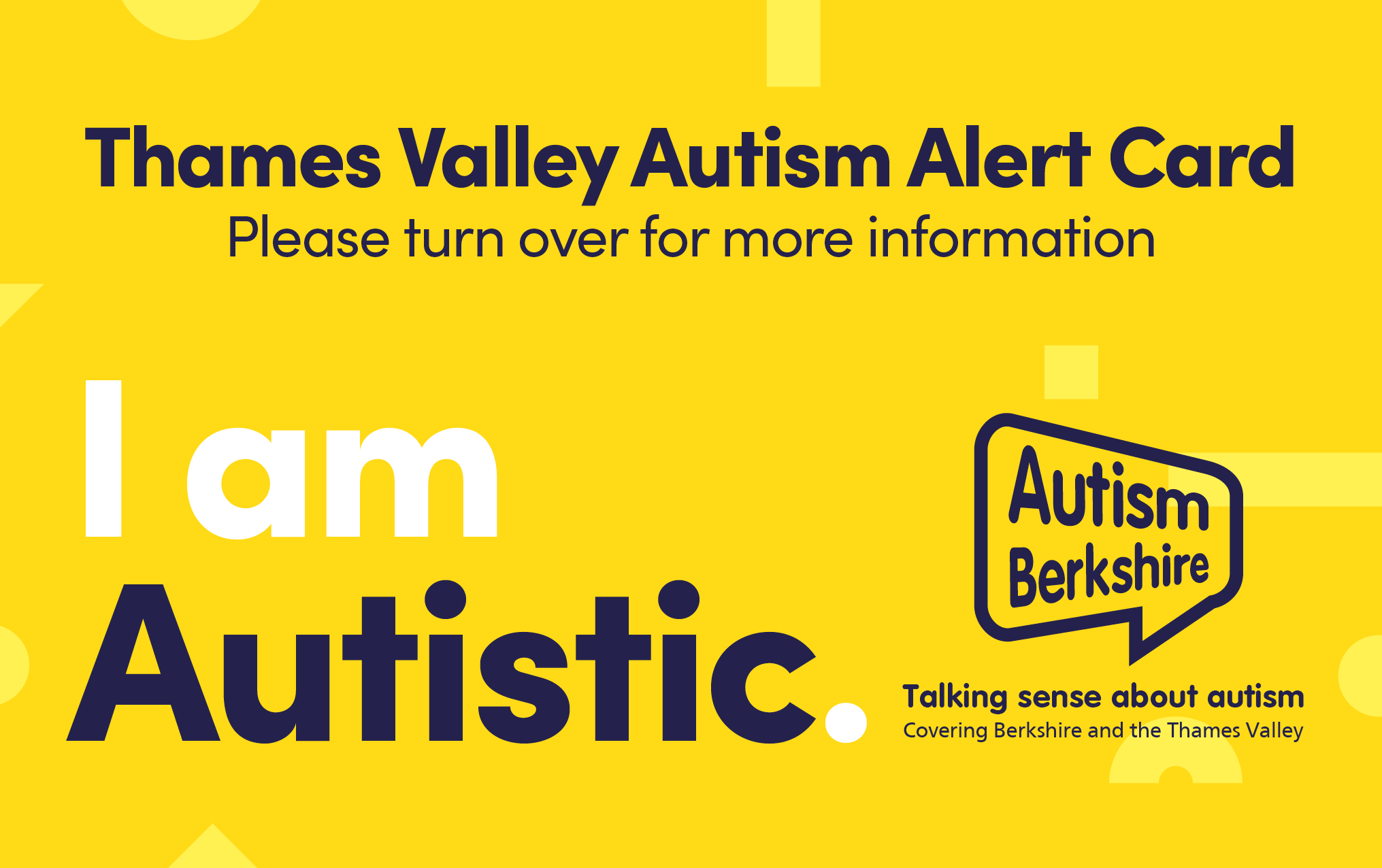
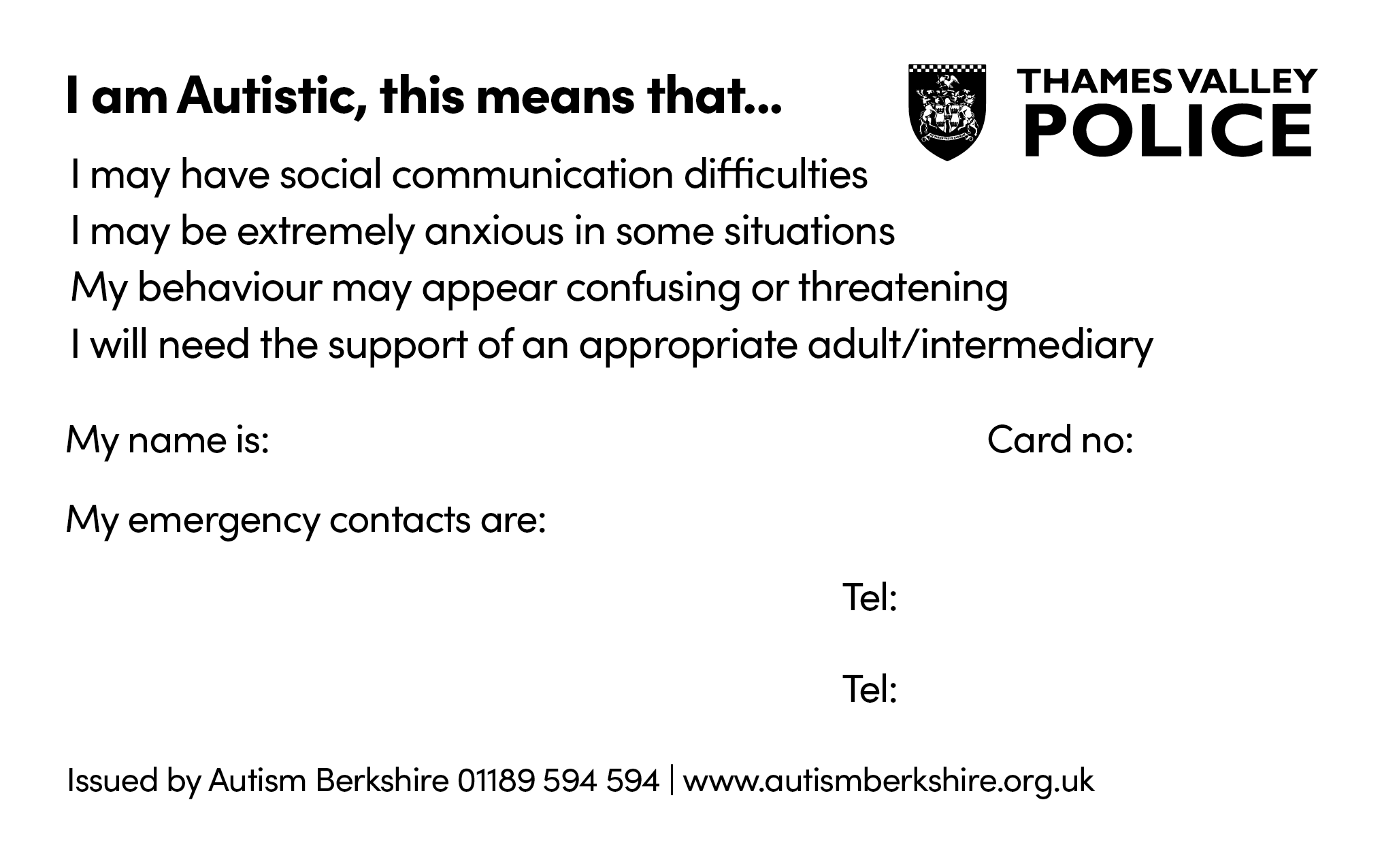
Autism Alert 3 Thames Valley
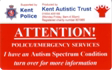
Autism Alert 4 Kent
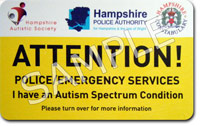
Autism Alert 5 Hampshire
Autism Alert 6 Essex, Suffolk, Norfolk, Cambridgeshire, Hertfordshire, Bedfordshire
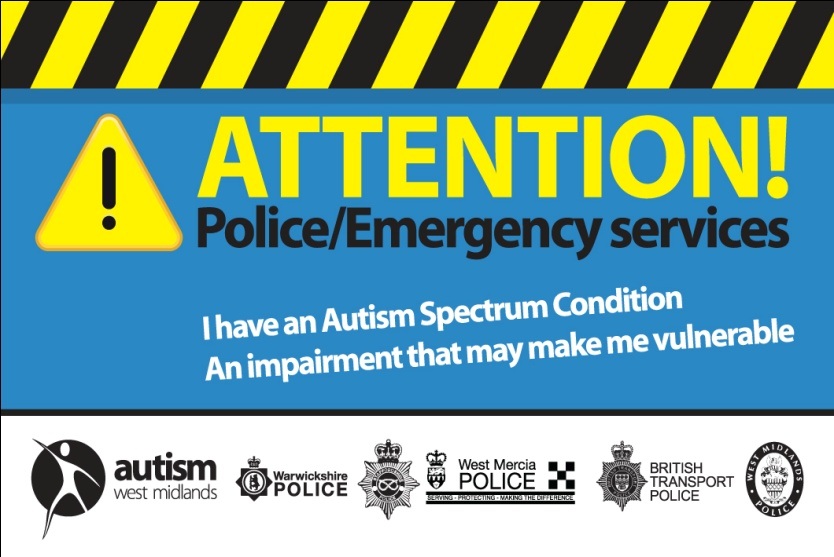
Autism Alert 7 West Midlands, West Mercia, Warwickshire, Staffordshire, British Transport Police
Autism Alert 8 Merseyside, Cheshire
Brain Injury ID Pilot project - see list of areas

Pegasus

pegasus card


Police Forces: Nottinghamshire, Lincolnshire, City of London, Surrey, Sussex, Bedfordshire, Hertfordshire and Cambridgeshire.

The Pegasus system was developed by Chris Channon MBE, a former paralympian who has cerebral palsy. It is aimed at those whose disability or illness makes it difficult for them to communicate when calling or speaking face to face. It’s designed to make it easier to contact the police quickly and easily. It’s a secure database which contains details registered by an individual. They only have to say ‘Pegasus’ and give their pin number or show their Pegasus card to an officer. The Pegasus scheme is currently arranged at a local level. the card image above is from Sussex police and may look different in other areas.

How to get the card: Click on your police force to find out how to apply; Nottinghamshire, Lincolnshire, Surrey, Sussex, Bedfordshire, Hertfordshire, Cambridgeshire.


E-Card

ecard GMP

Police Forces: Lancashire, Greater Manchester

Lancashire Constabulary have developed an emergency information card, which aims to assist people with disabilities to communicate with police or other emergency services. It is credit card sized and has space for the person’s name and photo, medical condition, details of an emergency contact person, and other useful information such as communication needs or requirements in an emergency. The E Card is free of charge and distributed via various channels including NHS mental health teams. It was funded in partnership with Lancashire County Council, Physical Disabilty and Sensory Impairment (PDSI) and Lancashire Partnership Against Crime. the card was launched in 2007, has been identified as best practice by MIND and received recognition from in the media.

How to get the E-card


Keep Safe Cymru Card

safe cymru

Police Forces: South Wales

Mencap Cymru, Learning Disability Services and South Wales Police have jointly developed the scheme for anyone in the South Wales force area with a Learning disability or mental health and communication need.

How to get the Keep Safe Cymru card


Autism Alert Card (type 1)

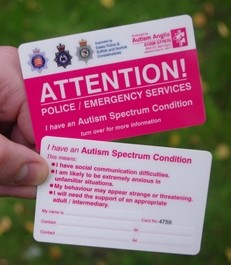
There are a wide variety of Autism Alert Cards in use. As initiatives are local, designs vary widely between areas.

2019 autism card london

Police Forces: Metropolitan Police Service, City of London Police, British Transport Police

The same London scheme provides an 'Autism Passport'.

How to get the London autism alert card and passport.


Autism Alert Card (type 2)

autism alert


Police Force: Devon and Cornwall

The Autism Alert Card is free, plastic and credit card sized It can be issued to individuals aged 10 or over who live anywhere in Devon and Cornwall, although similar schemes are in place in other areas of the country and so the card may be recognised elsewhere.

How to get the Devon and Cornwall Autism Alert card


Autism Alert Card (type 3)
2026 IamAutistic cardinhouse Page1 Final 2026 IamAutistic cardinhouse Page2 Final

Police Forces: Thames Valley

Autism Berkshire issues the Thames Valley Autism Alert Card free of charge to anyone living in Berkshire, Buckinghamshire, Oxfordshire and Milton Keynes who has an autism diagnosis.

This link will take you to the page with details of the card and a link to the online application form: https://www.autismberkshire.org.uk/thames-valley-autism-alert-card/ 


Autism Alert Card (type 4)


kentautismalert

Police Forces: Kent

How to get the Kent Autistic Trust Autism Alert card


Autism Alert Card (type 5)

Hampshirealert

Police Forces: Hampshire

How to get the Hampshire Autism Alert card (a smartphone app is also available).


Autism Alert Card (type 6)

alertanglia
Police Forces: (Anglia) Essex, Suffolk, Norfolk, Cambridgeshire, Hertfordshire, Befordshire

How to get the Autism Anglia Autism Alert card


Autism Alert Card (type 7)

autism attention

Police Forces: West Midlands, West Mercia, Warwickshire, Staffordshire, British Transport

Autism West Midlands have developed the Attention Card in partnership with police services across the West Midlands. It has space on the reverse to include the contact details of a trusted person. In stressful situations professionals are able to contact this person.

How to get the Autism Attention card


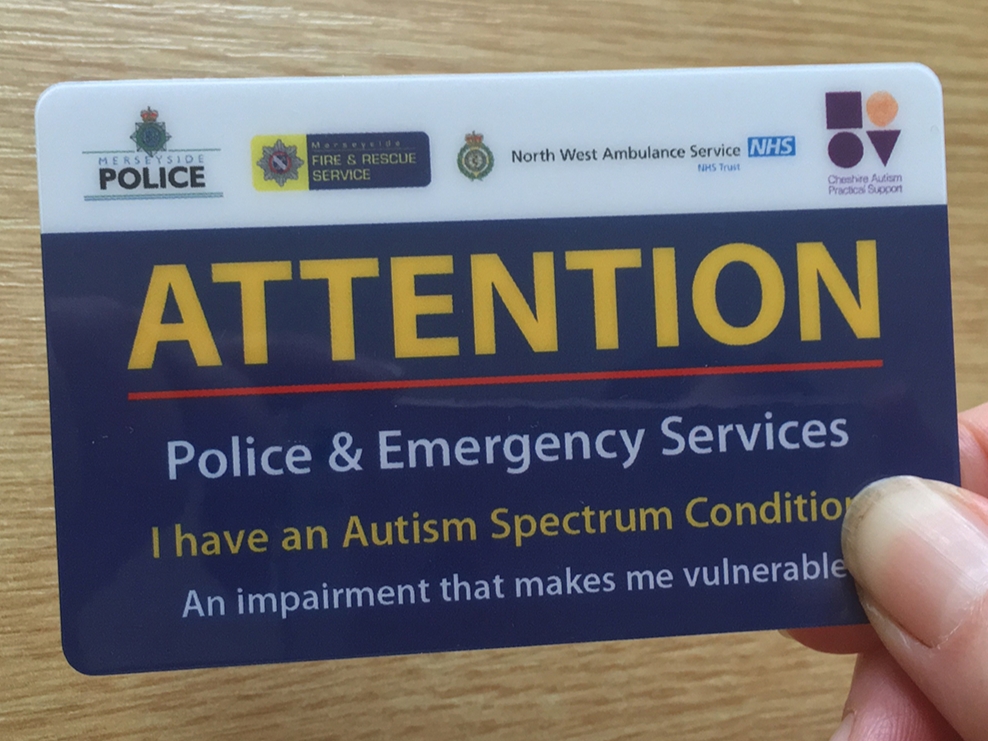
Autism Alert Card (type 8)

autism attention

Police Forces: Merseyside, Cheshire

Cheshire Autism Practical Suport the Attention Card. It confirms to emergency services that ‘The person you have with you will have a medical diagnosis of Autism Spectrum Condition’. Details can be recorded onto Cheshire or Merseyside Police’s intelligence system. This means that in an emergency, irrespective of whether they are carrying the card or Autism Code Keyring, their needs will be acknowledged.

How to get the Autism Attention card


Brain Injury Identity Card

braininjurycard

The Brain Injury Identity Card is currently being developed by leading brain injury charity Headway. It is designed to help identify a brain injury and ensure that the survivor receives an appropriate response. The card also displays a 24 hour criminal legal assistance helpline number, should a brain injury survivor require legal advice.

For more information about the Brain Injury Identity Card, email This email address is being protected from spambots. You need JavaScript enabled to view it..

Who's looking out for the adults?

by Chris Bath

Summary

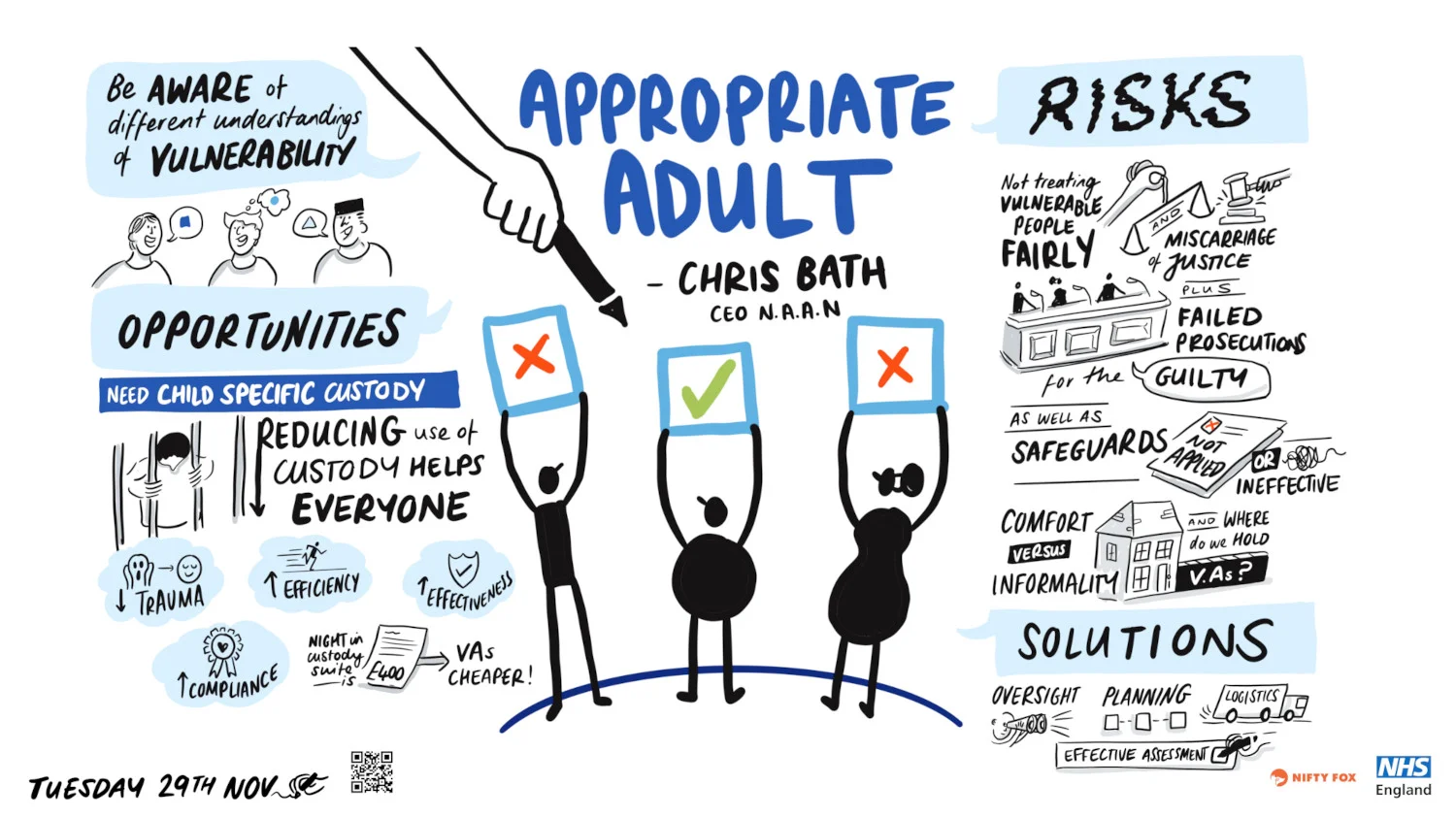
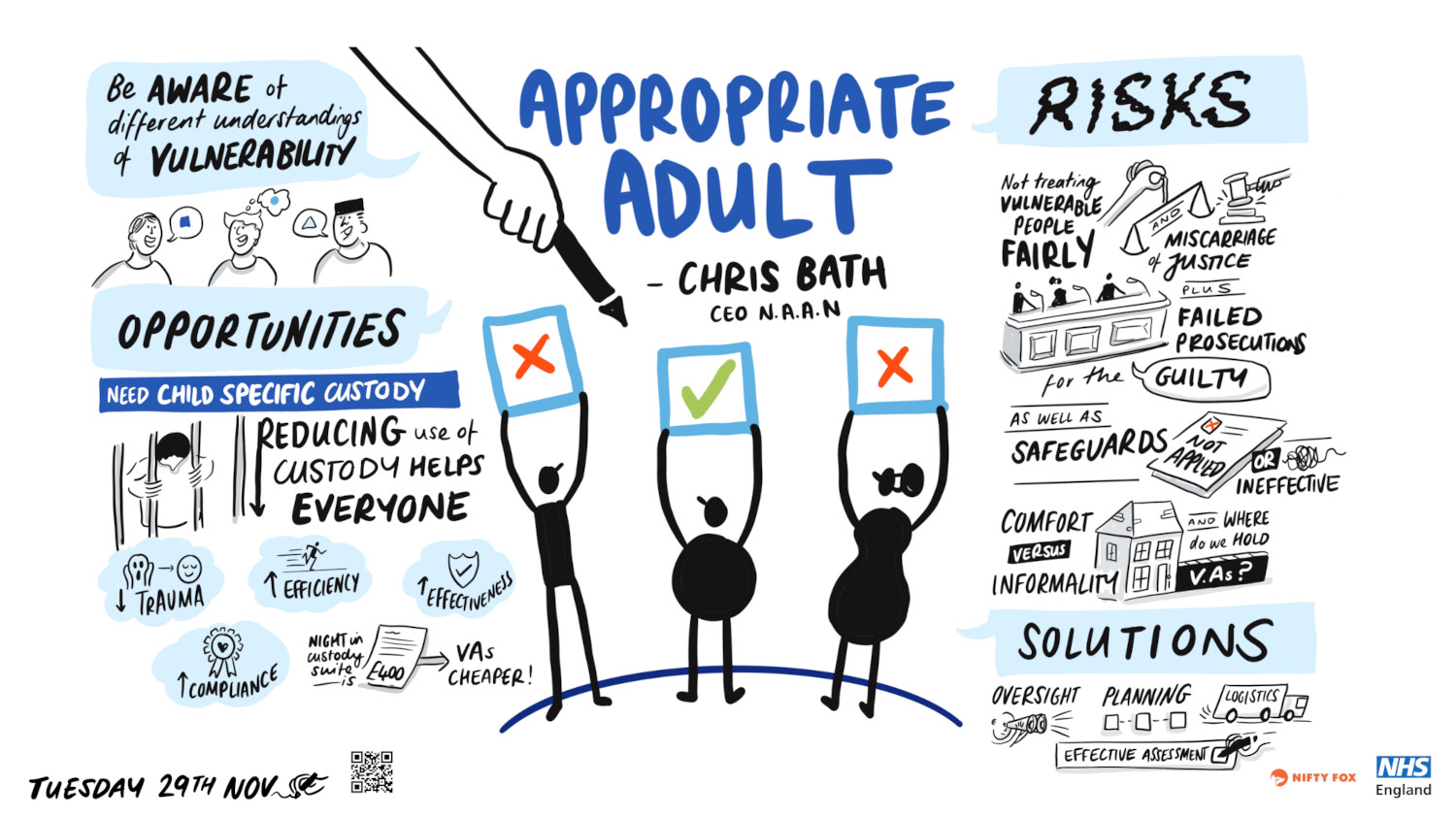
Appropriate Adults (AAs) are a critical safeguard for children and mentally vulnerable adults detained or interviewed by the police. However, there is no statutory provision of AAs for mentally vulnerable adults. Identification rates of mental vulnerabilities are historically very low but look set to increase with the Government's investment in Liaison & Diversion in custody suites. This will increase demand for AAs. At the same time, pressure on local authority budgets mean non-statutory services are under intense threat. If false confessions and other miscarriages of justice are to be avoided, cooperation around pooled budgets and regional co-commissioning is urgently needed, involving all parties with an interest in the welfare and rights of mentally vulnerable adults.

Download a short briefing on this issue.

Appropriate Adults

Under the Police and Criminal Evidence Act 1984 (PACE) Codes of Practice, police custody sergeants must secure an Appropriate Adult (AA) to safeguard the rights and welfare of vulnerable people detained or questioned by the police. This is a critical safeguard in our justice system that arose in part due to vulnerable people confessing to crimes they did not commit.

Originally covering juveniles (10 to 16 year olds) and mentally vulnerable adults, the anomaly of 17 year olds being treated as adults in police stations enjoyed a high profile in 2013. Long a concern for NAAN, and many others, the issue was highlighted in the Criminal Justice Joint Inspection report Who’s looking out for the children (2011). Then, following a judicial review, PACE Code C was amended to ensure 17 year olds, and therefore all children, have the support of an Appropriate Adult.

Demand: the prevalence of mental vulnerability

Arguably a bigger concern (if only by sheer volume) is whether anyone is ‘looking out for the adults’. At any one time, one in six British adults (around 8 million) is experiencing at least one diagnosable mental health problem.[i] An estimated 1.2 million people in England have learning disabilities (2.3%), of which 75% are adults[ii]. Four per cent of the population have severe dyslexia.[iii] Some 39% of people in contact with probation have a current mental health condition, while in prison rates are much higher. Between 20 and 30% of offenders have learning difficulties or learning disabilities that interfere with their ability to cope within the criminal justice system. For example, a person may find it be difficult to understand and participate effectively during a police interview.[iv]

Supply: the lack of statutory provision

However, despite the requirement in PACE Code C, no agency has a statutory duty to provide AAs for vulnerable adults. Consequently, the existence of formal services, using trained, vetted individuals who attend when family or carers are unavailable, is limited. Some areas have ad-hoc arrangements. Social services emergency duty teams may respond if they have no higher priorities. In other areas services are entirely non-existent. In contrast, statutory provision, under the Crime and Disorder Act 1998, means Youth Offending Teams provide or commission a service for children in every local authority in England & Wales.

Historically, where provision for adults has existed it has typically stemmed from local authority adult social services and NHS mental health trusts. Some police forces, and more recently some Police & Crime Commissioners, have also provided financial support, though police employees are prohibited from acting as AAs for obvious reasons of independence. However, continued budget cuts mean any non-statutory service is under severe threat. NAAN has been contacted by several police forces and AA schemes that have been advised that local authority funding for AA services will end in April 2014.

Such cuts clearly affect the police’s ability to deal effectively with adults that are mentally vulnerable or experiencing mental illness. If AA schemes are lost, police will need to constantly source untrained individuals ‘off the street’ or try to create and manage their own schemes – raising issues of skills, resources, efficiency and most importantly, of independence.

The problem of identifying mental vulnerability

One possible reason why commissioners may not have may not have AAs for mentally vulnerable adults on their on their radar is an apparent lack of demand.

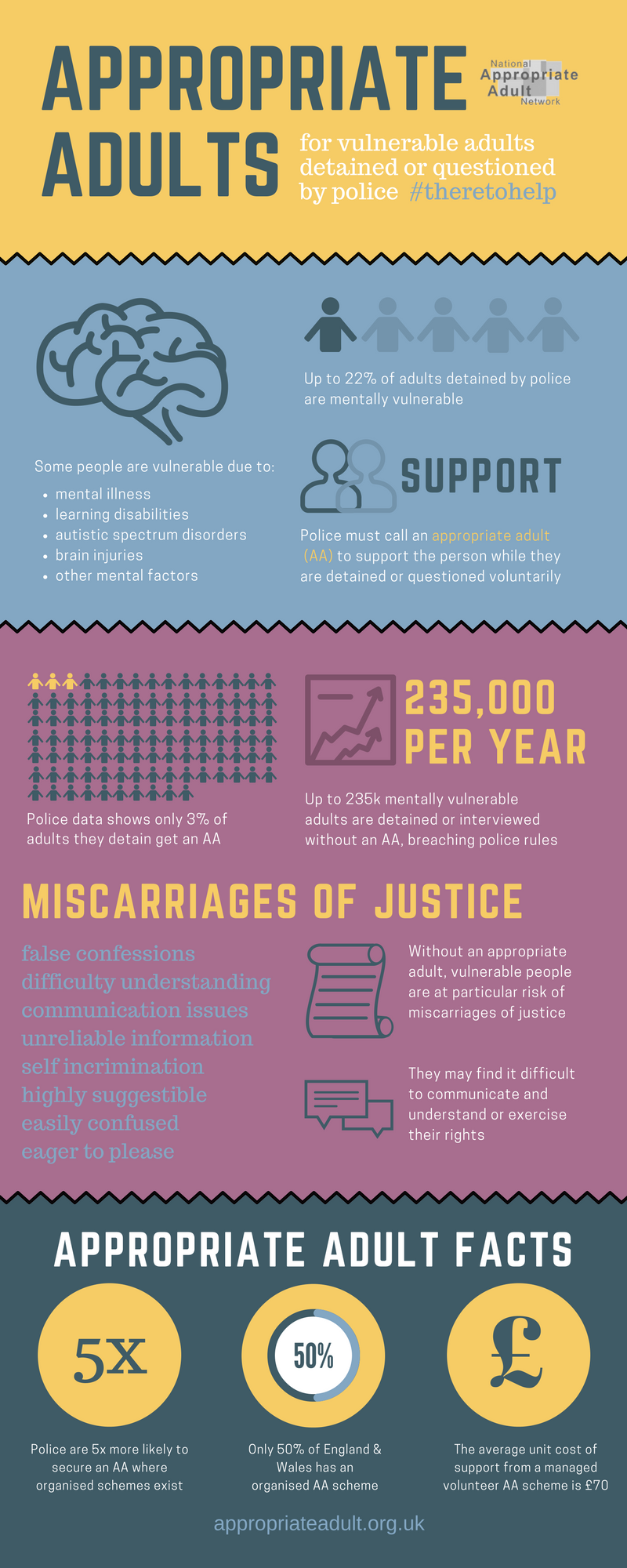
Rates at which mental vulnerabilities are identified in police detention are extremely low. Given the prevalence of mental vulnerability in society, and the justice system, in particular, annual demand for AA call outs ought to be much higher than it is. One study, which analysed over 21,000 police custody records, found an AA was used in only 38 (0.016%) cases.[v]

There are around 1.2 million arrests in England & Wales for recorded crimes annually. A NAAN survey of police forces in 2009/10 found that only 12 regional forces (of 34 respondents) reported any call outs of AA services for vulnerable adults. Of these, the Metropolitan police accounted for 54% of the reported 14,436 call outs annually. Excluding the Met, the South West (Dorset, Devon & Cornwall and Avon & Somerset) accounted for 50% of the remaining 6,636, with call out rates ranging between police forces from 4 to 120 per month.

Academic studies have suggested multiple factors affecting whether AAs are called out for vulnerable adults. These include: the skills, training, experience and attitudes of the arresting officers and the custody sergeant; the offence type; the arrest circumstances; the presentation of the individual, and pressures in the custody suite. This is supported by the findings of the joint thematic inspection on learning disability published in January 2014. Inspectors found that Appropriate Adults were not always called, even when it was recorded that the detainee had a learning disability. They concluded that, "The identification, assessment, referral and diversion of offenders with learning disabilities, and the provision of Appropriate Adults, depend on the ability of police officers and other custody staff to recognise learning disability. This is, in part, dependent on the level of training provided to officers and other staff."[vi]

It is not that the police don’t have strong incentives to call an AA. Breaches of PACE risk rendering evidence gained during interview inadmissible in court, not to mention disciplinary action. PACE Code C is clear that anyone “mentally disordered or otherwise mentally vulnerable” has the right to an AA. The threshold is intentionally set very low to reflect the fact that police personnel are not, and cannot be expected to be, experts in mental vulnerability. Custody sergeants are directed to call an AA whenever they have any doubt about the mental state or capacity of a detainee. PACE is clear that, once someone is identified as being mentally vulnerable, the police cannot proceed without an AA present.

This is a critical point. Once a custody sergeant recognises that an individual might be mentally vulnerable, the whole process stops until an AA can be found. Where there is a high-quality, reliable, quick-response AA scheme to call on, this does not cause a problem. However, without such provision, and in a busy custody block with over-stretched officers, there is a powerful disincentive to identify.

A vicious circle therefore exists in which the lack of supply creates an apparent lack of demand, which in turn fails to generate pressure to increase in supply.

Liaison & Diversion: an opportunity for change

In England, the Department of Health has announced a welcome £25 million to further develop liaison and diversion services for children and vulnerable adults in police custody. Their purpose is to identify and assess individuals suspected of having, amongst other conditions, mental ill health or learning disabilities, to ensure support, and to help inform criminal justice decision making. The Government’s commitment is that liaison and diversion services will be in every police custody suite by 2017, run under the auspices of NHS England.

The good news is that this investment will do much to solve the issue of chronic under-identification of mentally vulnerable individuals. The bad news is that, just as the vicious circle is broken, AA provision for vulnerable adults may be almost non-existent. This presents a risk to the liaison and diversion programme, and to efficient police custody processes.

Impact

With the exception of the vulnerable people themselves, it is frontline police who will feel the lack of AAs most keenly. Set neatly between a rock and a hard place, local stations are already in debates about setting up their own schemes. This is both entirely understandable and deeply concerning. Appropriate adults are a critical part of the checks and balances of our justice system, protecting the most vulnerable from potential abuses of police power. Even well intentioned police run schemes are at risk of breeding compliant AAs, creating distrust in the mind of the person being detained, and damaging public perceptions of independence.

Solutions

Due to their historical support in some areas, one option is to look to adult social services or mental health trusts to avoid retrenchment and increase spending to meet the demand. Another possibility is that, since it impacts significantly on an NHS England project, they should find the money. Alternatively, it might be argued that, because the duty arises out of PACE, the police, Police & Crime Commissioners or the Home Office are solely responsible.

Ultimately, the answer is to place appropriate adult provision for mentally vulnerable adults on a statutory footing, as envisaged by Lord Bradley in his 2009 report. This approach would ensure parity with children’s AA services, provide clarity and accountability, and prevent mentally vulnerable adults from ‘slipping through the cracks’ between agency responsibilities. It would also ensure independence from the police, allowing them to focus on their core role, avoiding conflicts of interest, reinforcing the need for challenge and encouraging public confidence.

In the meantime, it is critical to act now to save existing provision. The cost of an appropriate adult scheme is small, with the role often fulfilled by parents, carers or volunteers, and opportunities to expand existing schemes. To replace such experience and knowledge will be far more expensive.

However, to place responsibility with a single agency would be to ignore the complexity of mental vulnerability and the harsh reality of the current economic climate. The range of needs (and therefore agency budgets) is broad including: mental health, learning disabilities, ADHD, autistic spectrum disorders and Asperger’s syndrome. If any one agency were given the choice between funding it all, and not funding it at all, they would likely find it impossible to do the former. Even a small cost is currently burdensome for any single commissioner.

So, if false confessions and other miscarriages of justice are to be avoided, and if the massive investment in liaison and diversion is to be successfull, cooperation is required. Discussions about pooled budgets and regional co-commissioning are urgently needed and should involve: adult social services, mental health trusts, NHS area teams, Clinical Commissioning Groups, Health and Wellbeing Boards, police forces, Police & Crime Commissioners and any other party with an interest in the welfare and rights of mentally vulnerable adults.

The National Appropriate Adult Network (NAAN) is a charity working to ensure that the rights and welfare of every child and vulnerable adult detained or interviewed by police are safeguarded effectively by an appropriate adult. Our mission is to inform, inspire and support effective policy and practice. As the national hub, we collect, develop and share knowledge and skills, as well as setting national standards for appropriate adults.

Download a short briefing on this issue.


Information for family & other supporters

Information for family and other supporters

This information is for people who have been asked to act as an appropriate adult for someone they know. This might be your child or other family member, your partner, or a friend.  

They might have been arrested, or invited to a voluntary interview. 

You may be feeling confused, overwhelmed, upset, even angry. The information will help you to understand your role and provide them with the best possible support.

What would you like to do first?

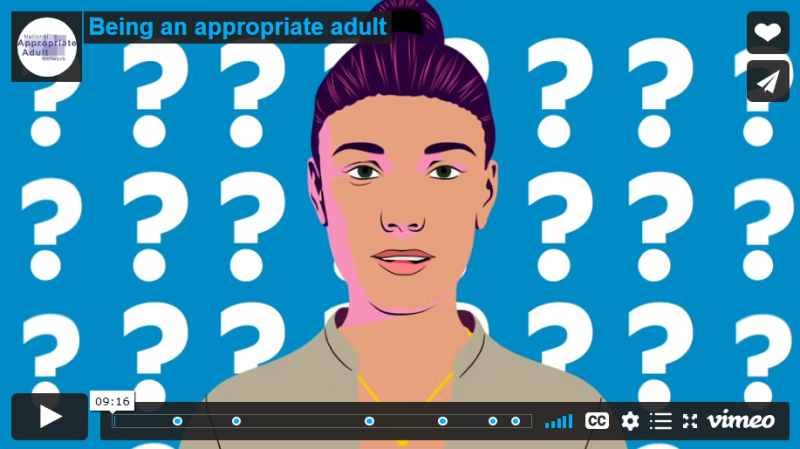
Video: Being an appropriate adult

This video explains the role of an appropriate adult in under 10 minutes. 

If your work regularly involves supporting children or vulnerable adults who may be arrested or questioned, we recommend appropriate adult training.

About the video


  • Video help

    In the tool bar under the video:

    • Click the lines to move between 'chapters' in the video
    • Click the four arrows  to watch in full screen mode
    • Click the Vimeo logo to watch on the Vimeo website (or app if you have it)
    • Click "CC" to add closed captions or subtitles (we hope to add more languages)
    • Click the cog to watch in lower quality (to save mobile data)

    Want to watch later with no internet connection?

    • Some custody suites don't have a signal
    • While you have a connection, download the Vimeo app from your app store
    • Find the video
    • Click the three dots and then "add to offline"
    • Chapters and subtitles are not available in the app

    You can also watch the video on the Vimeo website by:

  • Give us your feedback

    If you are a parent, family member or other supporter who has watched the video, we'd love to hear your feedback.

    Fill in the feedback form.

  • Can my organisation use the video?

    Do you represent a police force, charity community group, or other organisation?

    If you'd like to use the video in your work, please see our video implementation page for information and resources (including our poster).  

    If you are currently acting, or thinking about acting as appropriate adults, you may be interested in membership, training and qualifications. 

    In the meantime, we'd love your your feedback on the video. 

  • Credits

    The project was a partnership between Dr Miranda Bevan (funded by the London School of Economics and the Economic and Social Research Council) and the National Appropriate Adult Network.

    Ilustration and animation by John Brown and Scott Spencer.

    Voice acting by Audionarrative and Jon Wright.

    Translations kindly donated by    


Written guides

These guides can be printed or or saved to your device, so you can access them in police custody or a voluntary interview.

If your work regularly involves supporting children or vulnerable adults who may be arrested or questioned, we recommend appropriate adult training.

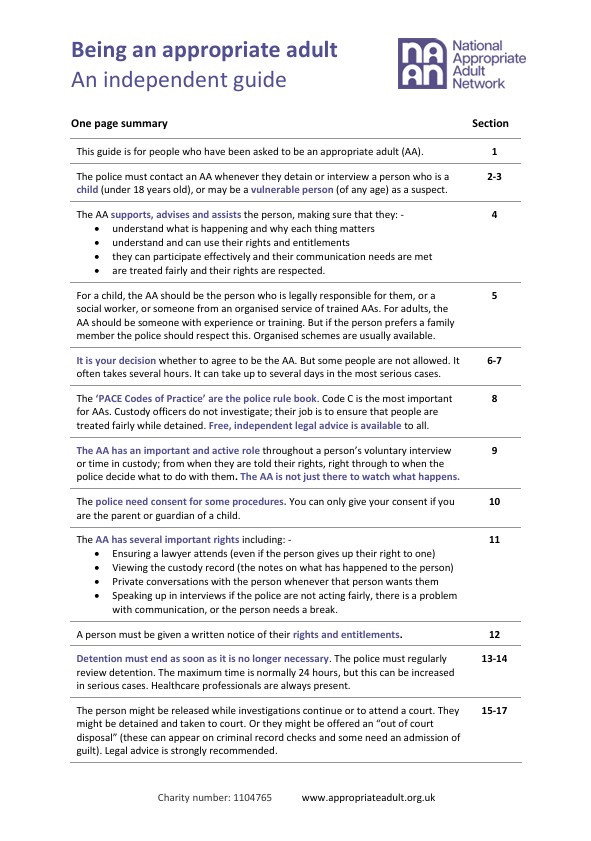
Our detailed guide

Our recommended guide for anyone who has not had AA training (10 pages).

Being an appropriate adult: an independent guide

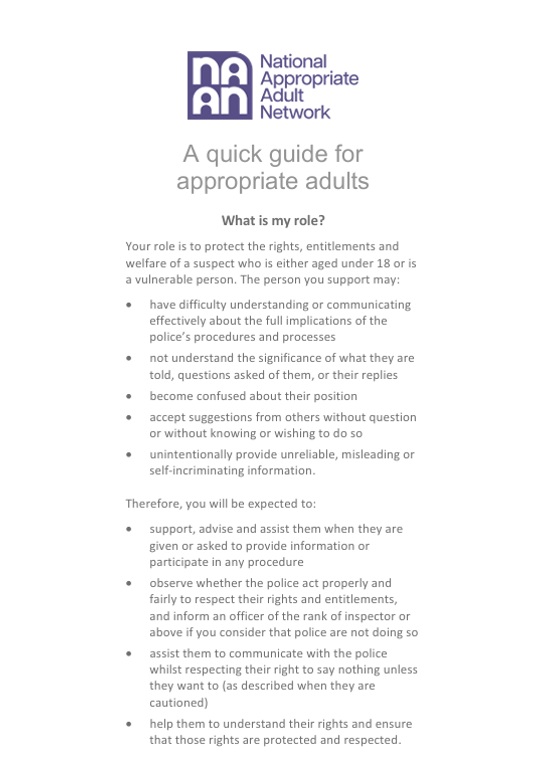
Our simple guide

Print double-sided and fold into thirds to make a pocket sized pamphlet (2 pages).

A quick guide to being an appropriate adult

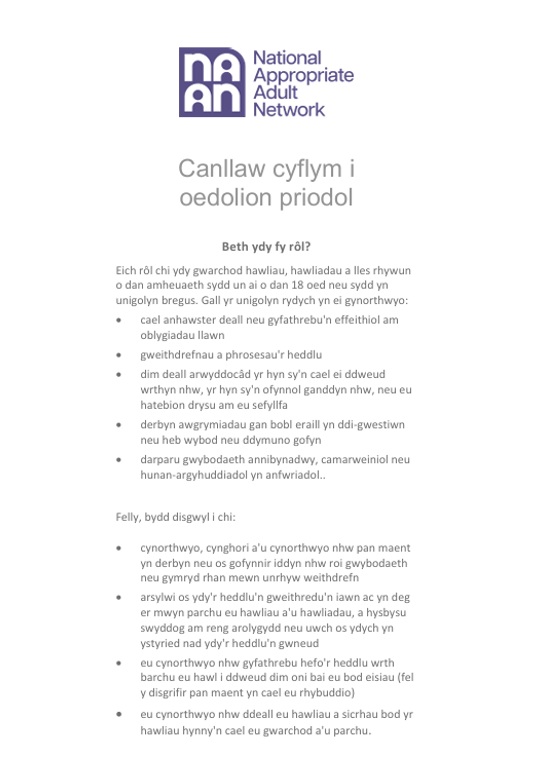
Ein canllaw cyflym

Argraffwch ddwy ochr. lygwch yn draean i wneud pamffled maint poced (2 dudalen)

Canllaw cyflym i oedolion priodol

Need more help?

We know that every situation is unique. We also know there is a need for a national helpline that can provide individual advice. As a very small charity, we don't yet have the capacity to answer individual cases. We are looking at how this kind of support could be provided in future.

However, we have a range of other web pages that may be helpful, including:

Continue reading

Information for people who need an AA

Information for people who need an appropriate adult

If you are under 18 or a ‘vulnerable person’ and suspected of a criminal offence, the police must find an appropriate adult to come to the station to help you and be present during questioning and searching.

Here are some examples of who the appropriate adult might be:

  • your parent, guardian or carer
  • another family member or friend aged 18 or over
  • your social worker
  • someone trained to be an appropriate adult.

Frequently Asked Questions

Information from other organisations

Watch the videos below to find out more about what to expect in police custody. They were not made by NAAN. 

At the Police Station

By the independent award-winning charity Just for Kids Law

What happens next? Explaining the youth custody process

By Thames Valley Police

Continue reading

Our Work

Our work

NAAN is a charity working to create a fairer justice system for children and vulnerable adults through an effective appropriate adult safeguard. 

We are a membership organisation, open to organisations and individuals.

We don't provide appropriate adults but many of our member organisations do.

Read our Annual Reports

Our vision

Every child and vulnerable adult detained or questioned as a suspect is treated fairly with respect for their physical and mental welfare, can exercise their legal rights and entitlements, and can participate effectively.

Our mission

To maximise the effectiveness of appropriate adults as a safeguard for children and vulnerable people by strengthening local provision, informing the public, and contributing to a fairer system.

To understand the people and problems that drive our vision and mission visit...

The need

Our strategic objectives

1. Strengthened local provision

We will strengthen local community organised schemes to deliver more effective, efficient, consistent and sustainable appropriate adult support for children and vulnerable people.

2. Informed children, vulnerable people and supporters

We will empower children, vulnerable people, parents, family, friends and professionals to make well informed choices and increase the effectiveness of familial and other non-scheme appropriate adults.

3. A fairer system

We will work with others to make the wider system of rights and safeguards work in a fairer way for children and vulnerable people.

4. Increased impact

We will make the charity more effective, efficient and sustainable.

To understand the difference our work makes visit...

Our impact

Our activities

  • Our role

    With over 100 member organisations, we provide an independent centre of expertise, innovation and infrastructure support.

    We work across policy, commissioning, provision and accountability to increase the effectiveness of the AAs that safeguard children and vulnerable adults

  • Who we serve

    People arrested and/or interviewed by police who are:

    • Children and young people (10 to 17) 

    • People of any age who are vulnerable as defined by PACE (including but not exclusively; mental health, learning disabilities and difficulties, autism)  

  • Who we support

    • Appropriate adults (parents, relatives, carers and support workers; professionals; community volunteers)

    • Appropriate adult schemes (local authorities, private sector, charities)

    • Appropriate adult commissioners and funders (both current and potential)

    • Influencers including reformers, academics, media and service users

    • Policy makers including civil servants and politicians.

  • Our collaborations

    NAAN is a member of:

    Our previous memberships include:

    • HMIC Expert Reference Group on the police custody change programme
    • Standing Committee for Youth Justice 
    • Care not Custody Coalition
    • Bradley Report Group

How our activities contribute

Initiative Example activities Link to strategic objective
1 2 3 4
Supporting AA practitioners
  • National Training Course
  • Tutor-led training
  • Expert webinars
  • 24/7 'iKAAN' practitioner knowledgebase
✓ ✓
Supporting AA leaders
  • Annual professional development days (annual)
  • Quarterly network meetings
  • Weekly e-updates
  • 24/7 AA leader knowledgebase
  • Advice and support on demand
✓ ✓
Supporting AA commissioners
  • 24/7 AA leader knowledgebase
  • Advice and support on demand
  • Consultancy projects
✓ ✓
Supporting family AAs
  • Animated video guide
  • Downloadable guides
  • Improving Gov.uk content
✓
Strengthening the AA evidence base
  • Original research
  • Supporting third party research
  • Academic member sub-group
✓ ✓ ✓ ✓
Policy and systemic change
  • National representation
  • Research dissemination
  • Consulation responses
  • Written and oral evidence
✓ ✓
Sustainability
  • Growing our membership
  • Developing earned income
  • Maintaining funder relationships
  • Using technology effectively
✓
Supporting our own people
  • Ensuring staff satisfaction
  • Development opportunities
  • Equity, diversity and inclusion
✓

For more on our activities visit...

Our values

  • Justice

    We believe in a fair justice system for all, with the presumption of innocence and the right to participate effectively in proceedings. 

  • Accessibility

    Just as we demand an accessible justice system, we strive to achieve accessibility in our own work, from design to delivery.  

  • Equity

    We recognise that intersectional structural disadvantage affects our society, justice system and organisation. We know that fair outcomes require different inputs for different needs and, ultimately, the removal of causes of inequity.

  • Diversity

    We recognise and embrace the significant diversity in our society in order to better achieve our objectives.

  • Independence

    We act with independence and assert and protect the independence of appropriate adults.

  • Humanity

    Individuals are at the heart of what we do. Every individual we engage with is a human-being and deserves respect and dignity. Personal connection and relationships matter to us. 

The criminal justice system is marked by racism, misogyny, and systemic discrimination. The children and vulnerable people who need this safeguard are disproportionately from communities affected by those injustices. Strengthening the safeguard and challenging the inequities in the system it operates within are inseparable.

How we work

  • Leadership

    We lead change in the interests of justice for children and vulnerable people, focusing on what could be, while recognising how things are.

  • Lived experience

    We will aim to put lived experience at the heart of our work, through our partnerships with others and our own structures and activities.

    See more on our approach to equity, diversity and inclusion.

  • Collaboration

    We recognise our own limits and value the knowledge, expertise, experience and roles of others including AAs, local leaders and people with lived experience. We will seek effective partnerships with organisations that have complementary networks and capabilities.

  • Evidence

    We underpin our work with the best evidence currently available and encourage further development of the evidence base.

  • Innovation

    We innovate to meet existing and evolving needs. We will use the power of technology to widen our audience and deepen our impact.

  • Connection

    We create and strengthen connections between practice, policy and research. We will connect our membership to each other and to other networks.

Our history

NAAN was established as a membership network in 1995 by frontline practitioners, Mind, Mencap and Revolving Doors Agency, to develop and share best practice in the AA role. We registered as a charity in 2004.

NAAN co-founder, Ian Blackie was there at the very begining. He's been a trustee, Chair, and remains a committed member today. Here he remembers how it all began...

  • 1. The beginning

    "In 1994 the Revolving Doors Agency, now known as Revolving Doors invited MENCAP, Mind and me, to meet at their offices to discuss appropriate adult issues.

    Greenwich, where I worked as an Emergency Duty Social Worker had been one of the first areas to set up a volunteer scheme for vulnerable adults. As a result of this we were receiving more and more calls from other authorities requesting advice on how to start and run a service".

  • 2. Basic discussions

    "The discussions we had were at a basic level. Young people were generally supported by their friends, family and social workers. Adults however were not well supported and were often not identified as vulnerable. I remember one senior police officer saying “we don’t want to get bogged down in all this PACE nonsense, lets just get on with it”. One London police station regularly used the manager of the Kebab shop opposite as an AA and did a good discount on 'take aways' for police officers".

  • 3. The conference

    "As the request for help and advice increased, we decided to take a risk with virtually no funding to organise a conference in 1995. In spite of a national rail strike, the conference was attended by 140 people.

    A mandate was given to the organisers to set up a national forum. This was to organise national meetings to enable schemes and organisations to discuss matters of common interest and act as a voice for appropriate adults".

  • 4. NAAN is born

    "With a small profit from the conference and the good will of many people and agencies these ad hoc meetings continued.

    It was recognised that training and standards needed to be developed. So in 1997 funding was sought and NAAN was born.

    Objectives were set for the steering committee and part time co-ordinator".

  • 5. Our first objectives

    1. Independent charitable status.
    2. Develop and promote national standards of national training and performance.
    3. Further develop and maintain links with other organisations in the criminal justice system.
    4. Develop guidelines in respect of the differing needs of juveniles and vulnerable adults.
    5. Facilitate communication between members of the Network.
    6. Organise regular meetings/conferences for members.
  • Looking back

    Over 30 years later, while NAAN has changed significantly, it continues to serve its founders' objectives. 

    • Charitable status was achieved in 2004
    • We have comprehensive , evidence-based, approved, national standards.
    • We have strong links including with the Home Office, MoJ, NPCC, CPS, ADASS, YJB, civil society and academics.
    • Our National Training Course reflects the needs of children and adults. 
    • Members meet quarterly online, annually in person, and we have a weekly e-newsletter.
    • We run regular online events.

Organisational status

  • Our legal status

    Initiated as an informal practitioner network, the National Appropriate Adult Network (NAAN) became a registered charity on 5th July 2004 and is a company limited by guarantee. 

  • Our area of benefit

    NAAN supports the role of the appropriate adult as constituted under the law in England and Wales.

    NAAN includes associate members from outside England and Wales (such as Northern Ireland, Jersey and Guernsey).

    NAAN does not cover the AA role in Scotland as defined under Scots Law. 

  • Our funding

    NAAN is currently funded via:

    • Membership fees
    • Earned income from the provision of training
    • Home Office grant funding
    • Grants from charitable trusts and foundations

    Please see our annual reports for more funding information

Continue reading

In memorium

On this page we remember those who have contributed to the success of the charity. 

Chris Hilliard

NAAN Trustee (2023-2025)

June 2025

With great sadness, we announce the sudden passing of NAAN trustee and friend, Chris Hilliard.

NAAN first worked with Chris in 2017, as members of the Care Not Custody Coalition. At that time, they were sharing their experience of being an autistic person (wrongly) arrested and detained in police custody.

As a former defendant (who was attacked by a mounted police officer during student protests), they went on to obtain a law degree and become an activist focused on improving the criminal justice system for people with learning disabilities and neurodivergent people.

Their story was a powerful one, and they kindly used it at a NAAN event in 2018, providing advice to us all on supporting autistic people in custody.

In 2022, we shared five days together, alongside criminal justice and disability rights experts, leading practitioners, and advocates from across the globe – many of whom had lived experience. This was a deeply special and complex event, for which they took responsibility for everything technology related. We remain a member of that group – and the tributes from around the world are deeply moving.

In 2023, Chris committed their time and energy to NAAN directly, as they joined the Board as a trustee. And once again, Chris’ intelligence, passionate advocacy, and human kindness are reflected in the messages from fellow trustees.

Chris had a deep commitment and boundless energy for making the world a better place. This spread across criminal justice, LGBTQ+ rights, and the environment. In addition to their role at NAAN, and their professional expertise in cycle retail, they were a busy local councillor. It’s clear from the tributes from Cheshire East and Wilmslow councils, that they were making a practical difference to public transport. Indeed, flags have flown at half-mast on the council’s main office buildings as a mark of respect.

Chris leaves behind a huge hole amongst family, friends, community and society. They are a reminder that spending time helping others – especially the most vulnerable – is the most valuable thing one can do. We hope their life, and the response of others to their loss, serves as inspiration to treat people as people, to respect everyone’s rights, and use our gifts for the common good.

Continue reading

Children and young people

NAAN is engaged with a range of policy issues affecting children and young people who experience police custody or voluntary interviews. 

We work closely with organisations and individuals involved with children's rights and the criminal justice system.

We are supporting the All Party Parliamentary Group on Children in Police Custody with an inquiry. Read our evidence here. 

Our work

  • Children's experience

    Powerlessness. Indignity. Isolation. Frustration. Confusion. Humiliation. Fear.

    These are the feelings children often describe about time spent in police custody, though they may conceal them from police with bravado.

    We use our position to highlight the specific needs of children and young people and to safeguard their interests in policy development.

  • Making rights real

    There is a significant, perhaps widening, gap between law and practice. Some PACE requirements are seen as impractical. Breaches are commonplace and often considered a minor matter, especially where cases will not go to court. Resources are critical. Both police and councils are doing difficult jobs in challenging circumstances. However, so is culture. Notwithstanding the police’s rigorous focus on physical safety, and initiatives on modern slavery, trafficking, county lines, and using custody constructively, children are in the first stage of an adversarial justice system. They are in crisis and at risk. They are not ‘safe’.

  • Collaboration

    Much more must be done by all of us: NAAN, government, police, lawyers, councils, providers, and AAs. We must make sure our ‘children first’ laws and policies apply in practice.

    We work collaboratively with the Children's Commissioner, Child Rights Alliance for England, HMICFRS, Howard League for Penal Reform, Just for Kids Law, Dr Miranda Bevan, Dr Vicky Kemp, Youth Justice Board. 

    NAAN is a member of the Alliance for Youth Justice and APPG on Children in Police Custody.

  • Appropriate adults

    The Police and Criminal Evidence Act (PACE) requires police to involve AAs when detaining, or voluntarily interviewing, any child or ‘vulnerable person’ (defined in Code C 1.13(d)). Without one, proceeding with many processes would breach PACE, risking an unfair investigation and inadmissible evidence.

    AAs safeguard a person’s interests, ensuring fair treatment, effective participation, understanding of rights, and the ability to exercise them. They support, advise and assist; observe and intervene; and assist communication. Importantly, they cannot give legal advice but can make sure a lawyer attends, even if a child has declined legal advice. The AA role covers the entire custody episode and can be complex and challenging.

Key issues

Over use of detention

Minimising detention

Minimising children’s detention is central to the United Nations Convention on the Rights of the Child, National Police Chiefs Council strategies on custody and children, and College of Policing Authorised Professional Practice. Yet average detention times have risen. Children are sometimes unnecessarily detained in the day and overnight – a risk for them and police.

NAAN helped to establish the All Party Parliamentary Group on Children in Police Custody, chaired by Janet Daby MP and is an external member. We are supporting a call for a shorter 12-hour PACE clock (detention limit) for children. 

Surrey Police CHILD pilot

Bail and accommodation transfers

The extent to which police authorisations, reviews of detention and pre and post charge bail decisions are focused on children’s interests is variable. 

The police are less likely than courts to grant bail. 

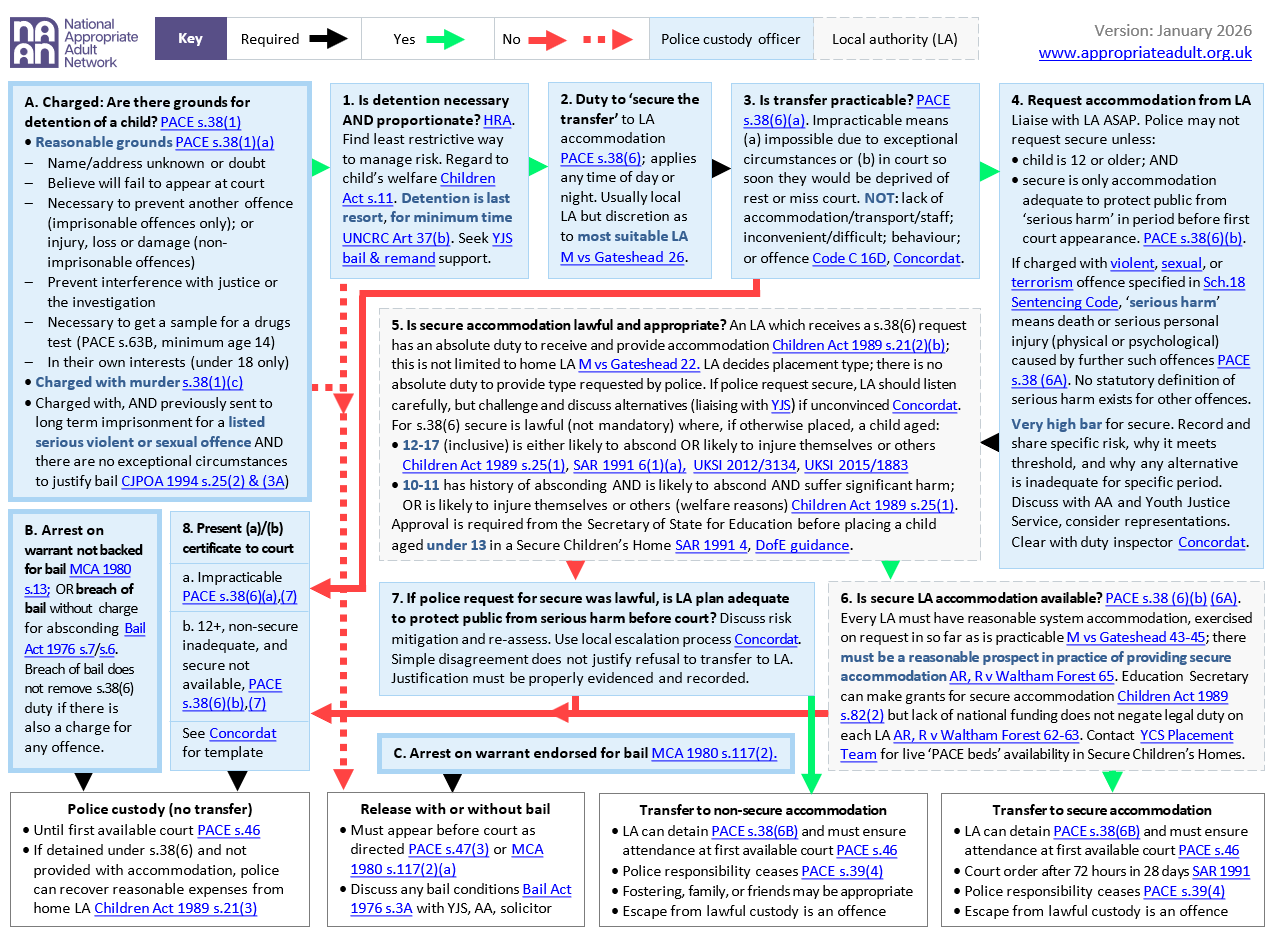
Councils are failing in their legal duty to provide accommodation and sometimes police do not request it, or request secure accommodation when the legal threshold is not met (see our dedicated page on 
PACE section 38(6) transfers to local authority accommodation).

Download the flowchart

Appropriate support

Limited access to appropriate adults

The AA safeguard is essential, but too often it is not used effectively. While many children receive rapid, extensive and excellent support, some only get an AA immediately before an interview. They spend hours without support, significantly increasing risks to justice.

PACE requires police to tell the AA and secure their attendance as soon as is practicable, and children have a right to consult privately with their AA at any time. However, research has found police delaying referrals and limiting access to children.

Legislation and standards make it clear council AA provision must be available at any time. Nevertheless, availability is a common frustration.

Despite clear national standards, some schemes are still not able to operate 24/7, respond quickly enough, support the entire custody process, or support voluntary interviews. Councils must design and resource AA schemes that enable PACE compliance. 

National standards

Family appropriate adults

PACE prioritises parents as AAs (unless involved in the case), and many children will value someone familiar and trusted who understands them. Yet, in emotional circumstances, parents must interpret PACE, understand their role, and challenge police appropriately, while relying on them for information. Well trained AAs (volunteers or paid) have the knowledge and experience to challenge without obstructing an investigation and, in theory, could be subject to inspection or regulation. But they are usually unknown to the child and must be skilled in building rapport. We've developed resources for family appropriate adults, including a video. And we are encouraging AA schemes to work together with parents.

Family AA resources

Legal advice

Access to legal advice

In England and Wales, the age of criminal responsibility is set at only 10 years old - one of the lowest in the world.

While children are asked by police whether they want legal advice, they are allowed to waive this right.

The take up rate for children has historically been low. This is often due to children not understanding the risks and benefits, making short-term decisions, having misconceptions about lawyers' independence or fees, or a lack of trust.

However, under PACE Code C 6.5A, appropriate adults have the right to ensure a solicitor attends the police station. While the child cannot be forced to then meet the solicitor, they nearly always do. However, the AA must first be aware of this right, and the value of legal advice - a key theme in NAAN's training for AAs.

Appropriate adult training

Remote legal representation

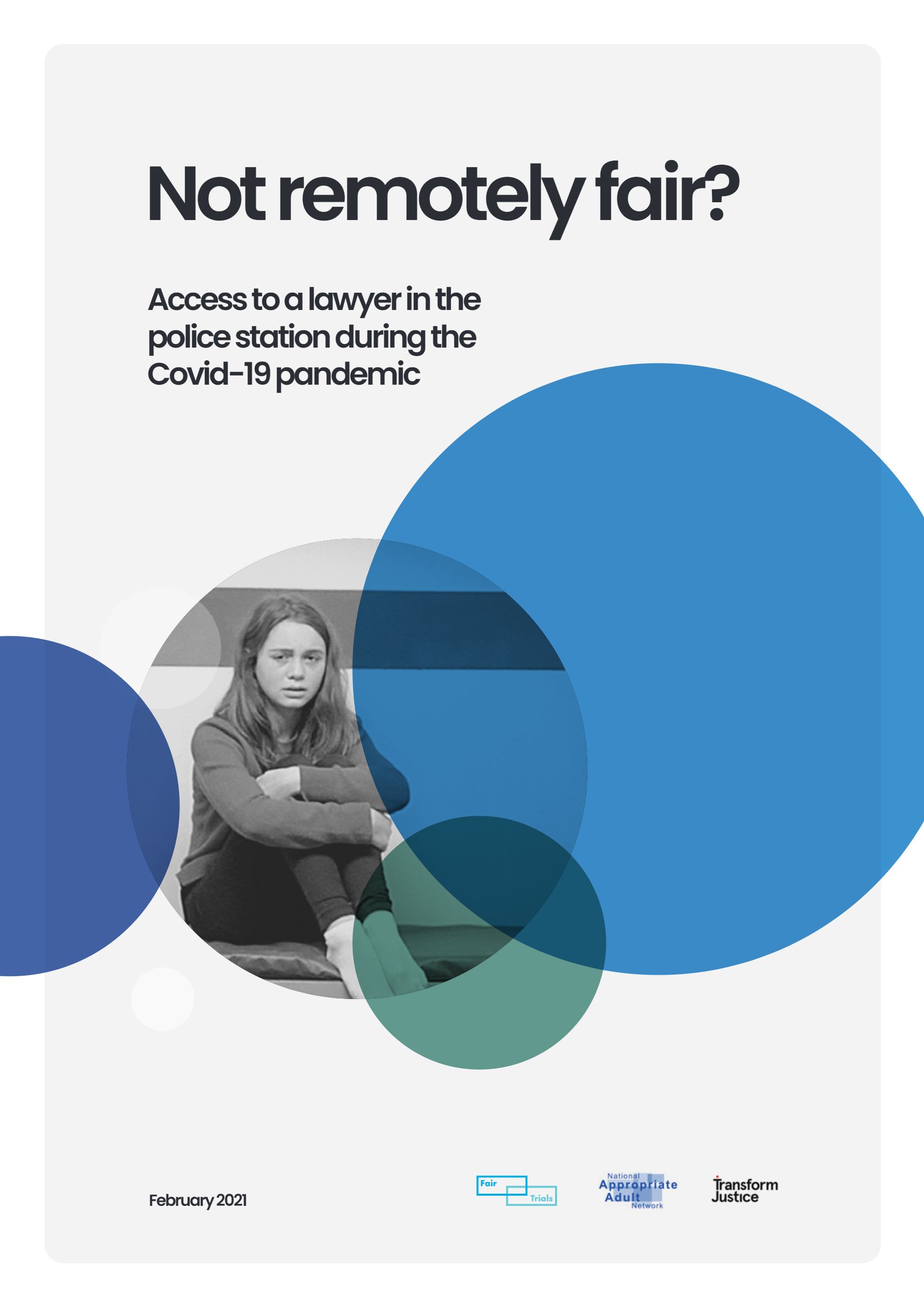
In response to Covid-19, a joint interim interview protocol was agreed by the CPS, NPCC, Law Society, CLSA, and LCCSA in March 2020. This supported the delivery of remote legal advice and interview support by legal representatives as temporary measure in extremis to cope with an unprecedented public health crisis. Since then NAAN has raised repeated concerns about the negative impact on children in police custody and interviews, resulting in several changes to the protocol over the months. This included a joint report with Transform Justice and Fair Trials International, based on evidence from appropriate adults. 

Sadly a decision to require legal representation to be in person in all cases involving children (in version 3 of the protocol) was later reversed, allowing the continued use of representation by video and phone in some circumstances. Despite the relaxation of other Covid-19 regulations, this protocol remains in place. In our view, the arrangements are in breach of the Police and Criminal Evidence Act 1984 Codes of Practice and should end. 

Read our report

Interviews and searches

Voluntary interviews

The extent to which police authorisations, reviews of detention and pre and post charge bail decisions are focused on children’s interests is

While addressing concerns about using custody for children, voluntary interviews bring their own risks. In addition to most AA schemes, most liaison and diversion services (which expertly identify vulnerability in custody) are not configured to serve them. With no independent custody officer, investigating officers are responsible for rigorously applying safeguards against themselves. Children (and parental AAs) may see such interviews as informal chats, not deserving of legal advice. See our dedicated policy page on voluntary interviews. 

Voluntary interview report

Strip searches

Whether it is strip searches or intimate searches of children, in police custody or under stop and search, the system of police powers is complex. And the safeguards are more limited than most people realise. 

Our report, prompted by the strip search of Child Q and others, highlights a wide range of issues including ethnic disparities and traumatic impacts, especially on children and vulnerable people. It suggests a range of potential strategic and technical changes, including a new focus on safeguarding.

Strip search report

Vulnerability

Vulnerability

The average human brain takes 25 years to develop. Yet at just ten, a child is criminally responsible and must make key decisions, such as whether or not to have legal advice.

Children in custody are disadvantaged by more than cognitive development. They are much more likely than other children to have poor mental health, a learning disability (up to 32% versus 4%), communication disorder (up to 90% versus 7%), be autistic (15% versus 1%), or have suffered a head injury with loss of consciousness for more than 20 minutes (18% versus 5%). Race, gender, abuse, neglect, trauma, exclusion, and ‘looked after’ status can also compound disadvantage.

Much of this is invisible unless actively looked for. Children detained regularly may be seen to ‘know the ropes’ causing their distress and disadvantage to go unrecognised and unaddressed.

PACE vulnerability videos

Past issues

17 year olds are children

NAAN was proud to work alongside bereaved parents and other charities to ensure 17 year olds were recognised as children in police custody – and secure their right to an appropriate adult.

By order of the Home Secretary Theresa May, PACE Code C was amended to this effect in 2013. The status of 17 year olds was improved in legislation with the passing of the Criminal Justice and Courts Act 2015 and fully rectified by the Policing and Crime Act 2017. 

17 year olds make up a very large proportion of all arrested children. Therefore, this very welcome change resulted in a significant increase in demand on children’s appropriate adult schemes, which are a statutory duty of Youth Offending Teams. However, under the new burdens doctrine, the Home Office was expected to fund this increased burden on local authorities. Years later, no such transfer of funds has yet taken place. NAAN repeatedly raised the issue with the Home Office and published a paper estimating the cost to local authorities to be around £1.5 million per year. 

Still interested...?

Vulnerable people

Policy

We're are not just working on identification. Did you know that while local authorities have a legal duty to provide an appropriate adult for children, there's no equivalent duty to provide one for vulnerable adults?

Click below to find out more, and catch up on our latest activities, updates and media.

Read more

Our priorities

Policy

We're working on a wide range of policy and practical issues, including:

  • Vulnerable adults
  • Children
  • Voluntary interviews
  • Strip and intimate searches
  • Remote legal advice
  • Accountability 

Read more

About AAs

Information

The role of the appropriate adult is to safeguard the interests, rights, entitlements and welfare of children and vulnerable people who are suspected of a criminal offence, by ensuring that they are treated in a fair and just manner, and are able to participate effectively.

Read more

Continue reading

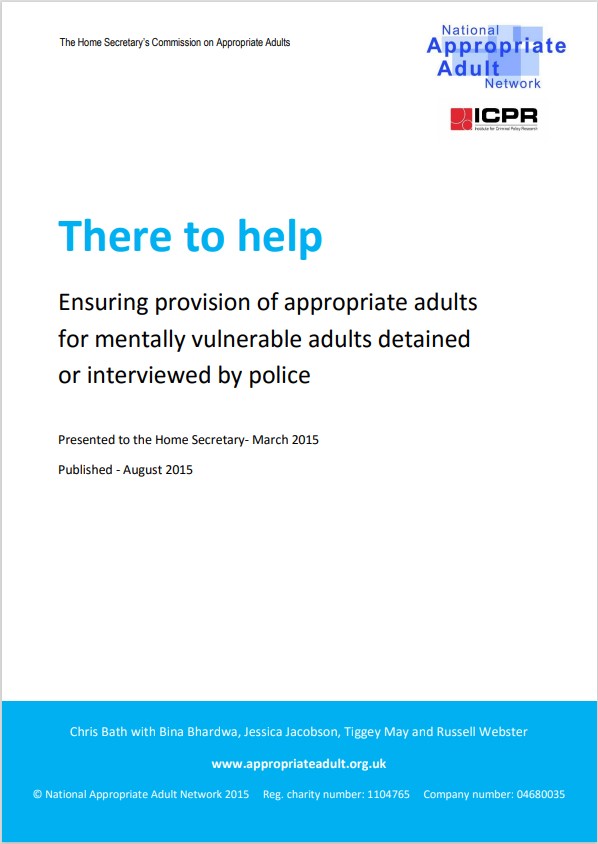
There to Help (2015)

NAAN was commissioned by the Home Secretary in January 2015 and selected the Institute for Criminal Policy Research as academic research partners.

This is the first report in the
There to Help research series.

There to Help - 88 pages

Executive Summary - 2 pages

In her speech to the Police and Mental Health Summit 2014, Home Secretary Rt Hon Theresa May MP said:  

"There is evidence to suggest that there are not enough Appropriate Adults to support vulnerable people who are in police custody. Appropriate Adults provide vital support and help to de-mystify what can be an intimidating and threatening experience. It is right that all vulnerable people can access this invaluable service. So the Home Office will commission the National Appropriate Adult Network to examine this situation and help us determine where the problems lie, and what can be done to ensure that that all vulnerable adults in police custody are able to receive the support they need from Appropriate Adults".

Responses

  • Rt Hon Theresa May MP

    "The status quo is clearly not acceptable and I was concerned to read that a number of mentally vulnerable adults, who clearly meet the current eligibility criteria in PACE Code of Practice C, do not receive the support of an appropriate adult...the priority must be to act to ensure that vulnerable people are provided with the support they are entitled to".

  • Lord Bradley PC

    "The police work in a difficult environment with incredible time pressures. Trained appropriate adults must be quickly available wherever they are needed. Along with liaison and diversion, and street triage, they are critical part of a coherent approach to vulnerabilities which both saves money and delivers better outcomes."

  • Martyn Underhill

    Police and Crime Commissioner for Dorset and chair of the Independent Custody Visitors Association

    "We are clearly not getting it right for the more vulnerable members of our communities who need that extra protection and support. When a vulnerable person comes into contact with the police, their needs deserve to be properly identified, with a needs assessment made, and for them to then be dealt with quickly and fairly. For this to happen, every area needs an organised, trained appropriate adult scheme which is totally independent of the police.”

  • Avtar Bhatoa

    Chair of the Law Society’s Criminal Law Committee

    "To ensure fair justice for all, mentally vulnerable people need the help of an appropriate adult during what can be a daunting and confusing time. With the right support, mentally vulnerable people are less likely to suffer an injustice or to waive their right to free legal advice through fear and misunderstanding, which can compound their disadvantage in the justice system. It is vital that the recommendations in this important report are implemented."

  • James Bullion

    Association of Directors of Adult Social Services

    “Helping to support and safeguard our most vulnerable citizens, whether they are victims or suspects, is central to the role of adult social care services. Many local authorities have a long history of providing social workers or funding dedicated AA schemes. ADASS supports the report’s recommendations and is keen to work with central Government and local partners to ensure sustainable services are available for all.”

  • Gísli Guðjónsson CBE FBPsS,

    Professor of Forensic Psychology (whose expert testimony saw the convictions of the Birmingham Six and Guildford Four overturned)

    “Mentally vulnerable people are at increased risk of providing information which is inaccurate, unreliable or misleading. “The involvement of an appropriate adult to facilitate communication, ensure they understand their rights and are treated fairly, is absolutely critical to a fair process”.

Press and media

26/08/15 - BBC One Breakfast

 26/08/15 - BBC Two Victoria Derbyshire

 26/08/15 - BBC News

 26/08/15 - BBC Radio 4 Today Programme

Continue reading

[widgetkit id=13]

Contact

Chris Bath, Chief Executive, NAAN - This email address is being protected from spambots. You need JavaScript enabled to view it.